Auckland University of Technology is a separate institution; its Bachelor of Communication Studies is not an INTIAU programme or partnership. The BCS, code AK3303, is a three-year, 360-point degree based at City Campus. A student selects a major rather than treating every media subject as a separate bachelor’s award.
Begin a communications comparison with a situation in which someone needs to understand or act on information. What must the audience know, and what would count as a misunderstanding? Those questions are more useful than deciding first which platform looks most exciting. They also help separate production skills from ethical judgment and the study of how messages circulate.
Read the three-part degree structure
| Stage or component | What the published map shows |
|---|---|
| First-year core | 120 points, including Text, Image & Sound; Communication Ethics; Intercultural Communication; Media Production Studio. |
| Chosen major | 120 points developed across later study. |
| Flexible component | 120 points through specified combinations of minors, electives or a second major. |
The structure tells you where flexibility sits, but it does not make all combinations automatically feasible. Sketch a possible plan and flag prerequisites, course availability and clashes for confirmation. Compare the role of a major with the role of a minor before counting subject labels. Two impressive names can still occupy different amounts and levels of study.
Inspect an actual ethics course
The current COMM512 Communication Ethics prescriptor introduces ethical frameworks and responsibilities in media and communication practice. It addresses moral reasoning and concepts including truth, objectivity, rights and autonomy. Confirm the descriptor applying to your teaching period rather than reusing an expired downloadable version.
As one specialist example, the Public Relations major page includes PUBL604 Strategic Messaging, PUBL605 Reputation Management and PUBL710 Public Relations Industry Project. Its February and July sequences are presented separately.
Use those examples to ask how a programme connects interpretation, production and accountability. A course title alone does not tell you which audience is studied or how a project is assessed. Record a confirmed description, your question and the relevant offering date in separate columns. That prevents a reasonable expectation from becoming an invented syllabus detail.
Worked exercise: revise an ambiguous notice
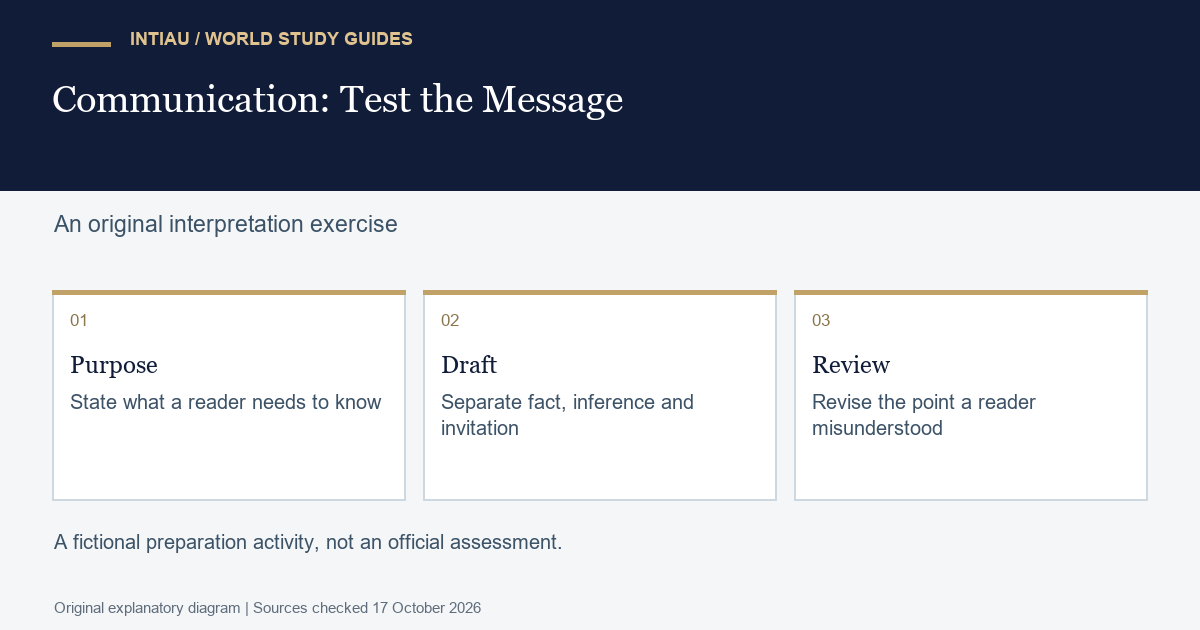
Invent a notice for a fictional community exhibition. The first draft says, “Doors open early; everyone should register soon.” Give the event a simulated opening time of ten o’clock and define registration as optional for visitors but necessary for exhibitors. Mark these as invented facts. Ask what a visitor and an exhibitor could each reasonably misunderstand in the original sentence.
Write two short versions, one for each audience. Underline factual information, circle an invitation and put an assumption in brackets. Remove any phrase that pressures the reader without explaining the relevant action. Keep the two versions consistent about times and conditions. Changing a message’s tone should not silently change the facts it communicates.
Ask a peer to answer three questions after reading each version: who is it for, what should that person do and by when? Record the answers without coaching. If the reader misunderstands, propose two possible explanations before revising: the wording may be unclear, or the assumed context may be missing. One reader’s response exposes a question; it does not establish how all audiences would respond.
Produce an annotated draft pair and a brief revision log linking each change to an observation. Include a note on what you chose not to claim. This original exercise requires no public posting, survey, personal data or contact with a real institution. Its value lies in making a communication choice explainable, rather than merely making the second version sound more polished.
Keep entry and study-start information distinct
Checked on 17 October 2026, the brochure lists starts on 22 February and 12 July 2027. These are study starts, not application closing dates. It lists University Entrance or equivalent and an English-language standard, including accepted equivalents.
Use your own school qualification to check the applicable entry route. Then confirm the start-specific course sequence and the current descriptor for any course central to your decision. Keep admissions evidence, major planning and practical preparation in separate records so that one unanswered question does not get hidden behind a completed checklist elsewhere.
Three communication questions
Does a study-start date establish a closing date?
No. Application timing needs its own current check.
Is Public Relations the only possible major?
No. It is a selected example for reading specialist study.
What should a message test record?
The intended reader, observed interpretation and a reason for each revision.
Official source trail
- Communication Studies degree
- 2027 communication brochure
- COMM512 current prescriptor
- Public Relations example
For INTIAU information, visit INTIAU Courses or INTIAU Contact. These links do not apply to the separate institution discussed above.
Related guides
View the study diagram