The University of Osaka, formerly known in English as Osaka University, is a separate institution; its Human Sciences International Undergraduate Degree Program is not an INTIAU programme or partnership. It awards the Bachelor of Human Sciences and provides an English-medium learning environment, alongside opportunities to develop Japanese.
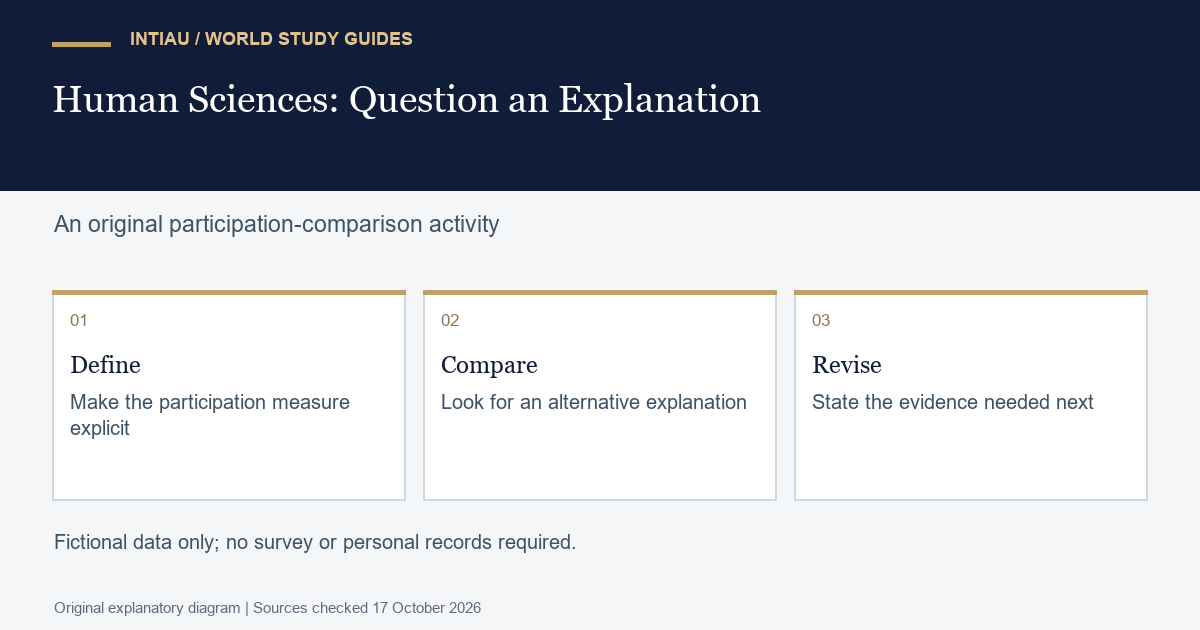
Human sciences comparisons become more useful when a broad concern becomes an investigable question. “Participation is unequal” might describe attendance, influence over decisions or access to resources. Define which meaning you intend before comparing programmes. Otherwise, a course list can appear to answer your question while actually addressing a different one.
Read shared foundations before concentrations
| Stage | Published structure |
|---|---|
| First three semesters | Shared foundation courses. |
| From semester four | Advanced study focused on Diversity and Inclusion Studies, Japan Studies, or Political and Global Studies. |
| Later independent work | An undergraduate dissertation related to the chosen concentration. |
The October 2027 guide gives a normal four-year cohort duration and permits accelerated graduation only for students meeting academic criteria. Its course examples include Human Rights, Sociology of Migration, Japanese Law and Peace and Conflict Studies. Those are examples, not a guarantee of every future offering.
Compare the function of a concentration with the award name. A focus can give intellectual direction without changing the degree awarded. In your notes, distinguish a confirmed structural requirement, a sample subject and your own proposed research interest. Keep the distinction visible when reading an older university overview whose concentration labels may differ from the current programme site.
Use a real course example carefully
Sociology of Migration is one of the guide’s actual course examples.
Use that example as a starting point for questions rather than an invitation to invent content. What definition of migration is used? Which kinds of evidence are examined? What level of explanation is attempted? A named example does not supply the weekly syllabus or assessment weights. Record those fields as unresolved until the relevant course edition provides them.
A small reading matrix can contain the course title, the published description available and a question you want the full syllabus to answer. Leave genuine gaps blank. This is more useful than filling them from a similarly named course elsewhere, particularly when comparing a broad foundation with later specialised or dissertation work.
Worked exercise: what counts as participation?
Invent two community workshops. In A, 18 of 30 invited people attend; in B, 12 of 15 attend. Calculate attendance rates of 60 and 80 percent. Label the entire dataset fictional. Write two distinct observations: A has more attendees, while B has a higher proportion of invitees attending. Neither observation alone establishes which workshop is more inclusive.
Now add a fictional difference: A offered an evening session and B offered a morning session. List three alternative explanations for the attendance pattern, including an explanation about how invitations were distributed. Ask which additional information could distinguish them. Do not assume that every person absent from an event lacked interest, or that every person present had equal influence.
Construct a second participation measure, such as whether different proposals were considered, using invented meeting notes. Explain why the new measure answers a different question from attendance. Compare the conclusions and identify where they could conflict. No survey, contact with participants or personal records is needed; the task is to test how definitions shape an argument.
Your output is a definition sheet, two transparent calculations and an evidence-request paragraph. Ask a peer to underline any sentence that moves from description to causation. Revise it or state the assumption explicitly. This original preparation exercise is not a university assignment or evidence about a real population.
Separate online registration and document receipt
Checked on 17 October 2026, the programme lists online registration from 10:00 JST on 1 December 2026 to 23:59 JST on 5 January 2027. Application documents must arrive by post by 8 January 2027. These are separate stages; completing registration alone does not complete the application.
The programme’s public information is provided by the School of Human Sciences in Suita. Consult its prospective-student page and current application guide together.
Use the eligibility category matching your educational background and confirm the required language evidence. Keep conditional-offer requirements beside the relevant date. A course concentration can guide your preparation, but it does not replace formal eligibility or document instructions.
Three human-sciences questions
Does a concentration change the award name?
The programme identifies one Bachelor of Human Sciences award across its concentrations.
Is registration the same as document receipt?
No. The published application stages have separate deadlines.
What should the participation exercise reveal?
How a definition changes the comparison and which explanations still need evidence.
Official source trail
- Human Sciences programme
- October 2027 application guide
- 2027 admissions stages
- Prospective-student information
For INTIAU information, visit INTIAU Courses or INTIAU Contact. These links do not apply to the separate institution discussed above.
Related guides
View the study diagram