The University of Bern in Switzerland is independent of INTIAU. Its Bachelor of Science in Physics comprises 180 ECTS, normally over six semesters, with an autumn start and German-language teaching. The framework combines a 120-credit physics major with 60 credits of minors, including a required 30-credit mathematics minor. faculty degree requirements
Read the major and minors together
When comparing physics programmes, separate three questions: how much physics is required, which mathematical preparation is compulsory, and what freedom remains outside those requirements. A headline credit total cannot answer all three. In your comparison notes, keep the compulsory mathematics visible rather than counting it as unrestricted choice.
The department’s published sequence places Analysis and Linear Algebra alongside the initial physics and mathematical-methods courses. Laboratory work, programming and numerical methods appear as the programme develops. Later study includes quantum theory, statistical thermodynamics, solid-state and particle physics, with a bachelor’s thesis. The same page lists an Astronomy minor separately. Its presence is a route to investigate, not evidence that every student must take it. Use the linked study plan for the complete combinations and regulations. department course sequence
Selected stages in the published sequence
| Stage | Selected official components | Useful comparison |
|---|---|---|
| Semesters 1–2 | Physics I–II; Mathematical Methods I–II; Mechanics I; Practical Course I | How do mathematical arguments connect with measurements? |
| Semesters 3–4 | Electrodynamics; Quantum Theory I–II; programming; numerical methods | Can you distinguish a model from its computational approximation? |
| Semesters 5–6 | Solid-state and nuclear physics; laboratory course; thesis; optics | What evidence would support an independent conclusion? |
This selection describes the order shown on the official page, not every course, credit allocation or optional combination. Compare prerequisites and the applicable legal plan before constructing a personal timetable. In particular, a later subject’s familiar name does not show which earlier mathematical techniques it expects you to use.
A real computational course
Introduction to Programming and Computational Physics describes Python programming applied to physics problems. Its selected themes include numerical integration, differential equations and Monte Carlo simulation of physical processes. That scope makes the computational element more specific than a general promise to develop digital skills. It asks students to connect programming with mathematical problems encountered in physics. The public description is a concise outline rather than a complete assessment brief or a catalogue of every exercise. A prospective student can compare whether another course explicitly joins numerical methods to physical interpretation, instead of assuming that any introductory programming course has the same purpose. official course description
International admission and preparation
Bern’s international application guidance distinguishes recognised prior university qualifications from country-specific school-certificate routes. Depending on the qualification, additional requirements may include an ECUS examination or proof of a university place in the country concerned. German-language preparation is checked separately: applicants without the relevant exemption need recognised C1 evidence or the university’s prescribed language-test route. The application process involves online registration and the required documents. Read the country conditions for the stated academic year; the available 2026/27 material does not establish a new 2027/28 deadline or identical future rules. international applicant guidance
A useful preparation note names the actual certificate, its issuing country and the missing evidence. “I studied some physics” does not answer whether a school qualification satisfies the formal admission route. Likewise, understanding an English course title does not establish readiness for a German-taught degree.
Original exercise: compare two numerical steps
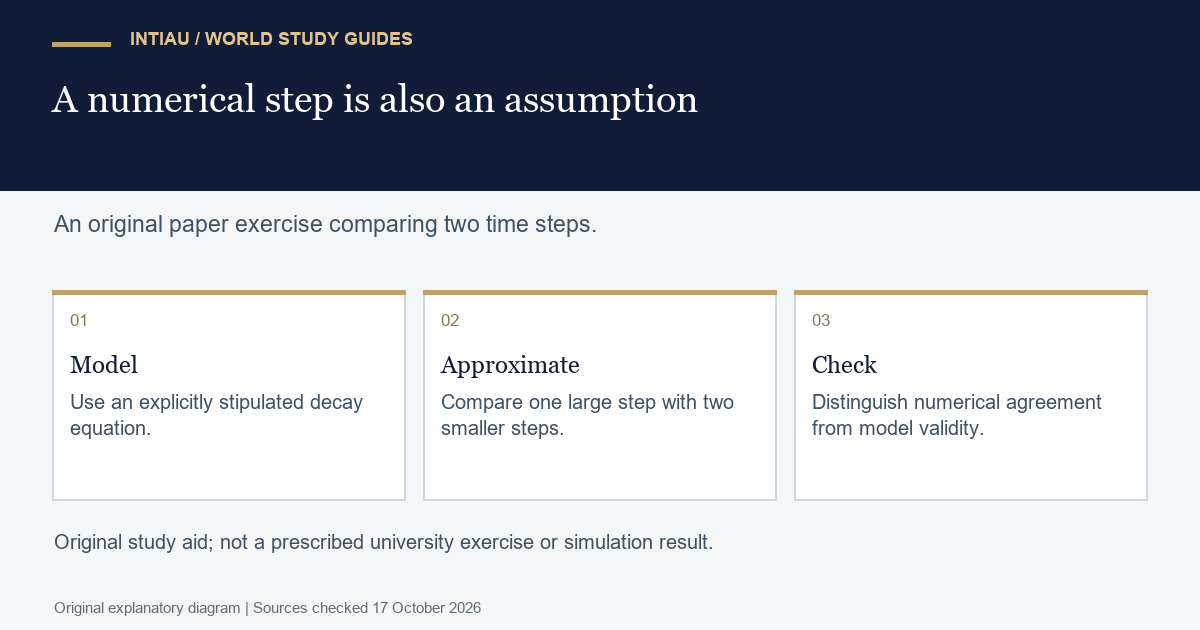
Suppose a fictional quantity follows the stipulated equation dy/dt = −y, starts at y = 1, and is approximated by the rule new y = old y × (1 − step). One step of length 1 produces zero. Two steps of length 0.5 produce 0.5 and then 0.25 at the same final time. The disagreement shows that step size matters for this approximation. It does not show that the underlying physical model is wrong, nor that the smaller-step answer is exact. Write a check using further step refinement, then state what separate evidence would be needed to evaluate the model itself. A good answer compares numerical convergence within the stipulated equation and measurements relevant to the physical claim. Keep those two tests distinct even if both use graphs.
Three practical questions
Are all minor credits unrestricted?
No. The faculty requires a mathematics minor within the wider minor-credit framework.
Is the computational outline a complete syllabus?
No. It identifies selected themes; use the official course and study-plan links for the applicable requirements.
Does a smaller time step validate a physical model?
No. It can test an approximation while leaving the model’s relationship to observations unresolved.
For INTIAU’s own information, see Courses and Contact.
Related guides
View the study diagram