The University of Birmingham is separate from INTIAU; Psychology BSc is its own degree. The 2027 prospectus identifies the three-year C800 route. Birmingham City University is a different institution.
Begin a psychology comparison with a question you could investigate. “People concentrate differently” is an interest, but it leaves the measurement, situation and comparison undefined. Try specifying a task, an observation and an alternative explanation. This makes it easier to recognise the difference between learning a theory and collecting evidence that could challenge it.
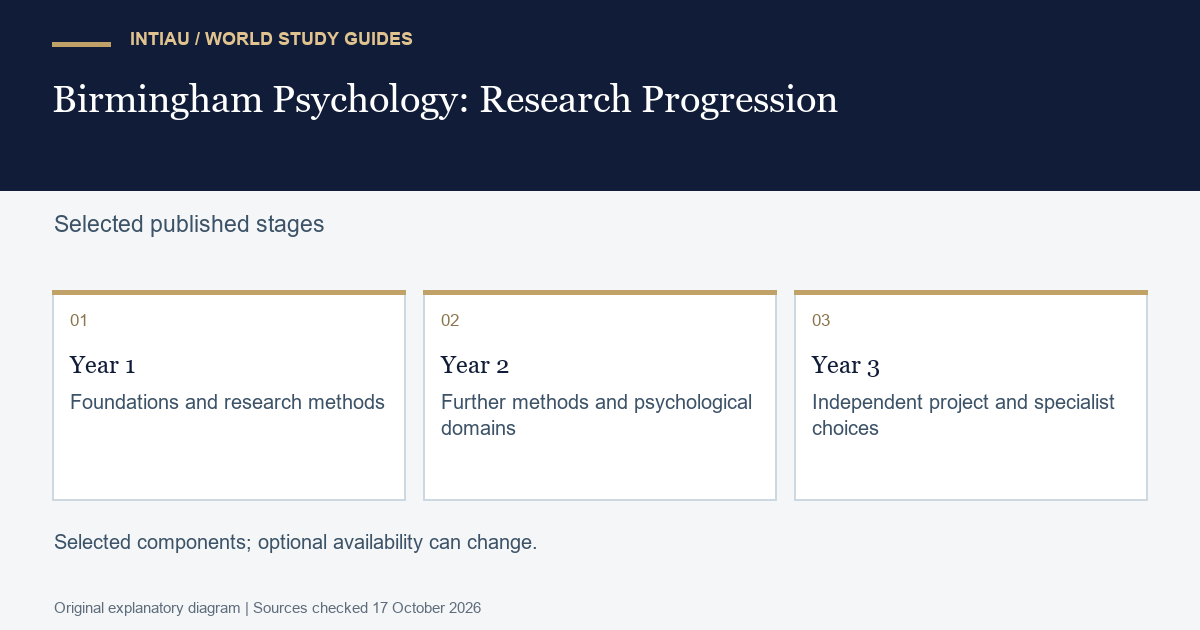
A selected sequence, with its entry cohort
| Stage | Selected components |
|---|---|
| 2027/28 | Cognitive Psychology, psychobiology and research methods. |
| 2028/29 | Language and Communication; further methods and development. |
| 2029/30 | Project and specialist options. |
Use a second column of your own for the work you hope to learn: defining a variable, analysing observations, comparing explanations or communicating uncertainty. A title can suggest a topic without settling how that work is taught. Keep a distinction between the university’s requirements and your interpretation of the learning opportunities.
One real module rather than an invented syllabus
The course page lists Cognitive Psychology as a required 20-credit first-year module. Its optional examples are indicative and may change. This map selects components; it does not reproduce the complete syllabus or supply an unseen assessment schedule.
For closer reading, follow a named module’s catalogue link and record only the information actually available. Leave weekly tasks or assessment weights unresolved where the outline does not state them. You can still ask a useful question: where would a student practise distinguishing an observed pattern from the mechanism proposed to explain it?
Original worked exercise: check a practice effect
This exercise is created for this guide, not assigned by Birmingham. Use fictional response times rather than testing people. Group A records 400, 420, 440 and 460 milliseconds on a simple imagined task. Group B records 360, 380, 400 and 420. The averages are 430 and 390 milliseconds, a difference of 40 milliseconds.
Write a cautious description of that difference before explaining it. Now add a missing detail: Group B saw the task twice beforehand, while Group A encountered it for the first time. The arithmetic has not changed, but the interpretation has. The difference could be connected to practice rather than the characteristic you originally wanted to compare.
Design a fairer paper comparison. Specify what both groups should receive before measurement, how the task instructions would be kept consistent and what observation would count as a completed trial. Separate a proposed improvement from evidence that the improvement works. No fictional result establishes a fact about real participants.
Next inspect variation within each group. The same average could arise from tightly clustered values or a mixture of very fast and very slow responses. Create a different four-value set averaging 390, then compare its spread with Group B. Explain why reporting only a single number might conceal an important feature of the observations.
Finish with a short methods note and a paragraph containing the result, an alternative explanation and a limitation. Ask a reader to mark every causal word, such as “caused” or “because”. Check whether the exercise actually supports that wording. Your output is a reasoning record, not a psychological assessment or a prediction about your suitability for professional practice.
Read the application instructions separately
Birmingham’s undergraduate guidance directs applications through UCAS and distinguishes course-specific deadlines. Its page includes September 2027 information. Use the chosen course’s current instructions rather than transferring a date from another route.
For an actual application, record the exact award and school qualification before comparing conditions. Check the English-language evidence requested in the programme’s entry information. Keep questions about eligibility separate from your curriculum interests: a useful study exercise does not establish that you meet an academic condition. This guide checked the linked information on 17 October 2026.
Keep a dated copy of your questions and the official links used to answer them. A clear unresolved question is more useful than a confident assumption.
Frequently asked questions
Is C800 the three-year Psychology route?
Yes. That is the route identified in the 2027 prospectus.
Does the table include every option?
No. It selects published components.
Does reading a module submit an application?
No. Follow the separate UCAS application process.
For INTIAU’s own information, see Courses and Contact. Birmingham determines its academic and admission decisions.
Related guides
View the study diagram