The University of Bristol is separate from INTIAU; BSc Biochemistry is a Bristol degree. Its 2027 course page identifies a three-year full-time programme at Clifton campus, with UCAS code C700.
A useful biochemistry comparison connects molecular explanations with the evidence used to investigate them. An interest in a disease, a protein or a technology is a starting point. Ask what observations would let you test an explanation, how measurements would be recorded and how an unexpected result would change the next question.
Trace the development of research practice
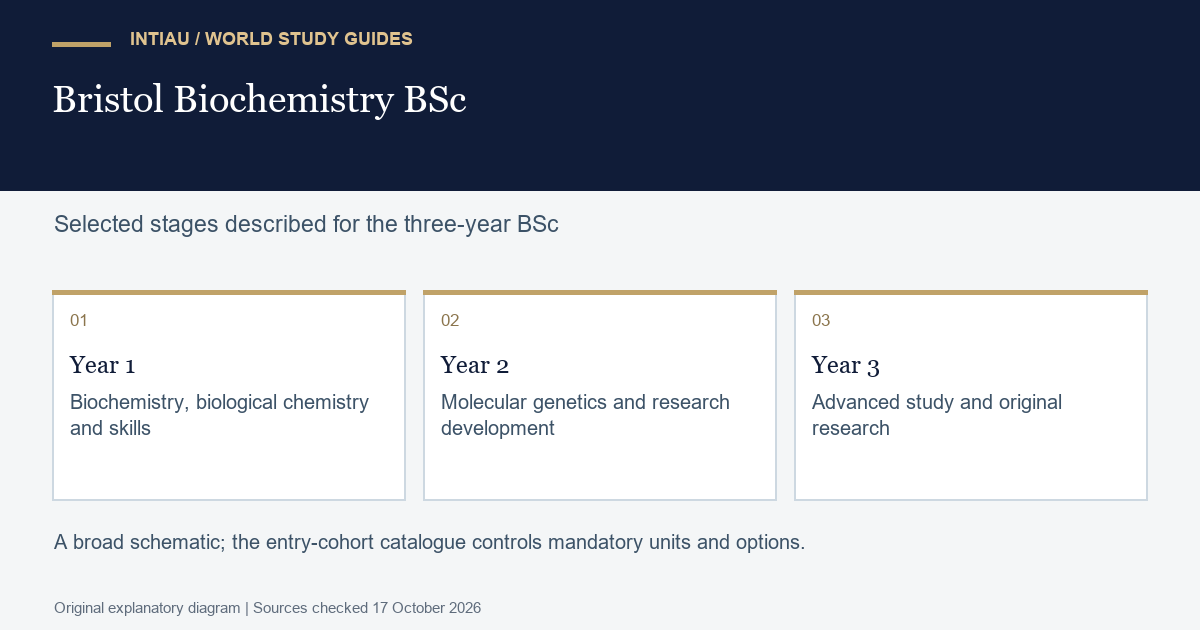
Bristol’s 2027 subject overview describes practical and academic preparation followed by more advanced study and original research. The selected table concerns the three-year BSc, rather than the different research sequence of the four-year MSci.
| Year | Published emphasis |
|---|---|
| 1 | Biochemistry, biological chemistry, practical and academic skills. |
| 2 | Biochemistry and molecular genetics; research development and options. |
| 3 | Advanced biochemistry, specialist study and an original research project. |
The 2027/28 entry-cohort catalogue identifies mandatory first-year units, including Fundamental Skills for Biochemists, alongside molecular content and a choice of options. It warns that programme and unit information can change. Use the catalogue for required combinations; this selected map is not a complete syllabus.
When comparing another degree, put subject content beside the activity through which it is learned. “Enzymes” is content; designing a comparison, checking a data table and explaining a limitation are activities. A course can be rich in familiar topics while still leaving questions about how students develop independent scientific judgement.
One actual practical-skills unit
The 2027/28 BIOC10007 unit specification covers experimental design, collecting and interpreting data, scientific literature and written or visual presentation. It connects practical biochemical work with academic skills. This is a selected real unit, not a copied laboratory manual or a claim that all units use the same teaching or assessment.
Look for the relationship between the measurement and the claim. A clear graph is not sufficient if its labels hide what was measured. A plausible explanation is not sufficient if the comparison changed several factors at once. Use those questions to read a unit’s learning outcomes more critically.
Original exercise: design a fair comparison on paper
This exercise is created for this guide, not assigned by Bristol. Work with a fictional experiment rather than laboratory materials. Imagine comparing two conditions that might affect a measured reaction. Define a single outcome, choose units and write a short record of what is held constant. Do this before inventing any results.
Create three imaginary measurements for each condition. Put the individual values in a table and calculate an average. Make one set noticeably more variable than the other. Explain what the average hides and what an additional repeat might help establish. Do not turn invented numbers into a conclusion about real biology.
Now introduce a problem: the instrument reading for one trial was recorded without units. Decide how you would report that uncertainty. Avoid silently repairing the record by guessing. Write a distinction between a missing observation, an unusual observation and an interpretation you do not yet understand.
Finish with a short figure caption and a paragraph stating the question, the comparison and the main limitation. Ask a reader whether they can distinguish a recorded result from your proposed explanation. The exercise helps identify whether your strongest interest is in molecular mechanisms, experimental choices, quantitative work or scientific communication; those are useful questions to bring to programme research.
Apply for the intended award and entry year
Bristol’s undergraduate application guidance explains the UCAS route and links entry requirements and application support. Use the current entry-year course information with that guidance. This guide was checked on 17 October 2026 and does not invent an application deadline from an undated summary.
Keep the BSc, MSci and any industry variant distinct on your planning sheet. Record the exact award you intend to apply for, then check its own instructions. A shared subject name does not make the routes interchangeable. If your previous qualification is unfamiliar to the published examples, ask Bristol which official entry guidance applies.
Frequently asked questions
Is this the three-year BSc?
Yes. The 2027 course page identifies BSc Biochemistry, C700, as three years full-time.
Is Fundamental Skills for Biochemists a real unit?
Yes. BIOC10007 has a published 2027/28 unit specification.
Does a curriculum map submit an application?
No. Follow Bristol’s separate undergraduate application instructions and UCAS route.
INTIAU’s own Courses and Contact pages provide its separate information. Bristol controls its programme and admissions decisions.
Related guides
View the curriculum diagram