The University of Hong Kong is a separate institution; its Food & Nutritional Science major within the Bachelor of Science is not an INTIAU programme or partnership. This guide concerns HKU Science, rather than a similarly named external award.
Begin your comparison with the kind of question you want to investigate. Understanding why a food changes during storage is different from judging how dietary evidence should guide a public message. Write one question of each kind, then look for the scientific preparation each would need. Avoid choosing a degree on the strength of an attractive career label alone.
Separate the major from the full degree
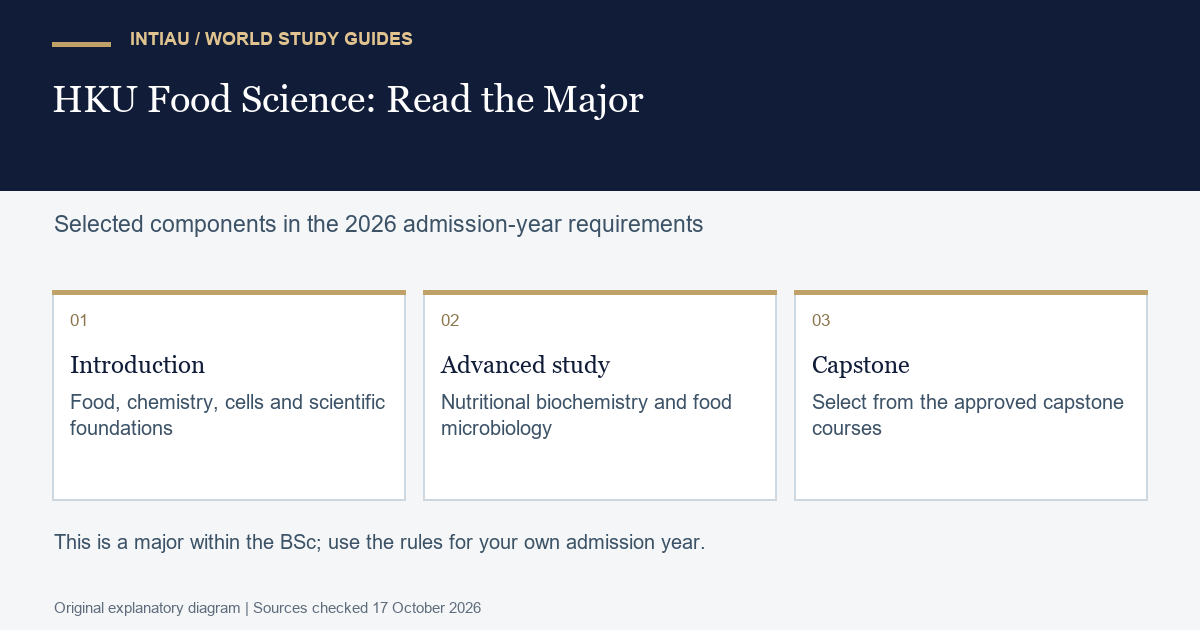
HKU describes a four-year BSc requiring 240 credits. Its common-admission framework allows students to choose science majors. A major requirement is therefore not the entire degree requirement; the faculty FAQ explains the distinction.
| Stage | Selected official components |
|---|---|
| Introductory | BIOL1201 Introduction to food and nutrition; BIOL2101 Principles of food chemistry; supporting science courses. |
| Advanced core | BIOL3202 Nutritional biochemistry; BIOL3203 Food microbiology. |
| Completion | Advanced electives and one approved capstone course. |
Use the table to create a question-led reading list. Next to every course, record whether you need conceptual understanding, a laboratory method, statistical interpretation or communication practice. This is your analytical layer, not an extra official requirement. Check the full regulations before deciding whether an elective combination meets the major or leaves room elsewhere in the degree.
Inspect a real syllabus example
The 2026 BIOL3203 syllabus covers microorganisms in food, spoilage, preservation and foodborne pathogens. It also addresses detecting and counting microbes. The six-credit course lists prior biochemistry options as prerequisites; read the precise alternatives before planning enrolment.
When reading a syllabus, distinguish a biological mechanism from the method used to measure it. A course can teach both without turning every observation into a health recommendation. Add a limitation column to your notes: what would you still need to know before applying the result to a different food, storage condition or group of people?
Practical exercise: compare preservation claims on paper
Create a fictional scenario involving a sealed snack stored under two imagined conditions. Write three possible explanations for a visible change: a biological process, a chemical change and a packaging problem. Use invented observations only, clearly labelled as simulated. Do not taste, culture or handle spoiled food for this exercise.
Prepare a small evidence table with columns for claim, observation, competing explanation and next information needed. For example, an invented colour change might support more than one explanation. Ask what a measurement would actually establish and what it could not establish. Keep statements about safety out of your conclusion unless you have authoritative evidence addressing that exact question.
Now write two versions of a 70-word explanation: one for a laboratory colleague and one for a general reader. Preserve the same level of uncertainty in both. Ask a peer whether the simpler version accidentally sounds more certain. Your final output is the evidence table, both explanations and a revision showing how you prevented an observation from becoming an unsupported recommendation.
Read the current application cycle independently
Checked on 17 October 2026, HKU lists 25 November 2026 at noon HKT for first-round evaluation under its 2027 international/non-JUPAS route, with later rolling consideration. Applicants must check qualification-specific and English requirements; minimum eligibility does not guarantee admission.
Match your qualification to the correct application scheme before collecting documents. Keep predicted results, final results and supporting references in separate checklist rows, each with the official instruction that governs it. The curriculum edition in this guide is explicitly dated; a 2027 application does not automatically make the 2026 major syllabus your binding future rules.
For comparison with another programme, keep the award framework, major components and applicant route on separate pages. This prevents a compact major table from being mistaken for a full degree plan and makes it easier to ask a precise question when a published page leaves a choice unresolved.
Three useful distinctions
Is Food & Nutritional Science a separate degree in this guide?
No. It is a major within HKU Science’s BSc framework.
Does the syllabus example establish a professional dietetics qualification?
No. Use the relevant professional authority and the exact award requirements for that separate question.
What should the preparation activity produce?
A transparent comparison of explanations and uncertainty, not a claim that a fictional food is safe.
Official source trail
- Food and Nutritional Science major
- 2026 major requirements
- BIOL3203 syllabus, 2026
- BSc admissions and degree FAQ
- International and non-JUPAS applications
- Science faculty location
For INTIAU information, visit INTIAU Courses or INTIAU Contact. These links do not submit an application to the separate institution discussed above.
Related guides
View the curriculum diagram