The University of Canterbury is a separate institution; its Bachelor of Product Design is not an INTIAU programme or partnership. The BProdDesign normally takes three full-time years and 360 points. Industrial Product Design is one of its majors; this guide concerns that route rather than a combined degree.
The School of Product Design identifies its location as the University of Canterbury in Christchurch, New Zealand.
A product-design comparison should start with the decisions a learner must learn to justify. A visually appealing object may be difficult to assemble, repair or manufacture consistently. Write a short user problem before examining course titles. Then ask where a programme develops the ability to connect an idea with material behaviour and a feasible production process.
Follow a selected design progression
| Level | Examples from the major page |
|---|---|
| 100 | PROD111 Materials Science for Design; PROD112 Digital Modelling for Design. |
| 200 | PROD210 Design and Manufacture; PROD211 Materials Engineering and Selection; PROD213 and PROD214 design projects. |
| 300 | PROD311 Solid CAD; PROD313 and PROD314 Industrial Product Design 2A and 2B. |
The full degree combines compulsory study with the major. Its entry page requires University Entrance or equivalent and applicable English evidence; its science and mathematics preparation advice is a recommendation, not an additional universal entry condition.
Keep the distinction between degree-wide requirements and major requirements visible in your notes. Read the table as a selection, not a timetable. Record prerequisites before drawing a line from one project to another, and check the relevant annual course occurrence before assuming a semester. A subject page can describe a durable structure while an individual offering changes its dates.
Read an actual materials-selection example
The PROD211 Semester Two 2026 page describes processing, material properties, corrosion and selection for design applications. Its learning outcomes include stiffness-, strength- and fracture-limited design and using material-selection tools. This dated example does not establish a future assessment schedule.
When comparing a syllabus, separate knowledge of a material from the reasoning used to select it. Ask whether the description expects a calculation, a physical prototype, a software comparison or an explanation of constraints. Do not infer a particular laboratory procedure or assessment weighting merely because a topic appears in the description.
Worked exercise: redesign a replaceable cover
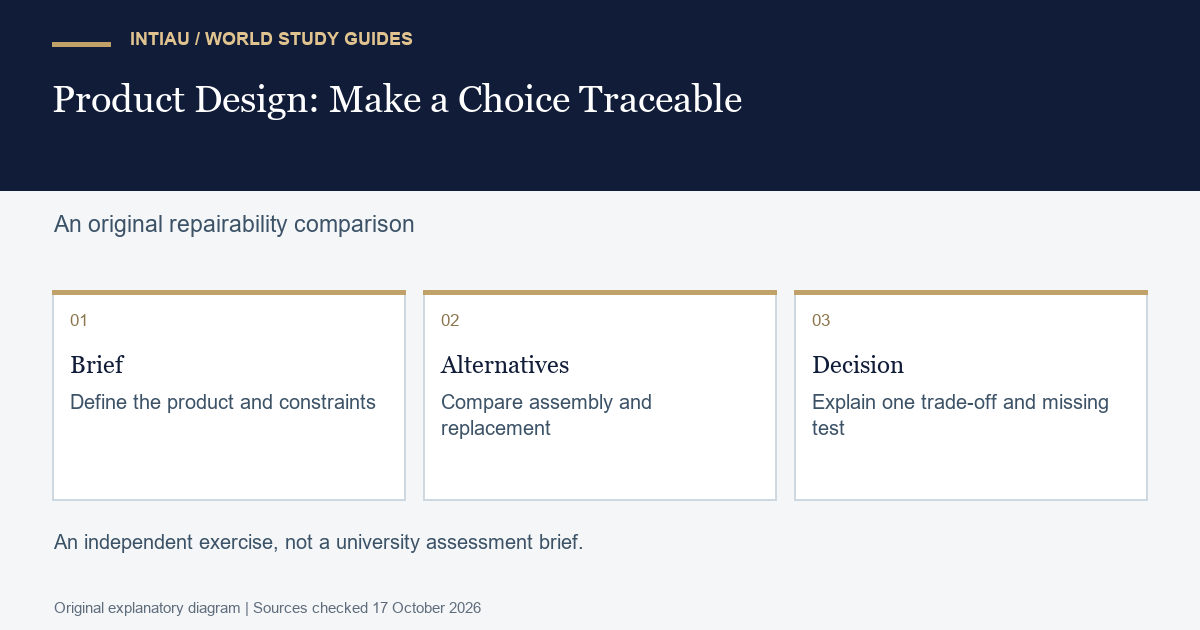
Invent a protective cover for a small desk organiser. It is a fictional, non-safety-critical product. The brief says a damaged cover must be replaceable without discarding the base. Draw two alternatives: a clipped cover and a cover held by two accessible fasteners. Give both the same outside dimensions and label every assumed property as simulated.
Make a comparison sheet with assembly steps, number of separate parts, access needed for replacement and a plausible failure question. Count the steps consistently: if finding a tool counts in one alternative, count it in the other. Suppose the clip version takes four assembly steps and the fastener version takes seven. That observation alone does not prove the clip is better; replacement frequency and damage during disassembly could change the decision.
Now change the brief so the cover will be replaced repeatedly. Identify which assumption matters most and propose a simple future test using an appropriate supervised setting. Do not perform a load or durability test from invented specifications. Your preparation output is a drawing pair, a transparent comparison and a short decision memo that identifies the next evidence needed.
Ask another reader to reproduce your step count from the drawings. If they cannot, revise the representation rather than adjusting their result to match yours. This turns a subjective preference into a more inspectable argument. Keep the exercise distinct from an official assignment or a portfolio requirement; it is a way to discover the curriculum questions you want to ask.
Check the route before copying a date
Checked on 17 October 2026, Canterbury directs applicants through its admission and enrolment guidance. Choose the qualification and applicant category that match your situation; this guide does not supply an unverified 2027 application deadline.
Create separate rows for academic entry, language evidence, programme choice and course selection. Put the source date beside each. If you are comparing a conjoint option, make a fresh requirement map rather than adding its title to this standalone degree plan. An attractive combination can have a different structure and should be checked on its own terms.
Three design-planning questions
Is the degree normally four full-time years?
No. The standalone BProdDesign is normally three years.
Is the course example a 2027 assessment promise?
No. It is explicitly the Semester Two 2026 occurrence.
What should a repairability comparison show?
Consistent assumptions, a repeatable comparison and the evidence needed to resolve a real trade-off.
Official source trail
- Product Design degree
- Industrial major requirements
- PROD211, Semester Two 2026
- Admission and enrolment
- Product Design school location
For INTIAU information, visit INTIAU Courses or INTIAU Contact. These links do not apply to the separate institution discussed above.
Related guides
View the study diagram