The Technical University of Denmark, DTU, is a Danish institution separate from INTIAU. Its formal qualification is Bachelor of Science in Engineering (General Engineering), a three-year, 180-ECTS degree.
The programme overview describes the English-taught route at Lyngby. Its study directions are Living Systems, Cyber Systems, Advanced Materials and Future Energy; a broad entry title does not mean that every student follows the same later course combination.
For a useful engineering comparison, ask how a shared scientific foundation supports different kinds of model. The same mathematics can describe a material, a signal or a flow, but its interpretation changes with the problem. Record one question for each direction that interests you. Then check the required courses rather than assuming that a general degree title removes the need for a coherent study plan.
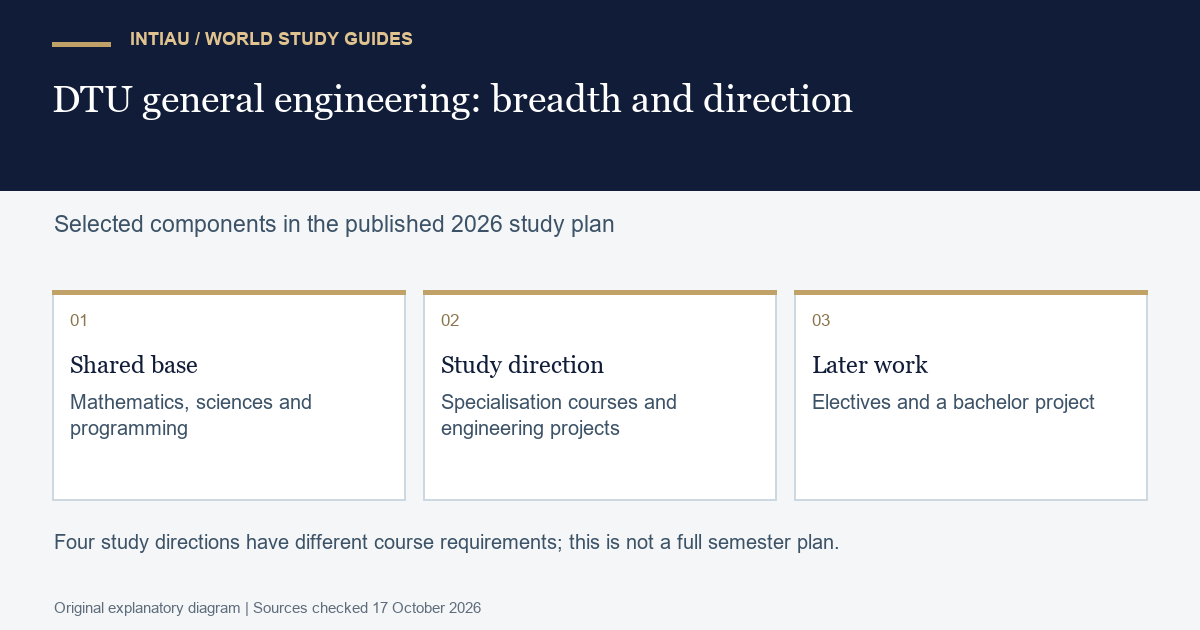
Selected components in the 2026 study plan
| Component | Selected direction |
|---|---|
| Polytechnical foundation | Mathematics, programming, statistics and natural sciences |
| Programme-specific work | Introduction courses and specialisation requirements |
| Engineering work | Design-build components and a bachelor project |
| Electives | Further courses within the programme rules |
The current study plan identifies required combinations and recommends completing the bachelor project in semester six. Consult it for the full credit rules.
A helpful comparison distinguishes an introduction from a complete specialisation. An early course can let you explore a subject without providing all the prerequisites for later study. Mark which choices are compulsory, which support a preferred direction and which remain exploratory. This makes the cost of changing direction visible without pretending that flexibility is either unlimited or absent.
A dated mathematics example
The official 01003 Mathematics 1a site for Autumn 2026 lists topics including logic, linear equations, matrix algebra and differential equations. This is a real teaching-edition example, not a copied weekly syllabus or a promise about a later intake.
Worked exercise: solve the system, then check the model
This original exercise uses fictional packages. A box contains ten sealed packets of two types. Type X has mass two kilograms and type Y one kilogram. The total packet mass is fourteen kilograms. Let x and y represent packet counts. The count equation is x + y = 10; the mass equation is 2x + y = 14, with kilograms understood in the second equation.
Subtract the count equation from the mass equation after expressing the coefficients consistently: the numerical difference gives x = 4. Substituting into the count equation gives y = 6. Check both statements: four plus six is ten packets, and four times two plus six times one is fourteen kilograms. A solution should satisfy the original conditions, not merely an intermediate rearrangement.
Now change the reported mass to 14.5 kilograms while keeping all other assumptions exact. Algebra gives x = 4.5 and y = 5.5. Those values satisfy a continuous numerical model but cannot describe whole sealed packets. The result reveals a conflict between the stated data and the integer-count assumption; it does not establish the existence of half a packet.
List possible explanations without choosing one prematurely. Perhaps the measured mass includes packaging, the packet masses vary, or one observation was recorded incorrectly. Each explanation suggests a different revised model. Removing the integer restriction just to obtain an answer would conceal the issue rather than resolve it.
Write a concise model audit with four entries: the unknown quantities, the units, the constraints and the measurements treated as exact. Then identify which assumption you would investigate first and why. This is useful preparation for comparing engineering study because a model can be mathematically solved yet poorly matched to the situation it is meant to represent.
The task is independent of DTU coursework. Its purpose is to reveal whether you enjoy explaining why a calculation is applicable, as well as carrying it out. Keep the two achievements separate in your study notes: solving the equations and defending their interpretation.
Application route and cycle scope
DTU’s application instructions direct applicants through the official Danish application system and explain the qualification-dependent procedure. Check the linked admission requirements and intended entry-year dates. This guide was checked on 17 October 2026 and does not project an undated calendar into 2027.
Questions about General Engineering
Is this the BEng qualification?
No. The formal title is Bachelor of Science in Engineering.
Which teaching edition supports the mathematics example?
The linked course site identifies Autumn 2026.
Can fractional counts solve the fictional packet problem?
They solve a relaxed numerical model, but violate the whole-packet assumption.
For INTIAU’s own information, see Courses and Contact.
Related guides
View the study diagram