
Understanding educational verification
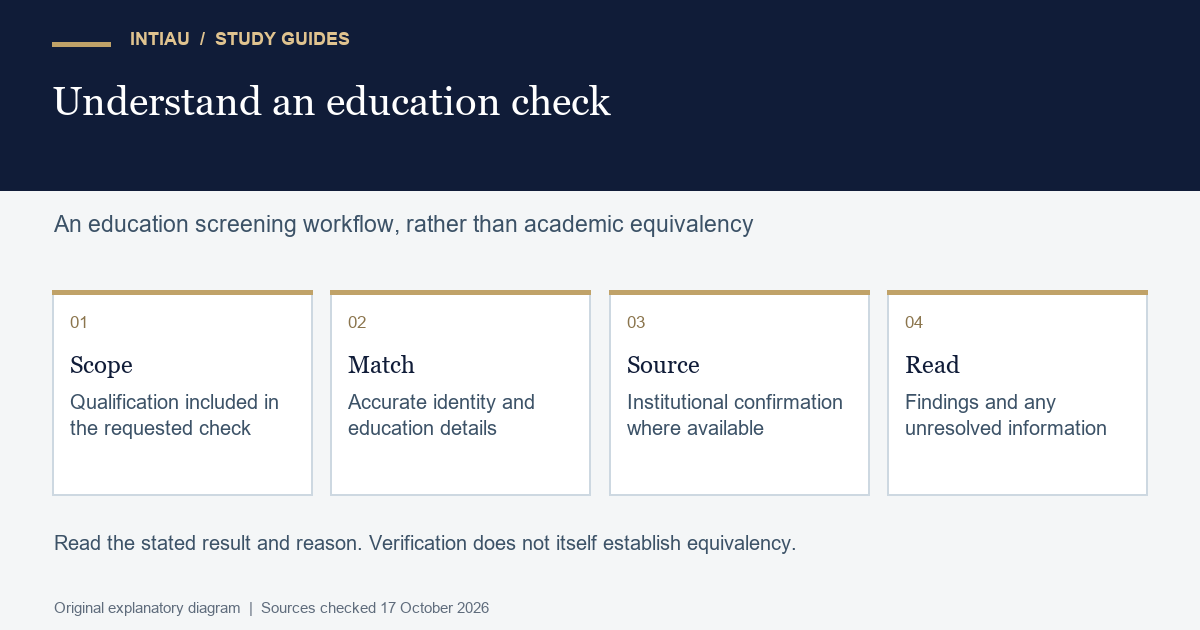
An employer may ask for an education check after reviewing a résumé or application. Certn’s education verification service checks educational information against institutional records. Understanding what has been requested, how the institution identifies your record and what the result means can make the process easier to follow.
Education verification and credential evaluation answer different questions
Certn describes education verification as checking educational claims, such as attendance or completion and the attainment of a qualification, against institutional information. Depending on the available records, a check may establish some details more completely than others. See the Certn education verification overview.
A credential evaluation serves a different purpose. For example, WES compares academic credentials with U.S. or Canadian education standards. Therefore, confirmation that a degree was awarded should not be presented as a course-by-course equivalency assessment. If an organisation asks for an evaluation report, ask whether it also requires a separate background check. The distinction follows WES’s description of credential evaluation.
Confirm which education is included
CertnCentric offers three scopes: highest completed education, all post-secondary education, or all education provided. Confirm the selected scope with the requester; see the current instructions.
| Prepare | Why it helps |
|---|---|
| Institution and country | Identify the institution that holds or issues the record, including the campus where relevant. |
| Qualification and subject | Use the wording on the official record; distinguish a completed award from study still in progress. |
| Attendance and completion dates | Check the record rather than relying on an approximate résumé date. |
| Name used during study | Be ready to explain an earlier name or spelling difference through the requested secure route. |
| Requested supporting documents | Provide clear copies only when requested; keep your originals and a private submission record. |
Certn’s education verification documentation identifies institution, degree, subject and attendance information. The checklist’s preparation tips are editorial advice; follow the live application’s requirements.
Understand the request before supplying information
First confirm the requesting organisation and the purpose of the invitation. If a message is unexpected, use a contact you already know to confirm it before sharing documents. Review the checks and consent information presented in your application. Keep record copies, identity documents and application references out of public comments, social media and ordinary enquiries that do not require them.
Certn’s consent documentation distinguishes an invitation completed by an applicant from a requester entering information through Quickscreen. It says the regular invitation gathers required consent and that the requester must obtain proof of consent before using Quickscreen. This distinction is useful for understanding who supplies information and authorisation; it is not an instruction to initiate a check yourself.
For details about information handling and available rights, read Certn’s privacy policy. Use the support or privacy route appropriate to your case if you need clarification. The applicable process can depend on your location and the service used.
Follow the application through to a meaningful result
Follow the case stages in CertnCentric’s current instructions. Certn’s verification documentation describes confirmation with the institution or its records repository. If asked for clarification, respond through the designated route and retain your correspondence.
CertnCentric’s results guide identifies four outcomes:
- Verified: the supplied education information was confirmed.
- Partially verified: only some information could be confirmed.
- Discrepancy: information obtained did not match some or all of the applicant’s information.
- Unable to verify: no supplied education information could be confirmed; the report provides an explanation.
Read the explanation as well as the label. Certn gives institutional non-response as one example of why verification may be unavailable. That example does not establish the cause in another case. If a result appears inaccurate, identify the precise field in question and ask the requester or relevant Certn support route how to raise it. Avoid resubmitting altered documents or creating a different education history to obtain a preferred result.
Set expectations about timing and the final decision
For current timing guidance, use Certn’s check instructions. Ask the requester how a pending check affects its deadline.
Where INTIAU information fits
For a question concerning an INTIAU record or the responsible university office, use the published contact page or consult the separate Degree Verification Portal. These university routes do not establish what an external provider or recipient will accept.
Compare the report purposes described in the WES credential-evaluation guide, the QuadraBay service guide and the IQVS verification guide. These comparisons do not establish that providers or recipients accept one another’s reports.
Frequently asked questions
Does a verified degree establish U.S. or Canadian equivalency?
Do not infer equivalency from an education verification result. Confirm whether the recipient needs a separate credential evaluation and which provider and report it accepts.
What should I do if an invitation is unexpected?
Confirm it with the requester through an existing, known contact before providing records. Read the application’s purpose and consent information, and use the designated submission route.
Does “unable to verify” mean the qualification is false?
The result means Certn could not verify the information within that check. Read its stated reason. Institutional non-response is one published example; it should not be assumed to explain every case.
Can I list an unfinished course as an awarded degree?
Describe the actual status accurately. Separate attendance, study in progress and a completed award. If a form does not describe your circumstances clearly, ask the requester or support team before submitting an inaccurate answer.
View the explanatory diagram
Official sources
Checked 17 October 2026. Product interfaces and requirements may change.
- Certn: Education verification services
- Certn: Education checks in CertnCentric
- Certn: Education check results
- Certn: Education verification documentation
- Certn: Applicant consent
- Certn: Privacy policy
- WES: Credential evaluation explained