
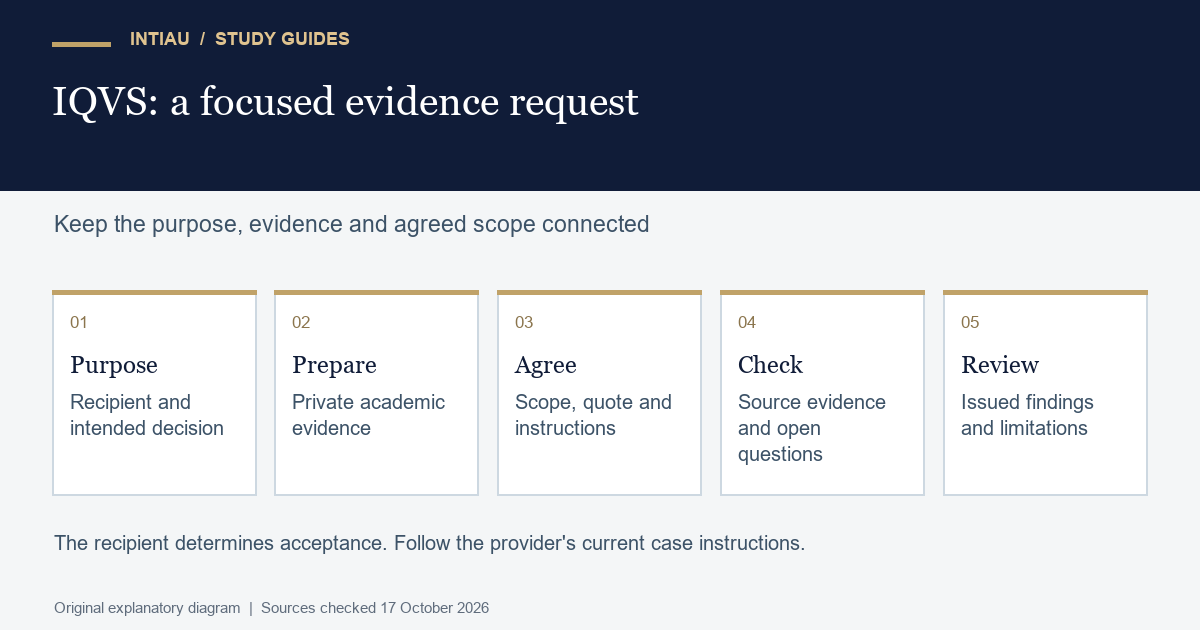
Before requesting a qualification check, establish the decision that the result needs to support. An employer may want an award confirmed; an admissions office may need academic records; a receiving authority may prescribe its own evaluation route. This guide explains the qualification-verification service described on the public IQVS website and provides a practical way to prepare a focused enquiry. It does not establish that a particular recipient accepts an IQVS report.
Identify the service before preparing documents
IQVS presents qualification verification, qualification assessment and translation as separate services in its public service overview. Its qualification-verification page describes a review of submitted academic and identity evidence, with source enquiries where appropriate and authorised. A useful first question is whether you need confirmation of an existing award, an assessment of demonstrated learning, a translation, or more than one separately scoped task.
Do not select a service solely because its name contains “evaluation”. Write down the recipient, purpose, qualification and expected deliverable. Then ask the provider to confirm that its proposed scope addresses that requirement. If an authority names a particular provider or official process, follow that instruction before paying for a separate report.
Prepare a clear academic-record checklist
The IQVS verification service description identifies qualification certificates, available transcripts, relevant identity information and institution details as preparation material. Its stated review can consider names, award and study dates, subjects, grades and consistency between documents. The precise evidence should follow the instructions for the individual case.
| Item | What to record privately | Question to resolve |
|---|---|---|
| Recipient | Organisation, purpose and its published instructions. | What report or direct institutional response will it accept? |
| Award | Exact qualification title, institution and dates shown on the record. | Which issuing office holds the relevant record? |
| Transcript | Whether a transcript is available and whether it matches the certificate. | Is a transcript needed for the agreed scope? |
| Identity match | Any difference between the name on the academic record and current identification. | What supporting evidence is required for that difference? |
| Source enquiry | Institutional instructions for releasing a record. | What specific authority or consent is needed? |
This worksheet is an organisational aid, not a universal document list. Avoid adding unrelated personal files simply because an upload field is available.
Understand the difference between evidence and a conclusion
IQVS states that its report separates information supplied in documents, facts confirmed by a source, unanswered points and professional interpretation. This distinction matters when reviewing a result: a legible certificate, an institution’s confirmation and a recipient’s decision are different kinds of evidence. The source institution also follows its own release procedures; an enquiry does not guarantee a reply or a fixed completion time.
When reading any verification report, ask which facts were checked, which source responded, what remains unresolved and what limitations apply. Keep the report’s scope alongside the recipient’s original instructions. A report should be read for the question it actually investigated.
Use the private case and review the quote
The IQVS homepage describes a sequence of selecting a service, entering case details, reviewing the scope and price, and following the request through the portal. Its public privacy notice directs applicants to private case-upload controls and discourages sensitive document attachments by email. Read that notice and the applicable terms before providing personal records.
For your own preparation, keep a short checklist of the documents requested and the questions still open. Review what is included in the quoted work and whether delivery to a recipient is part of the agreed service. Keep applicant records in the provider’s instructed private route; an article comment or public enquiry is unsuitable for them.
Keep university enquiries on the appropriate route
For questions concerning an INTIAU academic record or the responsible university office, use the existing INTIAU contact page or consult the Degree Verification Portal. These are university routes. This article does not describe a new connection between that information service and IQVS, nor does it authorise access to an applicant’s records.
The WES evaluation guide, Certn education-verification guide and QuadraBay service guide offer comparisons of report purposes. None of these articles establishes provider approval or recipient acceptance.
Frequently asked questions
Is qualification verification the same as recognition by a university?
No. A verification report addresses its agreed evidence question. The receiving university or other organisation determines whether it meets its own requirements.
Can an enquiry guarantee a response from an issuing institution?
No response or completion date is promised here. The institution controls its own record-release route, and available evidence may limit what can be confirmed.
Should I email a passport and transcript with an initial question?
Follow the current IQVS case instructions. Its public privacy notice directs sensitive case records to private upload controls rather than email attachments.
Does this guide establish an INTIAU–IQVS partnership?
No. It is an independent explanation of publicly described services. Any recipient-specific authority, acceptance requirement or institutional arrangement needs its own confirmation.
View the explanatory diagram
Official sources
Public website checked 17 October 2026 through Chrome. Service details can change; use the current case instructions.
- IQVS service overview and request process
- IQVS qualification-verification service
- IQVS privacy notice