
The Comparative Education Service (CES) is part of the University of Toronto School of Continuing Studies; this guide describes CES, not an INTIAU service or partnership. Its official pages are at learn.utoronto.ca. Information was checked on 17 October 2026, with particular attention to the distinction between applicant uploads and official academic records.
Choose the purpose and assessment detail
The CES service overview lists immigration ECAs and general-purpose assessments. For general purposes it distinguishes Document-by-Document and Course-by-Course reports, describing the latter for uses including admission and professional licensing. Confirm the required product with the intended recipient before applying; a familiar provider name does not establish which report that recipient wants.
The application-type guidance describes general-use reports as advisory and states that they do not guarantee employment, certification or professional licensing. It also separates immigration applications and directs certain regulated occupations to specialist bodies. Identify the receiving authority and purpose before deciding that an existing academic report meets a new request.
Separate an academic comparison request from a wider employment screening exercise. Ask what the recipient needs to understand about the qualification, whether it needs course detail and what other evidence it requires. A clear written question is more useful than assuming that every request labelled “education check” means the same process.
Plan for two evidence streams
CES’s country document requirements distinguish scanned supporting documents uploaded with the application from official academic records supplied through the institution. Complete the application and obtain the CES Student Number before arranging official records. The relevant country or region controls the detailed checklist; a generic list should not replace it.
The official-record instructions allow institution-sent sealed records, or forwarding an institution-sealed envelope where the institution releases it to the applicant. They also describe direct official electronic transcripts from the responsible institutional office. CES cannot order these records for you. Course-by-Course applicants should request the grading scale from their study period; insufficient grading detail can prevent that report from being issued.
| Stage | Action to plan | Personal checkpoint |
|---|---|---|
| Specify | Confirm purpose and report with the recipient. | Keep the answer with the application plan. |
| Prepare | Use the country checklist for supporting documents. | List missing items before submitting. |
| Connect | Associate the official records with the CES application. | Check the reference used in the request privately. |
| Review | Check whether further clarification is requested. | Keep receipt, acceptance and completion separate. |
Check scans and timing without making assumptions
The scanning instructions require colour scans of complete, legible pages and the reverse of documents even when blank. Use those instructions to inspect each file before upload. A visually tidy scan can still be incomplete if an edge or reverse side is missing.
CES’s waiting-stage guidance says assessment timing begins after all supporting documents, including official academic records, have been reviewed and accepted. Application submission, carrier delivery and assessment readiness are different events. Current estimates can change and are not guaranteed, so check the live guidance when planning a deadline.
Exercise: test a two-stream document plan
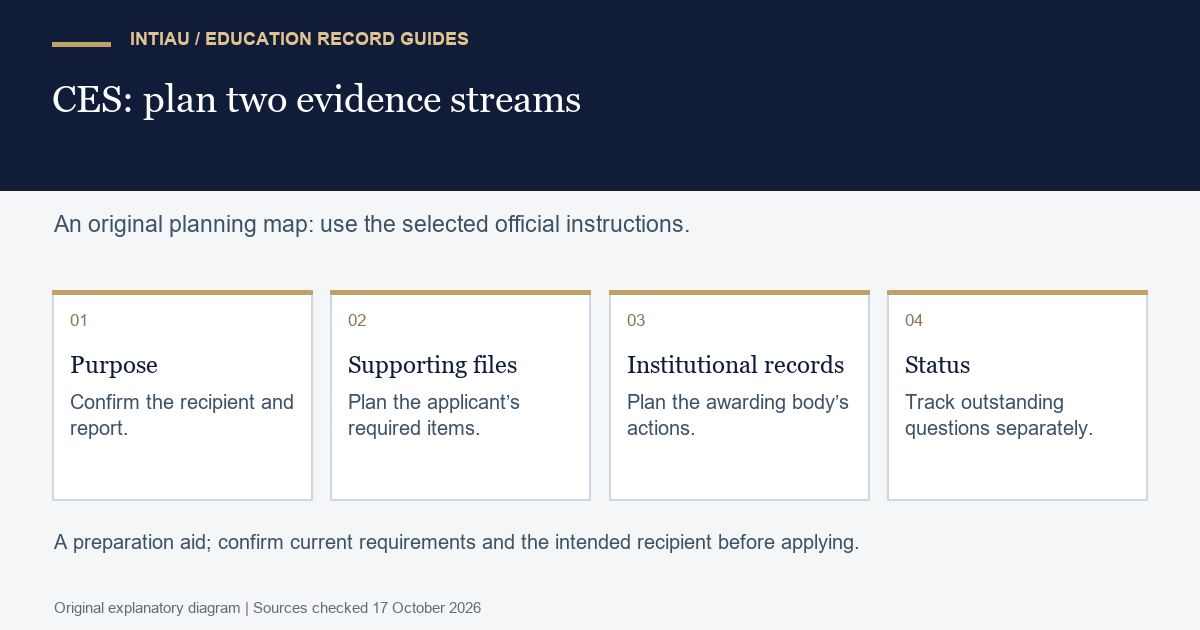
Draw two vertical tracks on a private page. Label one “My supporting files” and the other “Institutional records”. Put each item from the selected checklist on the appropriate track. Beside each item, write who acts next and the exact uncertainty, if any. The purpose is to avoid treating possession of a scan as evidence that an institutional record has arrived.
Test your plan with a hypothetical complication: the transcript has been dispatched, but the applicant’s upload lacks the reverse of a certificate. Identify which track needs attention instead of asking the institution to resend everything. Then try a second complication: the recipient requests Course-by-Course detail. Identify the question to ask about grading information and report choice before assuming the original plan remains suitable.
Finally, create separate boxes for “requested”, “sent”, “received” and “accepted for assessment”. Enter only confirmed actions. This makes the plan useful for follow-up without inventing a completion date. It is an original organisation exercise, not a substitute for CES’s country requirements or a promise that a particular credential will receive a particular comparison.
Questions before sending records
Do my uploads replace official transcripts?
No. CES’s country instructions describe both supporting scans and official academic records. Follow the applicable instructions for each stream.
Must I scan a blank reverse side?
Yes. The scanning page explicitly asks for the back of the document even when it is blank, alongside clear colour scans of complete pages.
Does the assessment clock start when I submit the application?
No. CES says timing starts after all supporting documents and official records have been reviewed and accepted. Consult its current waiting-stage guidance for estimates and qualifications.
Related INTIAU routes and sources
For questions about INTIAU’s own records, use the Degree route or Contact page. CES applications follow the university’s own process. Official references: CES overview, purpose, country requirements, official records, scans and assessment readiness.
Related guides
View the evaluation workflow
CES at Toronto: essential questions and answers
CES at Toronto is the subject of this page, presented for international readers who need a clear, official route through the material. The Comparative Education Service (CES) is part of the University of Toronto School of Continuing Studies; this guide describes CES, not an INTIAU service or partnership. Its official pages are at learn.utoronto.ca. The guidance below explains what the page records, how the process works in 2026, and how it connects to the wider services of Azad University International. Every statement is grounded in the published content of this website, so the original page remains the authoritative source.
What This Page Covers
This page about CES at Toronto is organised so that a reader can orient quickly and then return to the original text for the controlling detail.
The page is organised around the following subjects: Choose the purpose and assessment detail; Plan for two evidence streams; Check scans and timing without making assumptions; Exercise: test a two-stream document plan; Questions before sending records; Related INTIAU routes and sources.
Each section of the original page keeps its own place and wording; this summary exists so that visitors arriving from search can orient themselves before they read the full text. Where a step depends on a form, a portal or a member of staff, the route named on the original page is the route to follow.
For applicants comparing options, the practical value of this page is that it gathers the route, the responsible service and the expected preparation in one continuous explanation.
The Process in Plain Terms
Information was checked on 17 October 2026, with particular attention to the distinction between applicant uploads and official academic records..
Choose the purpose and assessment detail.
The CES service overview lists immigration ECAs and general-purpose assessments.
For general purposes it distinguishes Document-by-Document and Course-by-Course reports, describing the latter for uses including admission and professional licensing.
Confirm the required product with the intended recipient before applying; a familiar provider name does not establish which report that recipient wants..
The application-type guidance describes general-use reports as advisory and states that they do not guarantee employment, certification or professional licensing.
Read the original sections in order: the early paragraphs define the scope, the middle sections describe the procedure, and the closing notes state the limits, the prerequisites and the official points of contact. Nothing on this page replaces those instructions; it only makes them easier to navigate.
Context and Background
The official-record instructions allow institution-sent sealed records, or forwarding an institution-sealed envelope where the institution releases it to the applicant.
They also describe direct official electronic transcripts from the responsible institutional office.
Course-by-Course applicants should request the grading scale from their study period; insufficient grading detail can prevent that report from being issued..
An original CES evidence-stream workflow Stage Action to plan Personal checkpoint Specify Confirm purpose and report with the recipient.
Keep the answer with the application plan.
Prepare Use the country checklist for supporting documents.
Connect Associate the official records with the CES application.
Check the reference used in the request privately.
Review Check whether further clarification is requested.
Keep receipt, acceptance and completion separate. .
Check scans and timing without making assumptions.
The scanning instructions require colour scans of complete, legible pages and the reverse of documents even when blank.
Use those instructions to inspect each file before upload.
A visually tidy scan can still be incomplete if an edge or reverse side is missing..
CES’s waiting-stage guidance says assessment timing begins after all supporting documents, including official academic records, have been reviewed and accepted.
Application submission, carrier delivery and assessment readiness are different events.
Current estimates can change and are not guaranteed, so check the live guidance when planning a deadline..
Exercise: test a two-stream document plan.
Draw two vertical tracks on a private page.
Label one “My supporting files” and the other “Institutional records”.
Put each item from the selected checklist on the appropriate track.
Beside each item, write who acts next and the exact uncertainty, if any.
The purpose is to avoid treating possession of a scan as evidence that an institutional record has arrived..
Test your plan with a hypothetical complication: the transcript has been dispatched, but the applicant’s upload lacks the reverse of a certificate.
Identify which track needs attention instead of asking the institution to resend everything.
Then try a second complication: the recipient requests Course-by-Course detail.
Identify the question to ask about grading information and report choice before assuming the original plan remains suitable..
Finally, create separate boxes for “requested”, “sent”, “received” and “accepted for assessment”.
This makes the plan useful for follow-up without inventing a completion date.
It is an original organisation exercise, not a substitute for CES’s country requirements or a promise that a particular credential will receive a particular comparison..
Do my uploads replace official transcripts?
CES’s country instructions describe both supporting scans and official academic records.
Visitors often ask whether the summary changes the underlying procedure; it does not.
The responsible unit reviews each enquiry against the published criteria only.
Deadlines and required documents are exactly those stated on the original page.
Where translation is needed, the original English wording remains controlling.
The service does not charge for reading the public guidance on this website.
Personal data should only enter the official channels named by the University.
A complete first submission avoids most follow-up correspondence later.
The published route is the same for applicants inside and outside Iran.
Branch-specific details are confirmed through the worldwide units directory.
Course-level expectations are summarised on the education levels page.
Visitors often ask whether the summary changes the underlying procedure; it does not.
The responsible unit reviews each enquiry against the published criteria only.
Deadlines and required documents are exactly those stated on the original page.
Where translation is needed, the original English wording remains controlling.
The service does not charge for reading the public guidance on this website.
Personal data should only enter the official channels named by the University.
A complete first submission avoids most follow-up correspondence later.
How It Connects to University Services
This topic sits inside the service family of Azad University International, the international student service of Islamic Azad University. When a step requires identity confirmation, the same record can support Azad University Verification through the official verification portal, and routine correspondence is handled through the addresses published under Azad University Email.
If the question is personal — an application, a record, a deadline — the right route is Azad University Contact: the contact page names the responsible unit and the expected form of enquiry. General orientation, such as levels, branches and study routes, is public on this website.
Practical Preparation
Before acting, prepare the reference numbers, dates and identifiers the original page asks for. Then follow the named route once, in full; repeating a submission through several channels slows the responsible unit rather than speeding it up.
Keep copies of what was submitted and note the date. Where a receipt, acknowledgement or tracking reference is offered, keep it with the prepared documents so that any later question can be answered quickly.
Official References
Two official references frame the international context of this page. The central organisation publishes institutional information at the first reference, and the encyclopaedia article at the second summarises the University's history and scale for readers who are new to it.
Related University routes: the admission process, the University contact route, the degree verification portal, the course search portal and the education levels guide.
Official references: Islamic Azad University central organisation and the University overview article.