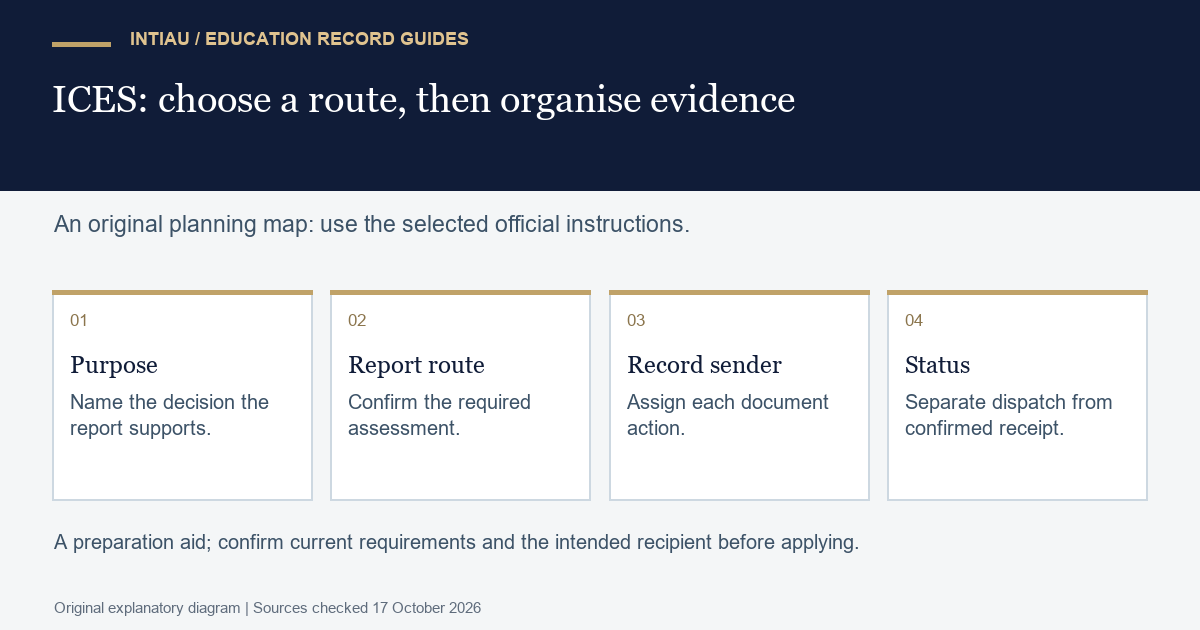
The International Credential Evaluation Service (ICES) at BCIT is a separate provider; this article describes its assessments, not an INTIAU service or partnership. Its official information is published at bcit.ca/ices. This guide uses the official pages checked on 17 October 2026 to distinguish general reports from the Canadian immigration ECA route.
Identify the purpose before comparing report names
ICES’s evaluation selection page describes Basic and Comprehensive reports. Basic lists credentials and their Canadian comparability, with institution and programme information. Comprehensive adds course detail, converted grades and credits, GPA and language of instruction. For a GPA, ICES requires all course attempts, including failed or improved results; missing information can lead to a modified report without GPA.
Some receiving organisations have specified an ICES report type or supplemental report. Check that requirement with the intended recipient. A useful question is: “Do you need a credential-level comparison, individual course information or a specific supplement?” Record the reply exactly enough to distinguish a mandatory requirement from a general recommendation.
Keep qualification comparison separate from an employment screening checklist. An employer might want to understand the educational level, verify an award, or carry out additional checks. Ask which decision each requested item supports. A more detailed academic report should not be assumed to complete an unrelated screening task.
Use the separate immigration route when that is the purpose
The official immigration ECA page states that ICES is designated by Immigration, Refugees and Citizenship Canada for Canadian immigration assessments. This route requires a fully completed and awarded academic credential comparable to at least one year of full-time study. It excludes work or life experience and directs certain regulated occupations to other assessment bodies. Check the applicable immigration instructions as well as the ICES page; an ECA is one assessment component, not an immigration outcome.
Understand the two document paths
For general applications, ICES’s requirements distinguish official records sent directly by the issuing institution or authority from original documents held by the applicant. The recipient and country rules can determine which route is mandatory. ICES does not obtain the records for you. Institution-issued official documents are retained; applicant-submitted originals are returned after evaluation.
The ECA document requirements separately describe applicant-uploaded identity and educational copies, followed by official educational records from the institution or awarding authority. An uploaded PDF is a placeholder for the required official evidence. ICES asks institutions to use one delivery method, email or mail, rather than sending duplicate sets by both. Country-specific instructions still apply.
| Decision | Official route to check | Personal action |
|---|---|---|
| Purpose | General assessment or immigration ECA. | Save the recipient’s description of the task. |
| Detail | Basic, Comprehensive or required supplement. | Confirm the report name before ordering. |
| Evidence | Country and report-specific requirements. | Allocate each document request to its sender. |
| Delivery | The permitted route for each document. | Record dispatch and receipt as separate events. |
Practise a document handover audit
Make a private worksheet with four headings: document, holder, required sender and unresolved question. Add one row for the award and another for the academic record. Then add a row for any evidence the selected instructions request separately. Avoid placing actual identity numbers in a worksheet that you intend to share while asking a general procedural question.
Trace each row from its present holder to the intended recipient. If your copy sits in your own folder, that tells you who possesses it; it does not establish that its journey meets the official-document rule. If the institution says it has dispatched something, note the date without marking the entire assessment complete. Use a separate status for “sent”, “receipt confirmed” and “question outstanding”.
Finally, read the worksheet as if you were another person helping with administration. Could that person tell which route applies, who acts next and which instruction resolves the uncertainty? If not, improve the action description. This is an organisational exercise, not an alternative ICES document policy or a prediction of completion time.
Questions before applying
Does a Comprehensive report always include a GPA?
ICES says it needs all course attempts to calculate GPA. Without that information it may issue a modified report without GPA; confirm the evidence needed before applying.
Are English translations needed for French records?
The translation guidance exempts French documents. Other non-English documents require complete, literal English translations under the published requirements.
Does uploading my transcript finish the ECA evidence requirement?
No. The ECA instructions distinguish uploaded copies from official educational documents supplied directly by the institution or authority. Check both parts of the requirement.
Related routes and sources
INTIAU record enquiries can use its Degree route or Contact page. ICES applications follow BCIT’s own channels. Official references: ICES, report selection, general documents, immigration ECA, ECA documents and translations.
Related guides
View the evaluation workflow