The Chinese University of Hong Kong is a separate institution; its BSSc in Global Studies is not an INTIAU programme or partnership.
A useful global-studies comparison starts with a bounded question. Instead of asking why the world is changing, choose two places, one policy problem and a defined period. Then ask what evidence would let you compare them fairly. This makes it easier to distinguish a curriculum that develops analytical tools from a list of internationally themed course names.
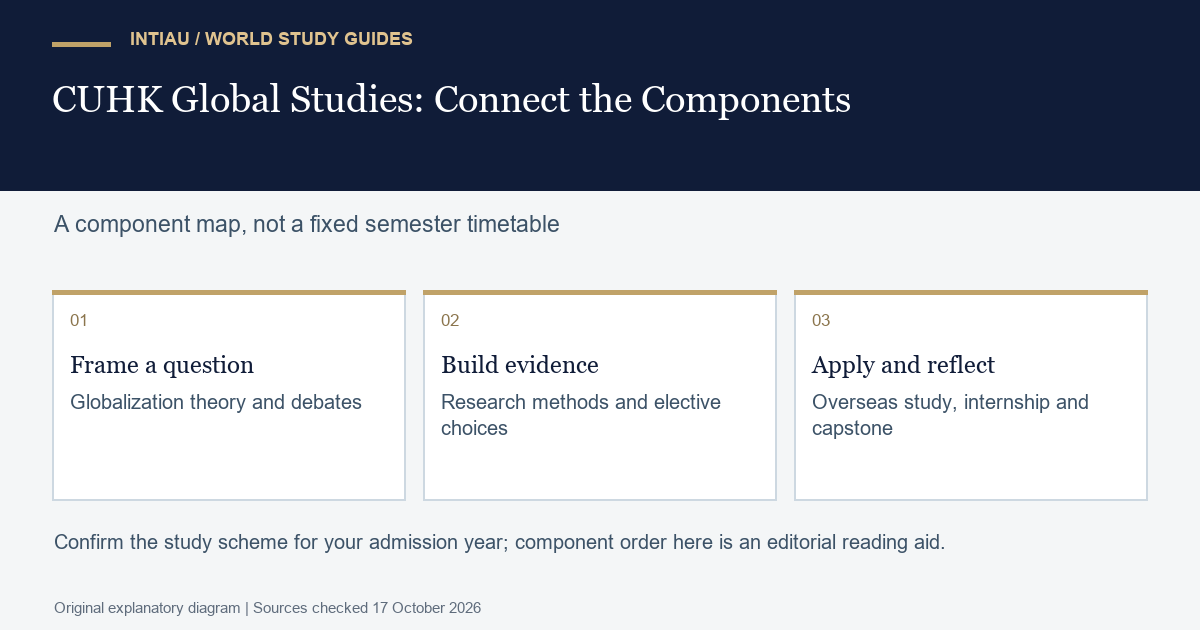
Read components without inventing a semester plan
| Stage | Selected official components |
|---|---|
| Foundations | Theoretical Perspectives on Globalization; Globalization: Issues and Debates. |
| Tools and choices | Research Methods for Global Studies; language courses; interdisciplinary elective clusters. |
| Experience | Resident Study Overseas and Internship. |
| Integration | Capstone course. |
The sequence above is an editorial way to read the components, not an official assignment of each component to a year. In your own comparison sheet, mark the point where you would need methodological preparation before making a substantial claim. For overseas or internship components, create a separate list of practical questions rather than assuming that every arrangement is automatic.
The current course list includes GLSD1001 Theoretical Perspectives on Globalization and GLSD2001 Research Methods for Global Studies. Check codes across editions.
A code is a useful anchor because a title can change while older pages remain indexed. Open the study scheme for your admission year before deciding which version controls your plan. Do not total units from inconsistent summaries. An unresolved difference is a question for the university, not an invitation to invent a corrected graduation requirement.
Practical exercise: a two-city policy comparison
Choose a fictional question about how two cities support people during extreme heat. Define an outcome narrowly, such as access to a cool public space during specified hours. Write down what counts as access: opening time, physical reachability, information availability or capacity. The definition should be explicit enough that a peer could apply it without guessing your intention.
Build a paper matrix with two city columns and four evidence rows: policy wording, implementation information, affected groups and unresolved gaps. Use simulated entries and mark them as invented. Add a source-quality note to every entry. A policy announcement may describe an intention, while an operational schedule supports a different kind of claim. Neither alone establishes the experience of every resident.
Write two competing explanations for an imagined difference between the cities. Then identify one piece of evidence that could weaken each explanation. Include a translation note if a concept might not mean exactly the same thing in two administrative contexts. Avoid ranking the cities before deciding whether the indicators are comparable.
Your output is a one-page matrix, a short methods paragraph and a conclusion containing one explicit limitation. Ask a peer to find a sentence that travels further than its evidence. Rewrite it more narrowly. This exercise is independent preparation for comparing claims; it is not a CUHK assignment, an approved research design or a substitute for the programme syllabus.
Separate major choice from the admission scheme
The school states that students admitted through Social Science broad-based admission can choose Global Studies in the second year. It separately directs non-JUPAS and international applicants to the admissions office; those routes should not be treated as identical.
For 2027 international entry, the official FAQ lists 12 November 2026 for the Advance Offer Round and 7 January 2027 for the Regular Round, checked on 17 October 2026. Qualification requirements and individual selection still apply.
Make a route note containing your qualification, applicant status and intended programme choice. Record whether a statement concerns university admission, later major selection or an experience within the curriculum. This keeps a valid statement about one route from becoming an unsupported promise about another. Recheck current requirements before acting on any date.
Three comparison questions
Does the table assign components to fixed years?
No. It groups published components for reading; your admission-year study scheme governs.
Are broad-based admission and international admission the same route?
No. The school identifies them separately.
What should a comparative exercise preserve?
Definitions, source quality, competing explanations and the boundary between an observed difference and the explanation proposed for it.
Official source trail
- BSSc Global Studies programme
- Global Studies curriculum components
- International admissions FAQ
- Global Studies office location
For INTIAU information, visit INTIAU Courses or INTIAU Contact. These links do not submit an application to the separate institution discussed above.
Related guides
View the curriculum diagram