Durham University is separate from INTIAU; BA History is a Durham programme. Its 2026/27 History programme list distinguishes V100 from the year-abroad and placement variants. This guide focuses on V100.
A history degree comparison should go beyond the periods you already enjoy. Ask how you will learn to frame a question, evaluate a source and explain a disagreement. A familiar century may be studied through unfamiliar material, while a new region may develop methods you want to learn.
Follow the current regulations before choosing topics
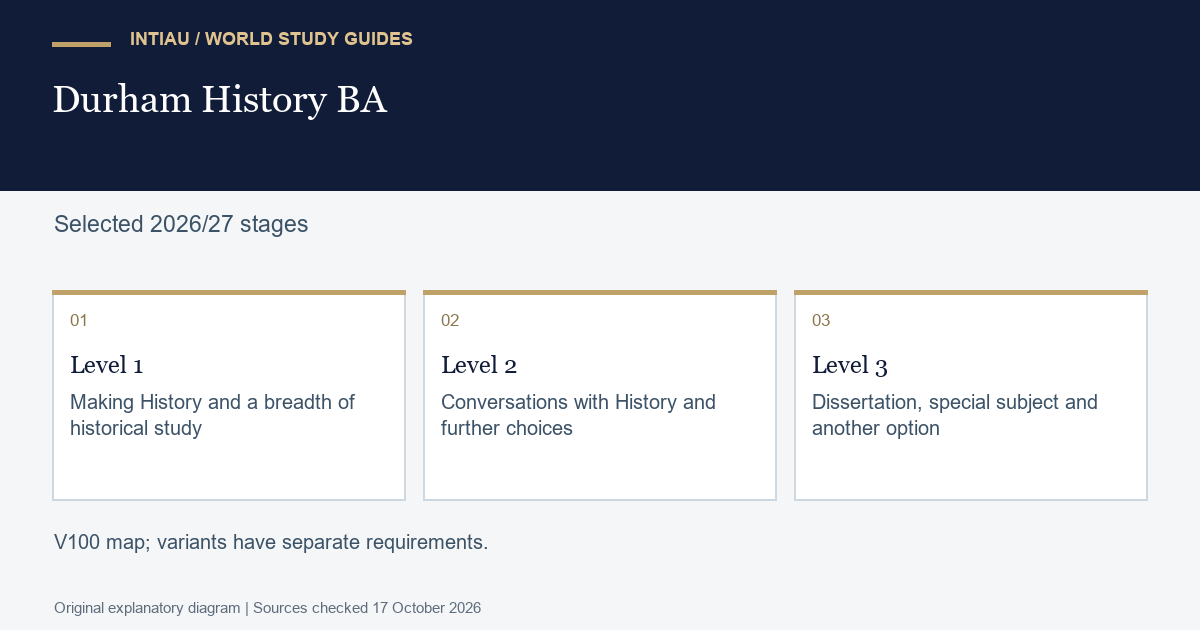
The 2026/27 regulations locate the programme at Durham City. They prescribe Making History at Level 1 and Conversations with History at Level 2. The final level combines a dissertation, a special subject and a further choice. This map selects stages, not all permitted combinations.
| Level | Required framework and choice |
|---|---|
| 1 | Making History; choices in methods, broad problems, earlier and modern history. |
| 2 | Conversations with History; historical options and exploration modules. |
| 3 | A 40-credit dissertation, 60-credit special subject and 20-credit option. |
Build your own comparison sheet with two separate columns: historical coverage and research practice. In the first, record the places and periods available. In the second, record the work a student must produce. Do not assume a long optional list means every combination fits a timetable or that an interesting title settles an assessment question.
A real example of independent questioning
The HIST2922 Conversations with History entry is a 40-credit Level 2 module available in 2026/27. It develops the definition of questions, engagement with historical literature and the planning of independent projects. Its published assessment is a project of up to 6,000 words, excluding footnotes and bibliography. These details describe this module and edition, not every History assignment.
The useful comparison is between a topic and a question. “Transport in a city” is a topic. Asking why two observers described the same transport change differently gives you a problem to investigate. A manageable question identifies a period, a body of evidence and the disagreement that makes research worthwhile.
Original exercise: put two accounts in conversation
This exercise is created for this guide, not assigned by Durham. Invent two short accounts of a town’s new railway: one written by a shopkeeper and another by a municipal official. Give each writer a different reason for describing the change. Keep the accounts clearly labelled as fictional; they are practice material, not historical evidence.
Make a source card for each account. Record who is speaking, the intended audience, what the writer could observe and what the account leaves out. Distinguish a statement about an event from a judgement about its value. The official’s confident tone does not make every claim complete, and the shopkeeper’s personal interest does not make the account useless.
Write two competing explanations for a difference between the accounts. Then propose an additional source that could help you choose between them: perhaps a map, a timetable or another observer’s record. Explain what that source could establish and what it could not. A new document is useful because it answers a question, not simply because it is old.
Finish with a 150-word research proposal. State the question, the evidence you would seek and one practical limit. Review whether your conclusion was decided before you examined the material. This small task helps distinguish an enthusiasm for historical stories from an interest in investigating how claims about the past are made.
Keep admission policy and curriculum years distinct
Durham’s published 2025/26 admissions policy directs undergraduate applications through UCAS and describes the Undergraduate Applicant Portal. It says entry criteria are advertised on course pages. This guide checked that policy on 17 October 2026; it does not turn its edition into a verified future calendar or assert a 2027 deadline from an older policy.
Before an application, use Durham’s live entry-year information to confirm the exact course and qualification requirements. Record any question about your school subjects separately from your preferred historical specialism. If you are considering a year abroad or placement, check that variant’s rules instead of treating it as an automatic extra year attached to V100.
Frequently asked questions
Is this a full list of History options?
No. The table selects stages; the regulations control the permitted choices.
Is Conversations with History a real module?
Yes. HIST2922 appears in the 2026/27 handbook as a Level 2 module.
Does this guide verify a new future application deadline?
No. Check Durham’s live entry-year instructions; the cited policy has its own edition.
INTIAU’s separate information is available through Courses and Contact. Durham decides its own admission and academic requirements.
Related guides
View the curriculum diagram