The University of Sheffield is separate from INTIAU; English Literature BA is a Sheffield degree. Its 2027/28 single-honours list identifies Q306 as a three-year full-time course. This guide concerns that route, rather than the separate combined language-and-literature degree.
To compare literature programmes, separate enjoying a text from making an argument about it. An interpretation needs details that another reader can inspect, and a historical claim needs context beyond personal response. Both can begin with curiosity, but neither becomes persuasive merely because a passage feels important.
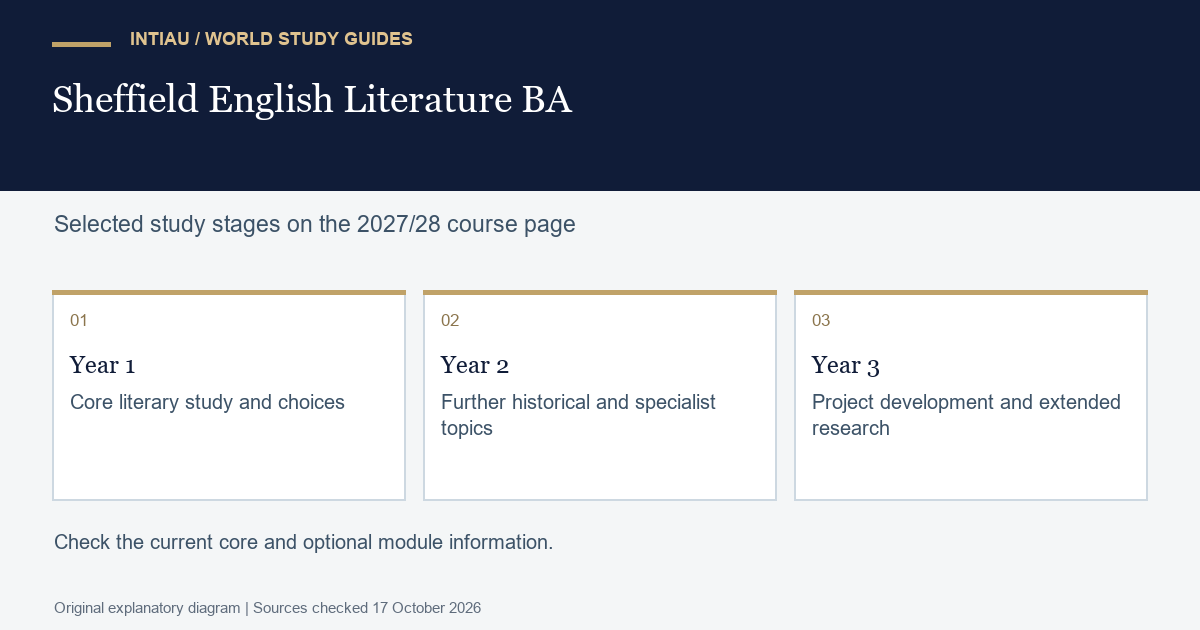
A selected map of the published course
| Year | Published work |
|---|---|
| 1 | Four core literary modules and optional study. |
| 2 | Further choices, including Chaucer and Shakespeare examples. |
| 3 | Project Modules 1 and 2, alongside specialist options. |
The course page gives changeable examples, not a guaranteed syllabus.
Read the map in two directions. One concerns the texts, periods and forms you want to investigate. The other concerns the work you want to learn to do: interpret a passage, connect material to a context, compare criticism or develop a sustained question. A useful choice combines those directions without assuming that every preferred topic will be offered.
A real research-project example
Project Module 2 extends the case study from Module 1, with peer and supervisor support. Possible formats include dissertation, digital artefact and creative work. These are selected examples.
That example helps distinguish a subject interest from a project design. “Memory in literature” is broad. A project needs a defined body of material, a question and an output that can support an answer. If a course offers different formats, ask what evidence and argument must remain visible when the format changes.
Original exercise: support two possible readings
This exercise is created for this guide, not assigned by Sheffield. Write a short fictional scene of your own in which a person returns to an empty room. Avoid borrowing a published passage. Include a repeated image, a shift in sentence length and one detail that the narrator does not explain.
Read the scene twice. In the first reading, treat the room as a place of comfort. In the second, treat it as a place of unease. For each, identify three textual details that support the interpretation and one that makes it harder to sustain. Keep a distinction between what the text says and what you have inferred.
Revise one sentence and explain how the change affects both readings. A strong analysis should be able to say which feature changed, not simply that the second version is “more powerful”. Consider rhythm, perspective, repetition or the information withheld from the reader. Ask someone else which details they noticed before sharing your preferred interpretation.
Finally, propose a small research question based on the disagreement between the readings. Identify what additional material you would need if you wanted to make a claim about historical context rather than only your own scene. Finish with a short argument that includes a counterpoint. The task helps reveal whether your interest lies in close reading, contextual research, creative practice or the relation between them.
Use the dated application instructions
Sheffield’s Applying essentials page directs undergraduate applications through UCAS. For September 2027 courses other than Medicine and Dentistry, it publishes an equal-consideration window from 1 September 2026 to 13 January 2027. The January date was still future when checked on 17 October 2026. Later consideration is qualified by remaining places.
Read the course-specific entry information alongside the university’s general requirements. Keep your school qualification, intended award and entry year together on a planning sheet. If you are comparing single and combined honours, record the exact title and code rather than assuming that shared words mean the same curriculum.
Before applying, turn one of your academic interests into a precise question for the university. For example, you might ask where students develop a particular kind of research or how a described project format is selected. Save the answer with its date so that later decisions depend on the applicable information.
Frequently asked questions
Is Q306 the combined language-and-literature degree?
No. Q306 identifies English Literature BA in the single-honours list.
Must every final project be a dissertation?
The published Project Module 2 description includes several possible formats.
Is the January date for September 2027 entry?
Yes. The application page explicitly dates that equal-consideration window.
For INTIAU’s own information, visit Courses or Contact. Sheffield controls its own programme and admissions decisions.
Related guides
View the curriculum diagram