Educational Credential Evaluators (ECE) is an independent credential evaluation organisation; this guide describes ECE’s services, not an INTIAU service or partnership. Its official website is ece.org. The information below was checked on 17 October 2026 and focuses on selecting a report and preparing the correct academic records.
Start with the decision the recipient needs to make
ECE’s applicant FAQ says it evaluates academic work and credentials, rather than work experience. It advises applicants to ask their school, employer or licensing board which report is required. A qualification comparison therefore answers a different question from an employer’s broader background screening request. Ask the recipient to describe the required evidence before treating either process as a substitute for the other.
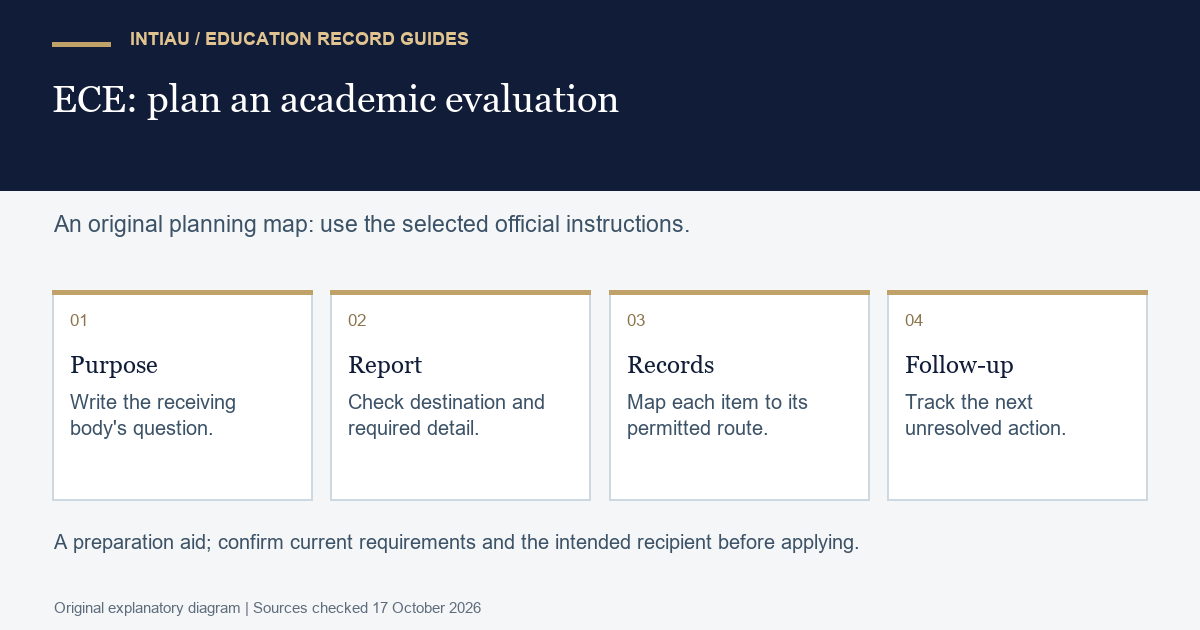
Write a short purpose statement: who will receive the report, which application it supports and what that recipient has requested. For example, a request to understand the level of a degree differs from a request to inspect individual subjects. Keep the recipient’s answer with your planning notes so that a later change of course or employer does not silently change the specification.
Distinguish the report’s destination and level of detail
The U.S. report options include General, General with GPA and Course by Course. General reports identify the credential and its U.S. equivalency without individual course or grade analysis. General with GPA adds a grade average. Course by Course adds subjects, credits and grades. A separate High School and University Level Course by Course option covers both levels; Subject Analysis requires a prior arrangement with the referring body.
ECE also publishes Canadian assessment options with Canadian equivalencies. These are academic assessments for study, employment or professional licensing purposes. ECE explicitly directs people needing a Canadian immigration ECA to the Government of Canada. Do not select a Canadian academic report merely because an immigration checklist also uses the word “assessment”.
Build the document route before sending anything
The documentation requirements vary by country or region. ECE distinguishes originals, institution-sealed records and items for which a photocopy or scan is acceptable. An applicant-held scan does not replace a required original or sealed record. Apply online before sending documents and use the resulting Document Matching Form or reference number to connect the package to the order. ECE may request additional records or verification.
Use the following original workflow table as a planning aid. Its final column is a suggested personal record, rather than an additional ECE submission requirement.
| Stage | Action | Useful planning record |
|---|---|---|
| Define | Ask the recipient to identify the destination and report detail. | A dated copy of its answer. |
| Map | Read the country instructions for each credential. | A list connecting each record to its required route. |
| Apply | Complete the online order before dispatching records. | The order reference, kept privately. |
| Follow through | Respond to any request for clarification. | A dated action log distinguishing requests from completed actions. |
Try a two-column document planning exercise
On a private worksheet, create one row for every qualification you want considered. In the left column, describe what you possess: the award document, academic record, language and names appearing on it. In the right column, record what the current ECE instructions require and who must supply it. Mark any gap as a question to resolve, rather than assuming that a familiar-looking certificate satisfies every requirement.
Next, test the worksheet against two situations. First, imagine that the university can issue a transcript but cannot reproduce the original award certificate. Identify which exact instruction needs clarification. Second, imagine that the recipient changes its request from a credential-level comparison to course detail. Check the report choice again before spending effort on delivery arrangements.
Finish by assigning an owner to each next action: you, the awarding institution or the recipient. Keep an unanswered question visibly open. This exercise separates document possession from submission responsibility and makes follow-up more precise. It is preparation advice, not permission to alter, reconstruct or substitute an academic record.
Questions applicants often ask
Can ECE evaluate my work experience?
ECE’s applicant FAQ limits its evaluations to academic work and credentials. Describe employment evidence separately and ask the recipient what other checks it needs.
Can I use ECE’s Canadian academic assessment for immigration?
ECE currently states that its Canadian assessments serve study, employment and professional licensing purposes. Its FAQ directs immigration ECA applicants to the Government of Canada; follow that distinction.
Will ECE return every document?
The documentation page distinguishes returnable originals from records sent in sealed institutional envelopes, which are not returned. Read the rule for your document category before arranging delivery.
Related INTIAU routes and official sources
For an enquiry about INTIAU’s own records, use its Degree route or Contact page. These links do not place an ECE order. Official references: ECE, U.S. options, Canadian options, documents and applicant FAQ.
Related guides
View the evaluation workflow