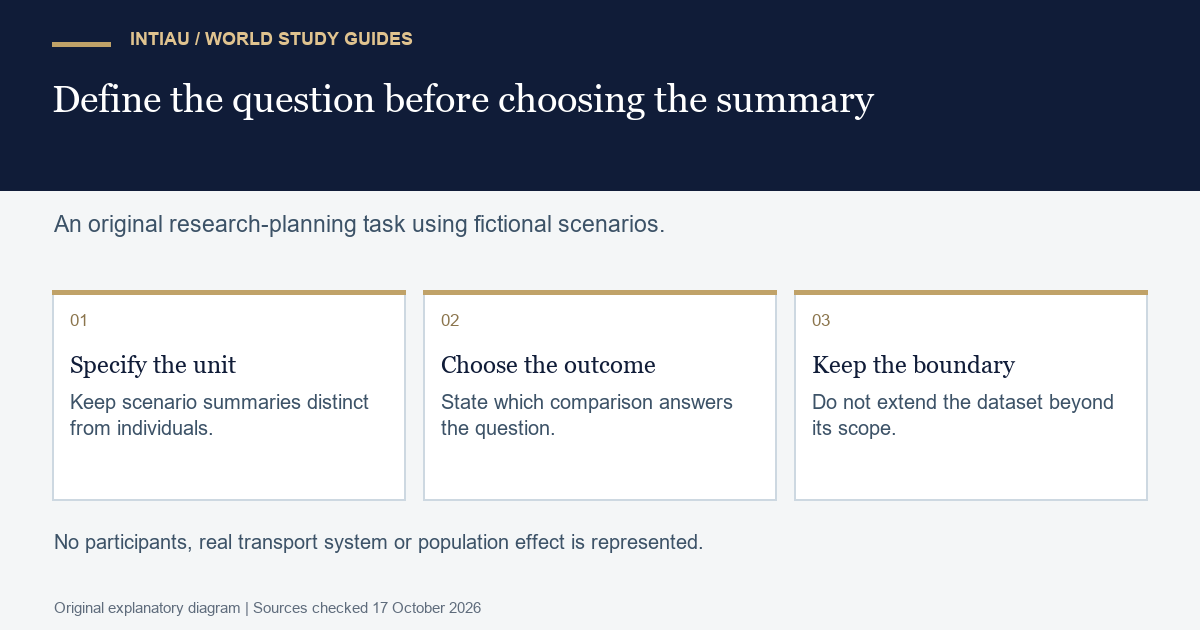
This self-study workshop turns the broad interest “better waiting times” into a question that a small invented dataset can actually answer. You will specify the comparison, unit, outcome and boundaries, then discover why changing the outcome can change the conclusion. The task uses simulation values only, with no participants or operational transport system.
The Cochrane question-and-scope chapter explains how a well-defined review question guides eligibility, searching, data collection and synthesis. Its clinical-review context is distinct from the fictional simulation exercise below.
Replace the broad interest with an observable comparison
The invented material compares two scheduling algorithms, A and B, on four matched model scenarios. Each number is one scenario’s summary waiting time in minutes. It is not the waiting time of an individual passenger. Keep that unit explicit when describing how many observations you have.
| Scenario | Algorithm A | Algorithm B |
|---|---|---|
| One | 1 minute | 4 minutes |
| Two | 1 minute | 4 minutes |
| Three | 9 minutes | 4 minutes |
| Four | 9 minutes | 8 minutes |
A workable question is: in these four specified simulation scenarios, how does the median scenario-summary waiting time differ between algorithms A and B? This identifies the alternatives, outcome, unit and scope. It does not claim to answer whether either algorithm improves a real transport network.
Write the question before calculating. If “better” remains undefined, a reader cannot tell whether it means a lower mean, lower median, smaller maximum, lower cost or a fairer distribution. Several of those might matter, but one label should not silently stand in for all of them.
Complete worked answer
A’s ordered values are one, one, nine and nine. The median is the average of the two middle values, one and nine, giving five minutes. B’s values are four, four, four and eight; its median is four minutes. Under the stated median question, B is lower by one minute.
Now calculate the means. Both sums equal twenty minutes across four scenarios, so both means equal five. Under a mean question, the difference is zero. These results are consistent: the two summaries answer different questions about the same supplied values.
The maximum is also different: nine for A and eight for B. That observation may motivate another question, but it does not justify replacing the original median question after seeing which result is more attractive. Preserve the initial question and label any later exploration separately.
A concise model conclusion is: within the four fictional scenarios, B’s median scenario summary is one minute lower, while the two means are equal. No sampling design or uncertainty model has been supplied, so this answer describes the invented dataset without claiming a population effect or a causal result in practice.
Check whether the question matches the evidence
Suppose someone rewrites the question as “How many passengers benefit?” The table cannot answer it because it contains scenario summaries, not individual passenger outcomes. Four rows do not become four passengers, and a difference between summaries does not reveal how many individuals have shorter waits.
Suppose the question becomes “Will B work next year?” No future scenario or external validation has been given. A bounded answer should identify the missing evidence rather than extend the table beyond its scope. Feasibility here means that the proposed question can be addressed with the supplied material.
Prepare a question card containing purpose, comparison, unit, outcome, dataset boundary and intended answer form. For this exercise the answer form is a descriptive difference in minutes. Keep any desired decision, such as choosing a schedule, on a separate line so that it does not become an unsupported conclusion.
For a next practice, define a rule counting scenarios whose summary is no more than four minutes. A meets it in two scenarios and B in three. The answer is now a count of qualifying scenarios. Explain why that count should still not be reported as a count of benefiting people.
Questions and completion criteria
Submit the initial question card, median and mean calculations, the one-sentence bounded conclusion and one unanswerable question with its missing evidence. The exercise is complete when another reader can reproduce the descriptive answer without guessing what “better” meant.
Does a defined question influence later review methods?
Yes. The cited chapter connects it with several subsequent review decisions.
Which algorithm has the lower fictional median?
B: four minutes compared with A’s five.
Do the two algorithms have different fictional means?
No. Both means are five minutes.
This is an original INTIAU editorial self-study activity; no qualification is awarded. Use Courses or Contact for institutional information.
Related guides
View the study diagram