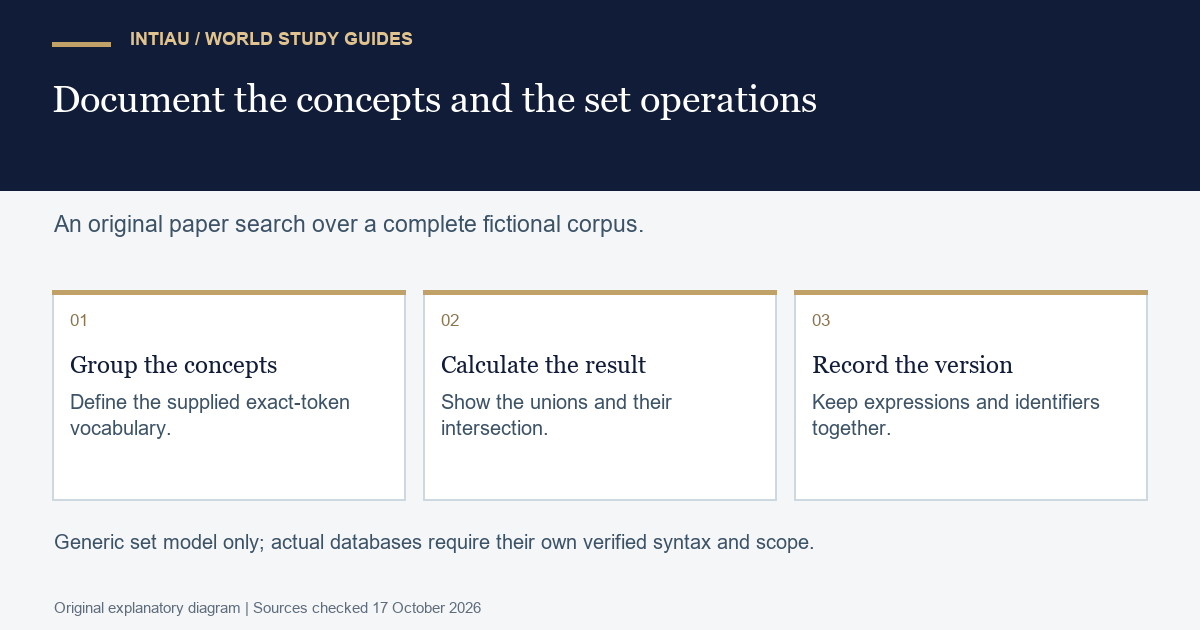
This self-study workshop makes a small search plan reproducible before any database is opened. You will define concept groups, calculate Boolean results over six invented records and document what the search does not cover. All records and term sets are supplied here; no live database search, account or real literature retrieval is required.
The NLM PubMed help defines uppercase Boolean operators and explains grouping with parentheses. PubMed has its own processing rules; the paper expression below is a generic set model, not a verified query for another database.
Build two concept groups
The fictional question concerns wayfinding information in museum-like settings. For the exercise, the first concept group contains the exact tokens map and sign. The second contains museum and gallery. These are a deliberately incomplete vocabulary, not a claim that the four words constitute a comprehensive real search.
| Record | Supplied exact tokens | Matches both concept groups? |
|---|---|---|
| 1 | museum map |
Yes |
| 2 | gallery sign map |
Yes |
| 3 | museum sign |
Yes |
| 4 | museum gallery sculpture |
No |
| 5 | map |
No |
| 6 | gallery |
No |
Our matching rule checks only membership in these supplied token sets. It has no stemming, synonym expansion, automatic mapping or field weighting. State that rule before interpreting a result count. A real interface may process the same visible words differently.
Complete worked search calculation
(map OR sign) AND (museum OR gallery)

map     = {1, 2, 5}
sign    = {2, 3}
museum  = {1, 3, 4}
gallery = {2, 4, 6}

wayfinding group = {1, 2, 3, 5}
setting group    = {1, 2, 3, 4, 6}
intersection     = {1, 2, 3}
The complete answer is records one, two and three. OR forms each within-concept union; AND keeps the records present in both unions. Record four has the setting terms but neither wayfinding term. Record five has a wayfinding term but no setting term. Record six has only a setting term.
Compare that with the different expression map OR (sign AND museum) OR gallery. Its first set contains one, two and five; its middle set contains three; its final set contains two, four and six. Their union contains all six records. The expression is broader because a map record or a gallery record can now qualify without meeting both concept groups.
This comparison does not rely on guessing an interface’s operator precedence. The alternative expression has explicit parentheses, so its intended set operations are stated. When moving to an actual database, verify that platform’s syntax and inspect any translated-query display it provides.
Write an audit trail rather than only a count
Create a practice log with the corpus version, exact expression, field rule, vocabulary, restrictions and result identifiers. For this run, call the corpus “fictional six-record set, version one”, the field rule “supplied token membership” and the restrictions “none beyond the supplied corpus”. Record the result identifiers, not just the count of three.
Suppose someone reports that changing the expression found three more relevant studies. That overstates the evidence twice. The exercise found three additional invented records, and no relevance assessment beyond token matching has been supplied. A search match is a candidate for later assessment, not automatic proof of eligibility or usefulness.
For a vocabulary extension, add orientation to the wayfinding group and stipulate a seventh record containing museum orientation. The expanded expression should now retrieve one, two, three and seven. Keep version one and version two results separate so a reader can identify the reason for the change.
For a restriction exercise, imagine excluding every record containing gallery. Under the original result set, that removes record two and retains one and three. Explain what is lost before adopting such a restriction in a real strategy. Here the loss is known because the complete fictional corpus is visible.
Questions and completion criteria
Submit both worked set calculations, the versioned practice log and the vocabulary-extension result. A transparent plan explains its operational rule and boundaries. It does not label an unexecuted real search exhaustive or report invented records as retrieved publications.
Why does grouping matter in a documented search?
It states which concepts should be combined as a unit.
Which records match both original concept groups?
One, two and three.
Has a real database search been performed here?
No. Every result follows from the supplied fictional sets.
This is an original INTIAU editorial self-study activity; no qualification is awarded. See Courses or Contact for institutional information.
Related guides
View the study diagram