The University of Geneva in Switzerland is independent of INTIAU. Its Earth and environmental sciences section distinguishes this bachelor from the separate computational-sciences route with an Earth/environment orientation. Begin with the section’s bachelor links so that a similarly worded title does not lead you into a different set of requirements.
Qualification, language and the applicant year
The Bachelor en sciences de la Terre et de l’environnement comprises 180 ECTS over six semesters. French is the teaching language, with English recommended. The programme page explicitly lists 30 April 2027 as the application deadline, or 28 February 2027 for applicants requiring a visa according to nationality. Its scientific sequence begins with broad foundations before more specialised Earth and environmental study. official programme and dates
Admission is a separate check. Geneva’s published 2026/27 conditions depend on the applicant’s previous qualification and country; the interactive conditions page asks readers to define that profile. General matriculation and faculty-specific admission are distinct. For example, the German Abitur conditions specify a subject pattern and a grade threshold, with an alternative involving proof of admission in Germany. That example cannot be applied to another country’s certificate. French examination or exemption rules also require an individual check. These are 2026/27 conditions, not a claim that every detail is already confirmed for 2027/28. qualification-specific conditions
Make two columns in your application notes: the dated application window and the academic conditions attached to your actual certificate. A date in the first column does not resolve an uncertainty in the second. Ask a precise question about the missing condition rather than sending a general request to confirm eligibility.
How the science develops
The table selects themes from the official programme overview. It is a reading map, not a transcription of the complete course catalogue or a timetable for every option.
| Stage | Selected published themes | What to compare |
|---|---|---|
| Year 1 | Planet Earth, palaeontology, crystallography, chemistry, mathematics and physics | Can you connect observation with quantitative explanation? |
| Year 2 | Geochemistry, structural geology, petrology, geophysics and environmental chemistry | Which measurements would distinguish competing processes? |
| Year 3 | Georisks, tectonics, environmental geology, palaeoclimate and a research project | How does a local result support a broader interpretation? |
The section links course programmes, timetables and field camps. Check their academic year before relying on a general overview for registration. teaching navigation
A real course: Grand camp de géologie
The official 2026/27 catalogue describes Grand camp de géologie as a spring field course lasting twelve days. Its aims join direct observation and rigorous description with interpretation, deductive reasoning and integrated synthesis. Selected disciplinary connections include sedimentology, stratigraphy, petrology and geomorphology. The catalogue assigns credits by programme: the Earth/environment third-year allocation differs from the generic headline allocation. Check the entry attached to your own study plan before transferring a number into a comparison. The publicly indexed official description was readable, while the direct page returned no extractable text in this check. These are selected catalogue themes, not a complete field itinerary, safety briefing or assessment specification. dated course catalogue
Original exercise: what does a contact prove?
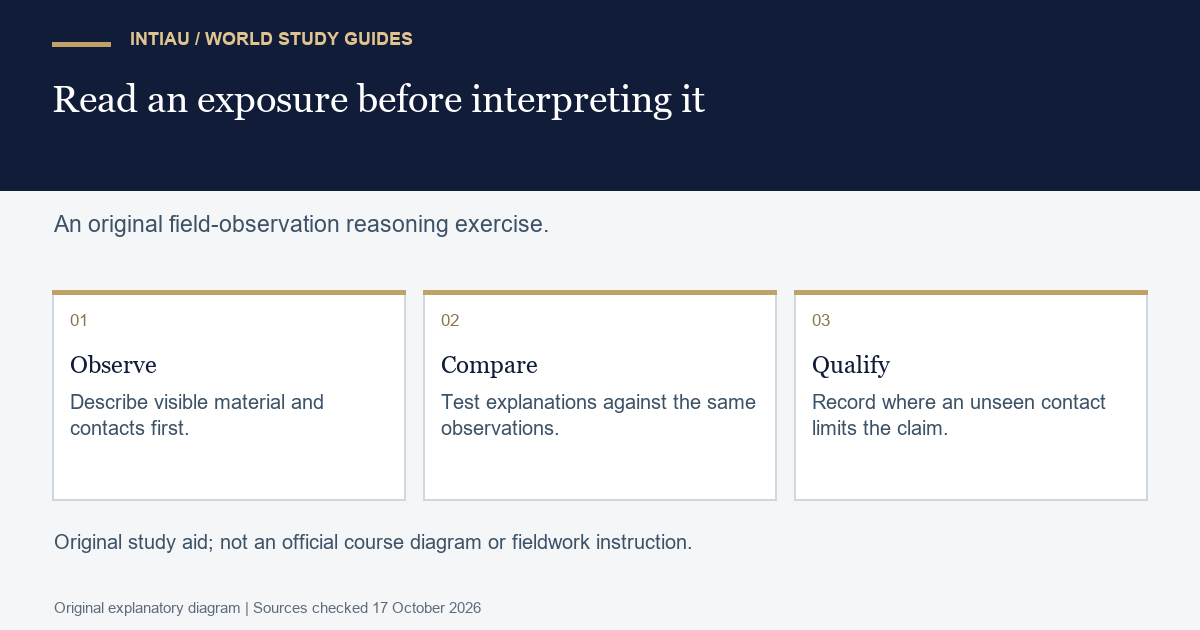
Imagine a fictional exposure with rounded pebbles inside layer A and a fine, continuous layer B above it. A notebook says, “A formed in a river and B records a lake.” Separate the observation from the interpretation. Pebble shape and the visible boundary are observations; the environments are proposed explanations. Now suppose a second exposure contains similar pebbles but no visible boundary because vegetation covers it. Does that establish that the same two layers continue between sites? No: similarity supports a comparison, but the hidden interval leaves alternatives open. Write one additional observation that could discriminate between continuity and two unrelated deposits. A defensible answer might seek a traceable marker layer exposed between the sites. It should explain why that evidence matters rather than simply demand more samples. Finally, rewrite the notebook sentence to retain the environmental hypothesis while recording its uncertainty.
Three practical questions
Is the computational-sciences route the same bachelor?
No. The section lists it separately from Earth and environmental sciences. programme choices
Should the field-course headline credit be copied automatically?
No. Use the allocation for the relevant programme and academic year in the linked catalogue.
Does an unexplored contact establish continuity?
No. The fictional exercise leaves that relationship unresolved until discriminating evidence is available.
For INTIAU’s own information, see Courses and Contact.
Related guides
View the study diagram