The University of Granada offers the Grado en Matemáticas, a four-year, 240-credit programme associated with its Faculty of Science in Granada. Teaching is in Spanish. This independent degree is not an INTIAU qualification or partnership. 2026/27 catalogue record.
When comparing mathematics degrees, ask what kind of explanation you want to learn to produce. A calculation, a proof and a model address related but different questions. Keep the assumptions beside a worked example so that a result that fits a few observations does not become an unsupported claim about every possible case.
Selected progression and an actual modelling course
The programme’s study-plan index groups courses by year and links their teaching guides. The selection below highlights foundations, modelling, advanced analysis and final work. Official plan index.
| Stage | Selected original course name | Question for comparison |
|---|---|---|
| Year one | Cálculo I; Álgebra I; Métodos Numéricos I | Which tools support a precise argument? |
| Year two | Modelos Matemáticos I; Topología I | What is assumed about the mathematical object? |
| Year three | Análisis Funcional; Ecuaciones Diferenciales II | How does the framework extend? |
| Year four | Options; Trabajo Fin de Grado | How is a sustained investigation presented? |
The 2026/27 Modelos Matemáticos I guide, approved 3 July 2026, identifies a required six-credit second-year course. Its selected themes include linear difference equations and structured populations, with earlier calculus and geometry recommended. Selected current course guide.
Use that example to distinguish a course’s named mathematical setting from an application story. A model may use the same notation in several contexts, while its assumptions and interpretation change. In your notebook, place the mathematical relationship, meaning of each symbol and evidence for using that relationship in separate columns.
The plan index and individual guide answer different questions: one locates components in a progression; the other identifies the edition and selected teaching themes. Retain both references when comparing study options. Do not infer the content of an unseen future guide from an unchanged course title.
Use the actual access and pre-enrolment route
The programme directs applicants to the university’s Access, Admission and Permanence service. No 2027/28 opening is asserted here. Programme applicant route; university access guidance.
UGR distinguishes meeting an access route’s requirements from participating in pre-enrolment to obtain a place. University access guidance.
Prepare your application comparison with the exact qualification held, intended entry year and unresolved document questions. Attach each date to its action and applicant category. A course guide’s approval date is evidence about that teaching document, not an application deadline. This guide’s source check was 17 October 2026.
Original worked exercise: two rules fit the same start
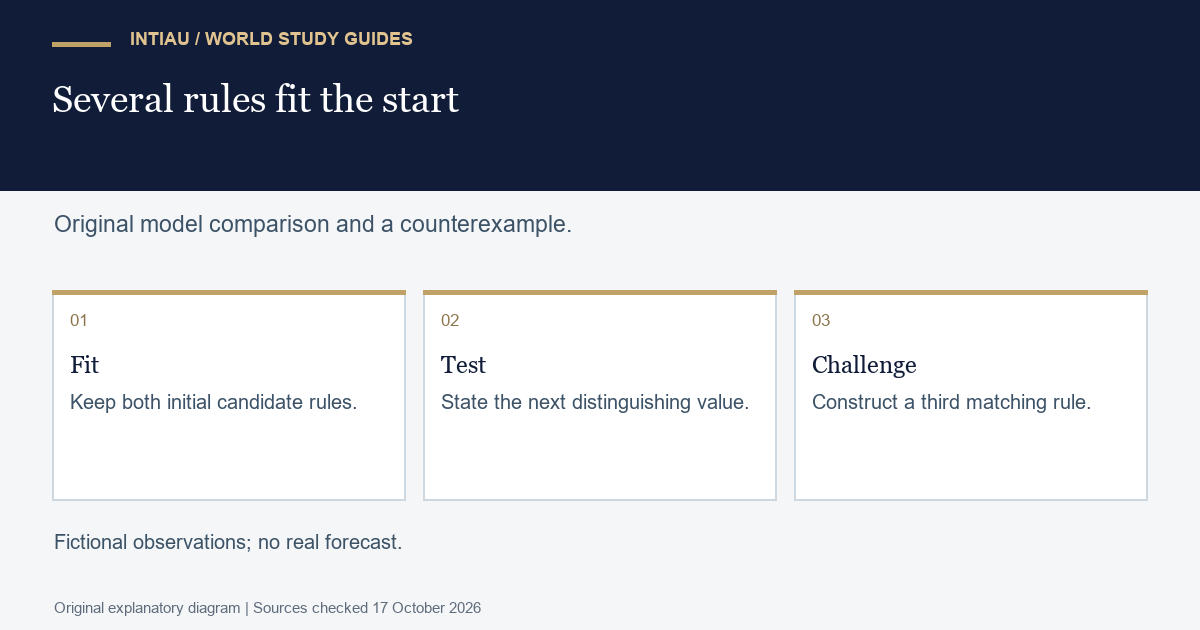
This independent numerical task begins with invented observations: at time zero the recorded value is two, and at time one it is four. Consider two candidate rules. Rule A adds two for every unit of time, giving y=2+2 t. Rule B doubles for each unit, giving y=2×2 to the power t.
Both rules reproduce the two supplied observations. At time two, A predicts six and B predicts eight. Write both predictions before introducing any new observation. The disagreement shows why matching the initial points does not identify a unique rule.
Now suppose a third invented observation at time two is six. This agrees with A at all three supplied points and disagrees with B at the third. State that result carefully. It supports choosing between these two candidates for this dataset; it does not prove that A will describe every later observation or that no third rule could fit the same points.
For a concrete counterexample to uniqueness, form rule C by adding t(t−1)(t−2) to A. At times zero, one and two, the extra product is zero, so C matches A. At time three the product is six: A predicts eight and C predicts fourteen. The first three observations alone cannot distinguish them.
Finish with a comparison sheet naming each rule, its assumptions and a future observation that would separate the remaining candidates. Do not label the largest prediction the most realistic one. This is a fictional modelling exercise, not a forecast of a real population or an official university assignment.
Practical questions
Does fitting three observations prove a rule?
No. The invented third candidate matches all three and then differs. Explain the scope of the comparison.
Is a recommended background course necessarily a formal admission requirement?
No. Keep the source’s category and wording. A teaching recommendation and an applicant eligibility rule answer different questions.
Is the table the full degree syllabus?
No. It selects a few components. Use the programme’s official plan and applicable teaching guides for complete requirements.
For INTIAU’s own information, see courses and the contact page.
Official source index
- Catalogue: programme identity.
- Plan: selected progression.
- Guide: selected modelling course.
- Access: applicant route.
Related guides
View the study diagram