École Polytechnique is a French institution separate from INTIAU. Its Bachelor of Science is entirely English-taught, normally three years and 180 ECTS. This guide focuses on its Mathematics and Physics double major.
The institution’s published address is in Palaiseau. Check programme-specific teaching arrangements rather than treating the address as an activity timetable.
A useful mathematics-and-physics comparison connects a model’s assumptions with the observations it could explain. Mathematical consistency and agreement with a set of measurements are related questions, but neither automatically supplies the other. When reading a course map, ask where you would develop theoretical tools and where you would learn to examine their experimental use.
The core and the double major
The published structure separates a common scientific first year from two years of specialisation.
| Stage | Published arrangement |
|---|---|
| Year 1 | Core mathematics, computer science, economics and physics |
| Years 2–3 | Double-major study, here Mathematics and Physics |
| Additional minor | Subject to Academic Council approval; not automatic |
The track overview names Introduction to Modern Physics. Its scope includes mechanics and relativity, optics, electromagnetism, thermodynamics and matter. The page also describes advanced laboratory sessions and mathematical applications in physics and mechanics, followed by a third-year research thesis. This is a selected course overview, not the complete syllabus linked by the institution.
Compare the relationship between a theoretical component and a practical one rather than counting how often “research” appears. Write down one model assumption, one measurable quantity and one possible disagreement between them. That short record makes a more precise starting point for reading individual course descriptions or asking about a pathway.
Worked exercise: two models for four observations
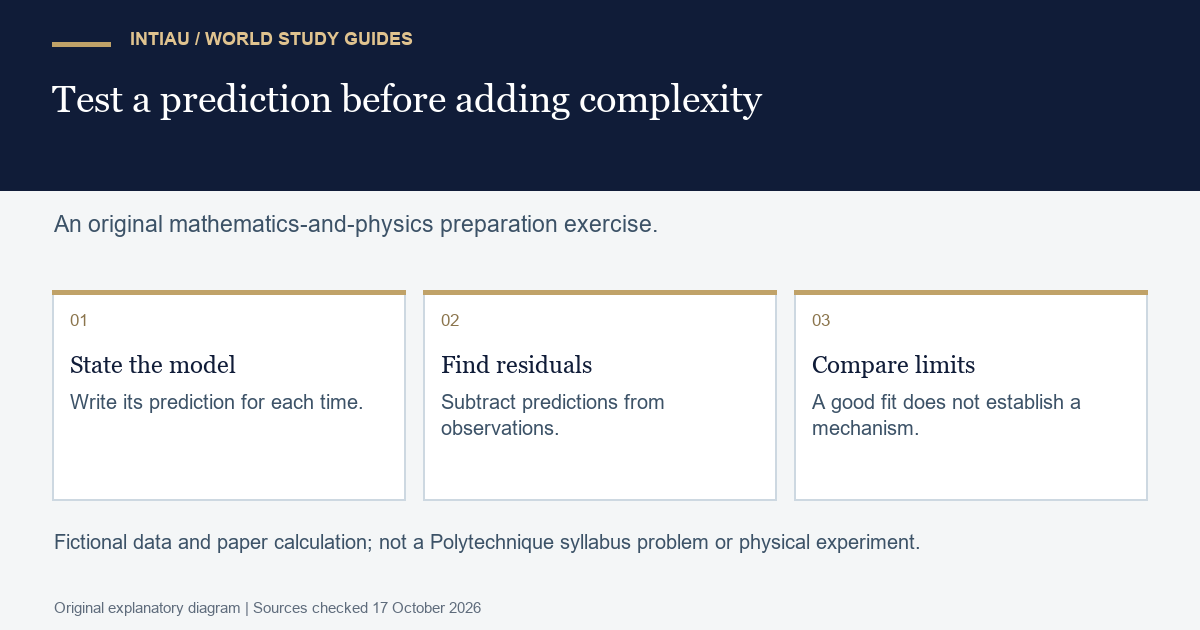
This original paper task uses invented observations. At times zero, one, two and three, an imaginary object’s positions are zero, two, four and six distance units. Model A predicts position equal to twice time. Model B predicts position equal to time squared. Compare the predictions without conducting a physical experiment or attributing the task to the university.
Model A predicts zero, two, four and six, matching all four observations. Define a residual as observed position minus predicted position. Its residuals are zero throughout, and the sum of squared residuals is zero. State that definition before calculating; reversing the subtraction changes the signs even though squaring later removes them.
Model B predicts zero, one, four and nine. Its residuals are zero, one, zero and minus three. Squaring and adding gives zero plus one plus zero plus nine, or ten. On this chosen comparison, Model A fits the supplied observations better. This result describes the four invented values; it does not establish a law of motion.
Now predict the position at time four. A gives eight and B gives sixteen. No observation at time four has been supplied. The disagreement creates a possible discriminating question for a future study, but the prediction is still a prediction. Do not place either value in the observation column simply because one model fitted earlier data exactly.
Next replace the final observed position with seven. A’s last residual becomes one, so its squared-residual total becomes one. B’s last residual becomes minus two, giving a total of five when the earlier residual of one is included. A still has the lower total, but its fit is no longer exact. Showing the changed arithmetic makes the conclusion auditable.
List the limits of this comparison: no uncertainty estimates, force model, sampling design or account of how positions were obtained. A more flexible mathematical expression could fit a small dataset perfectly while predicting poorly elsewhere. Choosing a model therefore requires more than seeking an impressive-looking match to a few points.
Prepare a worksheet with observation, prediction and residual columns for both cases. Finish with a plain-language finding and one question that would require new evidence. This tests your interest in linking calculation with interpretation, without presenting invented data as a scientific result or an admissions assessment.
Application instructions and date caution
The admission procedure requires strong mathematics and science preparation and English at C1. It considers applications for Year 1 only, rather than transfer into Years 2 or 3. Follow the official online or applicable Parcoursup instructions; the page warns against applying through both routes in one academic year.
Checked on 17 October 2026, the page combines a “2026 intakes” label with round dates running into 2027. Confirm the intended entry year and applicable deadline with the admissions office. This guide does not resolve that inconsistent label by inventing a cycle.
Three bachelor questions
Is the bachelor described as English-taught?
Yes. The programme overview specifies teaching entirely in English.
Does the stated route accept transfer directly into Year 2?
No. The procedure says applications are considered for Year 1 only.
Does an exact fit to four invented values establish a physical law?
No. The worked comparison lacks the evidence needed for that conclusion.
For INTIAU information, use Courses or Contact.
Related guides
View the study diagram