Université Grenoble Alpes is a French institution separate from INTIAU. Its Licence Physique contains distinct Grenoble and Valence routes. The live catalogue warns that 2027/28 programmes may change until 28 November 2026, with 2026/27 information still available.
The third-year Physics pathway lists French and Grenoble’s Domaine universitaire campus. A separately described international route should not be confused with an entirely English-taught licence.
A useful physics comparison asks what a mathematical relation assumes about the system it represents. The same course title can include conceptual explanation, calculation and experiment, with different evidence required for each. Before comparing options, write down a simple model you understand and one observation that would test its limits.
Progression and selected course scope
| Stage | Selected progression |
|---|---|
| L1 | Physics, chemistry, mechanics and mathematics portal, or distinct research route |
| L2 | Physics–mechanics, physics–chemistry or the Valence mathematics/mechanics combination |
| L3 | Physics or another compatible named pathway |
The third-year Physics list includes mathematics for physics, analytical mechanics, coherent optics, quantum mechanics and statistical physics. These examples show a combination of theoretical and experimental interests; they do not reproduce every requirement or make all options automatic.
The Geometrical Optics outline identifies PHY104–PHY202 as a three-credit first-year component. It covers refraction, image formation, lenses and optical systems, using problem-based teamwork and experimental comparison. Its page lists French. This selected public outline also carries the catalogue’s update warning; it is not a frozen 2027/28 syllabus.
Use the outline to distinguish solving a relation from testing it. A numerical answer is only one part of an explanation. A diagram, sign convention and account of uncertainty can be necessary to understand whether the relation describes what was actually observed. Do not infer an assessment format from an exercise published by an unrelated source.
Worked exercise: a thin-lens relation on paper
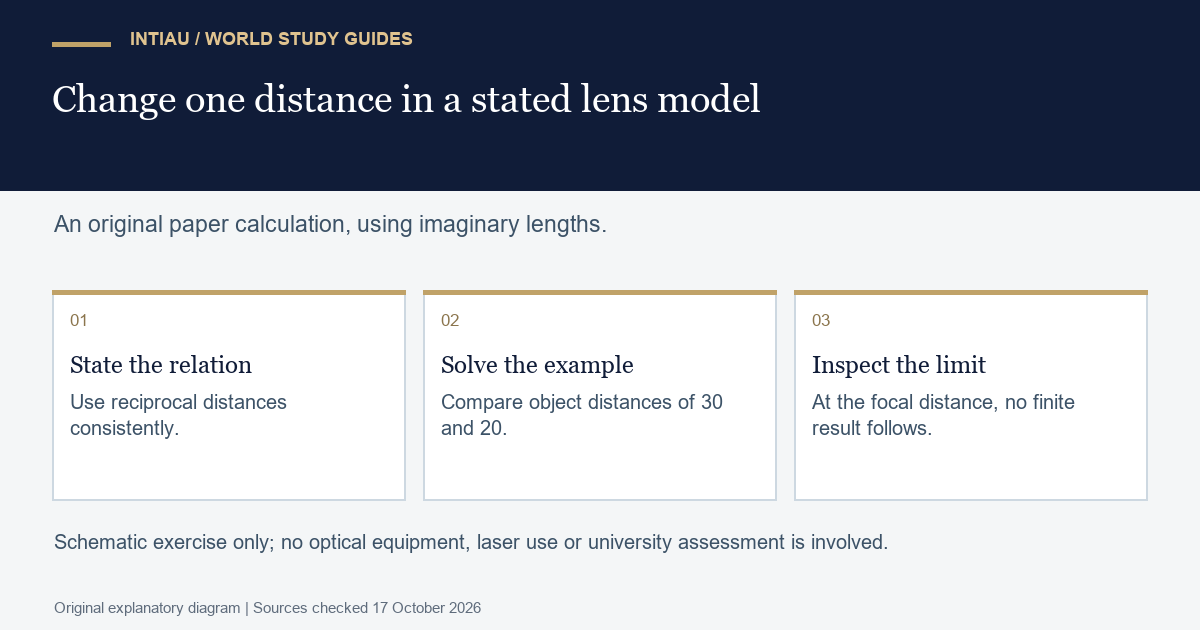
For this original task, take the simplified relation one over f equals one over u plus one over v. Let f be ten length units, and let u and v be positive object and image distances in the chosen convention. These are stipulated model quantities, not instructions for setting up optical equipment. Find v when u is 30, then when u is 20.
With u equal to 30, one over v is one tenth minus one thirtieth, or two thirtieths. Therefore v is 15. With u equal to 20, one over v is one tenth minus one twentieth, or one twentieth, giving v equal to 20. Show the reciprocal step before inverting; subtracting the distances directly would solve a different expression.
Now set u to 15. One over v becomes one tenth minus one fifteenth, or one thirtieth, so v is 30. The two distances have exchanged roles relative to the first case. This follows from the symmetry of the stipulated relation, not from new experimental evidence. A labelled sketch should keep the same reference point in all three calculations.
At u equal to ten, the right-hand subtraction gives zero. No finite v satisfies one over v equal to zero. In the idealised interpretation, the limiting image distance grows without bound. Reporting v as zero would reverse the meaning of the reciprocal and is therefore an arithmetic error within this model.
If the magnitude of magnification is defined here as v divided by u, the three finite cases give 0.5, one and two. This definition describes a magnitude only; it supplies no sign or image-orientation claim. State that boundary so a reader does not import a different convention without noticing.
Finish with a small result sheet showing f, u, the reciprocal subtraction and v for each case. Add one sentence identifying a feature the model leaves unspecified, such as lens thickness or measurement uncertainty. The task illustrates the difference between a solvable idealisation and a complete physical description. No equipment use or actual experiment is required.
Applications depend on the actual profile
The university’s procedure directory says the route depends on qualification, status, nationality, residence and component. It links Parcoursup, eCandidat, Études en France and prior-admission procedures. Choose the applicable route rather than treating that list as interchangeable application options.
Checked on 17 October 2026, this guide supplies no unconfirmed future deadline. Save the curriculum edition separately from the entry-cycle instructions. Confirm the campus, language and prerequisites of the exact pathway before making final plans.
Three physics questions
Is the displayed 2027/28 catalogue already fixed?
No. Its notice allows changes until 28 November 2026.
Which language does the third-year Physics listing specify?
French.
Does u equal to f give v equal to zero in the exercise?
No. The stipulated reciprocal relation has no finite v in that case.
For INTIAU information, use Courses or Contact.
Related guides
View the study diagram