The University of Groningen is separate from INTIAU; its BSc in Astronomy is an English-taught, three-year degree in Groningen. The programme page identifies 180 EC and a September start.
For a useful astronomy comparison, begin with the relationship between a measurement and an explanation. A bright point in an image is an observation shaped by an instrument. A claim about the object behind it requires assumptions and further evidence. Keep these levels separate when a degree description moves quickly from practical work to large questions about the universe.
Use the dated regulations for the selected map
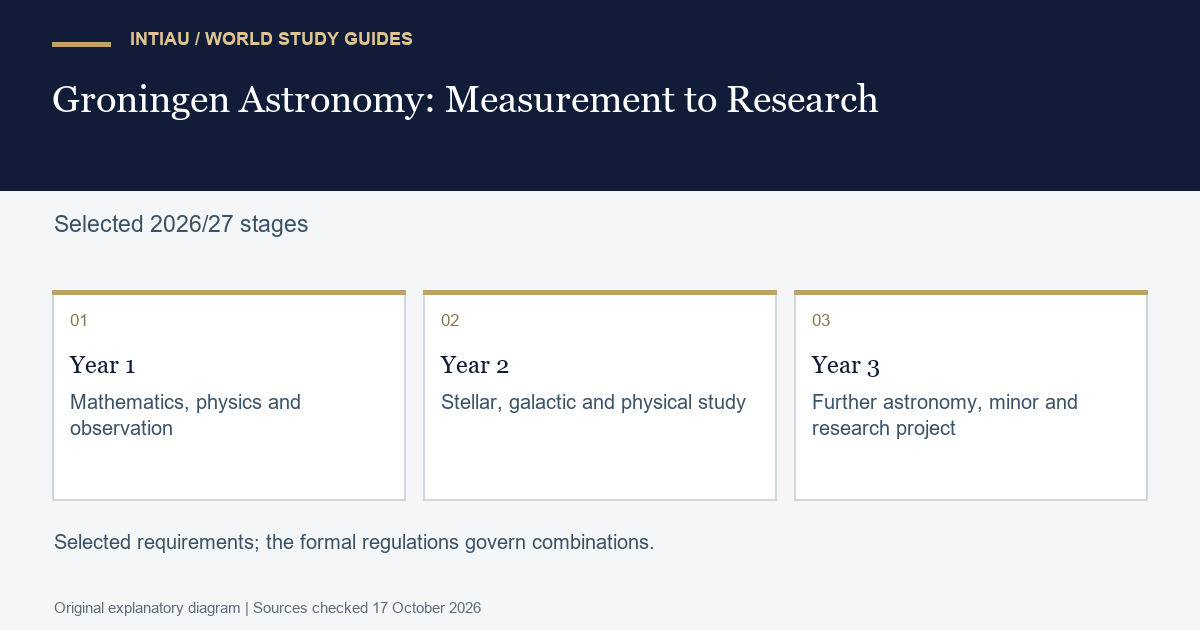
| Year | Examples |
|---|---|
| 1 | Calculus, physics, programming and Observational Astronomy. |
| 2 | Stars, galaxies, numerical methods and quantum physics. |
| 3 | Further astrophysics, minor and bachelor research project. |
Trace a dependency rather than just collecting subject names. A measurement needs quantitative interpretation, which may depend on a physical model, which in turn has limits. In your own comparison sheet, record where you would learn to identify those limits. Mark any assumed connection as your interpretation until a course description confirms it.
One actual observational course
The 2026/27 regulations list Observational Astronomy, WBAS015-05, as a five-ECTS first-year course. This verifies a real selected component, not an invented weekly syllabus. The regulations point to Ocasys and the assessment plan for detailed assessment information.
When an outline is unavailable, keep your question specific: what observations would students obtain, what calibration is required and how are uncertainties reported? A missing public detail is not evidence that the programme omits the activity. It is a reason to ask rather than infer a complete laboratory schedule from a title.
Original worked exercise: remove a background signal
This exercise is created for this guide, not assigned by Groningen. Work with simulated readings rather than directing an instrument at the sky. Imagine three recorded values for a source region: 120, 124 and 122 units. A nearby background region gives 20, 22 and 21 units. Their averages are 122 and 21.
Under a deliberately simplified model with comparable areas and exposures, subtracting the background average gives a net value of 101 units. Write the assumptions beside the calculation. The subtraction does not by itself establish the distance, identity or physical nature of a real object. It is only an accounting step within this fictional model.
Now change the situation: the background region covers twice the area of the source region. Ask whether the original subtraction is still appropriate. If the background is uniform in the invented example, the relevant contribution would be half the recorded background value. Explain why a measurement’s definition matters before adding more decimal places to a result.
Create a second possible problem: one exposure lasted longer than the others. Decide what information you would need to compare rates rather than totals. Keep the original record visible and show every transformation. Silently replacing a value makes it harder for another reader to distinguish a correction from a preferred interpretation.
Finish with the raw values, the model assumptions and two questions that the calculation leaves unanswered. Ask a peer to reproduce the result and challenge the uniform-background assumption. The output is a transparent reasoning record, not an astronomical discovery or a validated data-reduction procedure.
Keep the application sequence separate
For applicants with non-Dutch qualifications, Groningen’s registration guidance distinguishes application, admission and final enrolment. Begin in Studielink and complete the required submission in the Progress Portal. The university assesses the educational background and any subject-specific conditions.
Check your mathematics, physics and English evidence against the route for your actual diploma. This guide checked its links on 17 October 2026. Keep a future entry calendar separate from the 2026/27 curriculum used above, and verify the applicable deadline before submitting. A complete document set and a preferred research topic answer different questions.
When comparing another astronomy degree, retain one concrete question about preparation and another about later independent work. A clear gap in your current knowledge can be a planning task; it is not automatically proof that a programme is unsuitable or that admission is assured.
Frequently asked questions
Is the bachelor taught in English?
Yes. The programme page identifies English.
Is WBAS015-05 a real first-year component?
Yes. It appears in the 2026/27 regulations.
Does Studielink alone complete the international application?
No. Follow the Progress Portal instructions too.
See INTIAU’s own Courses and Contact information. Groningen makes its own admission and academic decisions.
Related guides
View the study diagram