Harvard University is an institution separate from INTIAU; the Economics A.B. described here is Harvard’s programme, with no INTIAU offering or partnership implied. Harvard presents the concentration as a liberal arts education rather than professional training for a particular occupation. The official concentrator guide is the starting reference.
A useful way to read this degree is to ask what kind of explanation you want to build. Are you interested in how incentives influence a decision, why an economy changes over time, or whether an observed policy actually caused a result? Those questions can overlap, but they require different habits of reasoning. Comparing them is more revealing than choosing a degree from an attractive job title alone.
How the concentration fits together
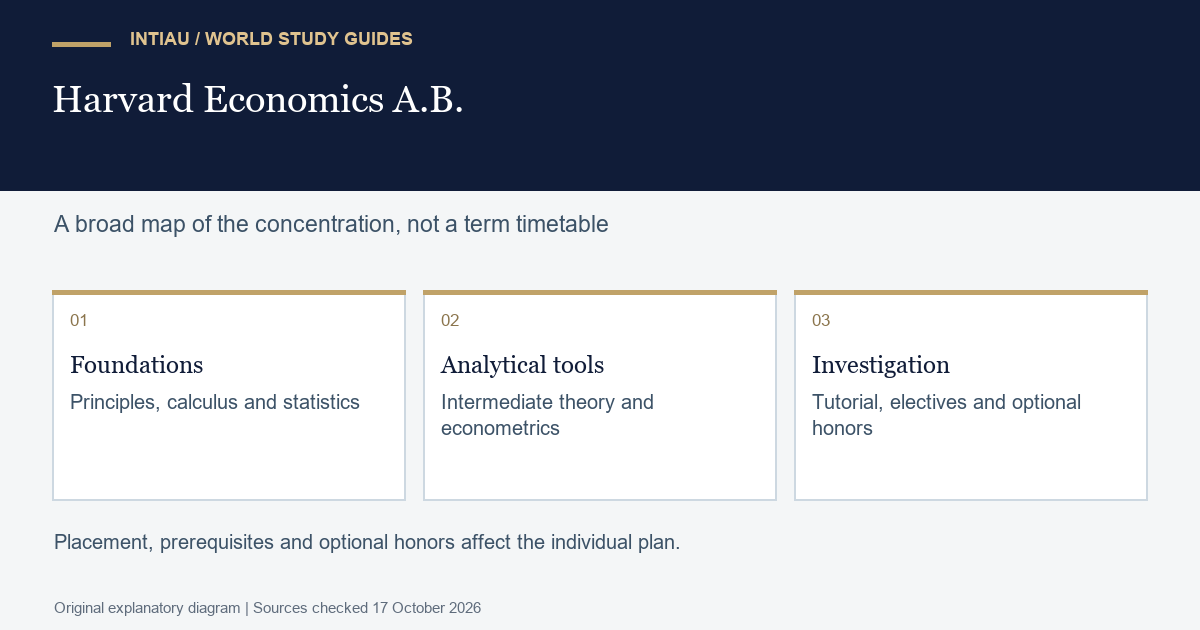
The following map condenses the current concentration requirements. It groups requirements by purpose; it is not a prescribed semester schedule.
| Component | Published content |
|---|---|
| Preparation | Math 1A or equivalent; EC 10A and 10B; an approved statistics course |
| Theory | Intermediate microeconomics and macroeconomics through 1010 or 1011 alternatives |
| Methods and discussion | ECON 970 tutorial; ECON 1123 or 1126 econometrics |
| Further study | Three economics electives, including one requiring intermediate theory |
Harvard’s February 2026 advising overview explains why introductory statistics belongs early in planning: students need it before the sophomore tutorial and econometrics. The overview also introduces intermediate theory as preparation for more advanced economic applications.
From fall 2026, for concentrators graduating in February 2027 or later, a designated writing elective is no longer compulsory. This change does not remove writing from ECON 970.
Placement and approved equivalents can change an individual’s plan, so a course list should not be treated as a personal credit audit. The guide also discusses optional honors study, including a thesis route. Read that choice in the context of the wider concentration rather than assuming that every student writes a thesis.
A real course example to inspect
The spring 2027 ECON 50 catalogue entry, Using Big Data to Solve Economic and Social Problems, links policy questions to regression, causal inference and machine learning. It states that prior economics or statistics coursework is not required and that labs use R/RStudio. This is a specific advertised course example, not an invented module outline.
For a public syllabus and teaching materials, the instructors’ Harvard-based Opportunity Insights course archive is useful. It explicitly describes its spring 2019 version. Treat those materials as a historical example of teaching and methods, rather than the definitive spring 2027 syllabus.
Try a study comparison exercise
This is an original reading exercise, not a Harvard assignment. Imagine a city considering a cheaper bus fare. Write two questions on separate cards. On the first, ask how a lower price might change the choices of existing passengers and people who currently travel another way. State your assumptions about time, convenience and crowding. On the second, ask what evidence would let you judge whether the fare change increased access to work.
Now draw a simple before-and-after comparison. Add a warning beside it: other things may have changed at the same time. Propose one comparison group and explain why it might still differ from the people affected by the new fare. Do not invent numerical results. Finish with two sentences describing which part you enjoyed more: building the incentive argument or checking the evidence. Keep both cards when comparing economics with a more narrowly vocational course.
Undergraduate application route
Application instructions checked on 17 October 2026 direct both international and U.S. first-year candidates to the Common Application with Harvard’s required supplements. The first-year admissions page currently lists 1 November for Restrictive Early Action and 1 January for Regular Decision. Confirm the cycle, restrictions and supporting-document instructions before submitting.
Students apply to Harvard College; economics is not a separate departmental first-year application. Harvard’s College FAQ places concentration declaration midway through sophomore year.
Questions readers often ask
Should I send a first-year application to the Economics Department?
No. Use Harvard College’s undergraduate application process; concentration declaration comes later.
Is a designated writing elective still compulsory?
Not for the cohort covered by the fall 2026 change; ECON 970 still includes writing.
Does the current ECON 50 listing require previous economics?
No. Its spring 2027 description says prior economics or statistics coursework is unnecessary.
For INTIAU’s own information, visit INTIAU Courses or INTIAU Contact.
Related guides
View the curriculum diagram