Heidelberg University is a German institution separate from INTIAU. Its Molecular Biotechnology BSc is a six-semester, German-taught programme beginning in winter.
The faculty overview identifies Heidelberg’s Institute of Pharmacy and Molecular Biotechnology as the organising institute. Check individual class locations through the university rather than assuming all teaching occupies one building.
A useful biotechnology comparison asks how a biological question becomes a measurable one. A list of molecular topics does not explain what an observation can establish, how a dataset is organised or which alternative explanation remains possible. Start with one question about a living system, then write down the mathematical and chemical understanding you would need to interpret its evidence.
Read the handbook’s edition, not its filename
The linked handbook is internally dated September 2024; its filename does not determine the edition.
| Stage | Published components |
|---|---|
| Foundations | Biology, chemistry, physics, mathematics and introductory bioinformatics |
| Advanced study | Bioinformatics, biophysical chemistry and drug-research components |
| Final stage | A selected focus and bachelor thesis |
Einführung in die Bioinformatik includes statistical data analysis, image analysis and project work. This is a selected example.
Keep three columns in a comparison notebook: scientific concept, kind of evidence and interpretation problem. A subject can contribute to several columns, but a course title does not prove that every technique you have encountered online is taught. Record the stated scope before adding your own interests. This makes it easier to formulate a specific question about a module instead of asking whether the degree is broadly “research based”.
Worked exercise: compare sequence proportions
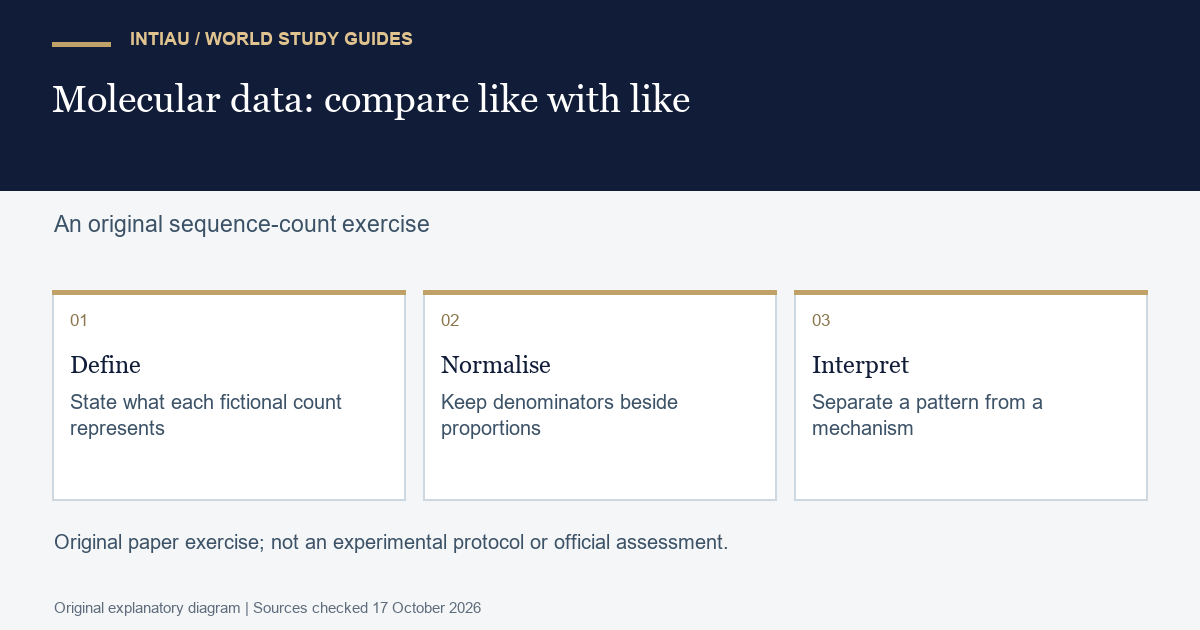
This exercise uses invented sequence labels and contains no biological records or laboratory procedure. A fictional dataset A contains 100 short strings, of which 20 have a label called M. Dataset B contains 200 strings, of which 30 have M. B contains more M-labelled strings, but its proportion is lower: 30 divided by 200 is 15 percent, compared with 20 percent in A.
Write both observations without choosing one as the only meaningful result. The count could matter for the total number available for a later fictional task; the proportion could matter for the composition of the dataset. The question determines which comparison is relevant. Saying that M is “more common” without naming the denominator leaves that question unresolved.
Now suppose the label is assigned by a simple rule: a string contains the pattern AB. The string ABAB contains two occurrences but is still only one string containing the pattern. If the first sheet counts matching strings and the second counts occurrences, dividing by the number of strings does not repair the mismatch. Define the counted event before calculating a percentage.
Make a tiny check sheet with four original strings: AB, BA, ABAB and CCCC. Three occurrences of AB appear across the sheet, while two of the four strings contain it. The occurrence count is three; the fraction of strings containing the pattern is one half. Both calculations are reproducible, but they summarise different quantities.
Add one further limitation: the rule says nothing about why the pattern occurs or what it would do in a real system. A numerical difference cannot establish a molecular mechanism. Write a conclusion stating the defined counting rule, the comparison and the missing explanation. This is an exercise in careful interpretation, not a discovery about actual DNA, proteins or disease.
For a final comparison, ask a reader to reconstruct your result from the four strings without hearing your explanation. If the reader obtains a different answer, inspect the definition and counting convention before treating the disagreement as an arithmetic error. The resulting revision log can reveal whether you enjoy the precise data reasoning that you want to investigate in a curriculum.
Retain the original strings beside every derived total. If you change the matching rule, recompute the count from that source sheet rather than editing the final percentage by intuition. A visible chain from definition to input to result makes a small analysis inspectable and helps expose an accidental change of question.
Application route and language boundary
The programme uses an admission-restricted dialogue-oriented procedure and directs applicants through its subject-selection application tool. Follow the profile-specific instructions and current language evidence requirements. Checked on 17 October 2026, this guide does not supply an unconfirmed 2027 deadline.
Prepare separate records for entry eligibility and programme comparison. An interesting module does not establish that a particular school qualification meets admission requirements, and a deadline does not establish that every required document has been accepted.
Three programme questions
Is this an English-taught BSc?
No. German is the listed teaching language.
Is the handbook edition inferred from its URL?
No. The internal September 2024 date is retained.
Does the string exercise establish a biological mechanism?
No. It compares explicitly defined fictional counts.
For INTIAU’s separate information, visit Courses or Contact.
Related guides
View the study diagram