Sorbonne University is a French institution separate from INTIAU. Its Licence Sciences de la vie includes a single-discipline pathway and distinct combinations with other subjects. This guide follows the single-discipline life-sciences route.
The SVCST first-year portal combines life sciences, chemistry and Earth sciences with mathematics. It includes initial integration followed by pre-orientation choices. The faculty is based at 4 place Jussieu in Paris; check actual teaching venues and the chosen route rather than assuming every activity has one location.
For a curriculum comparison, choose a biological question before listing techniques. Ask how you would define an observation, which quantity would be measured and how a numerical result would relate to the question. A method is useful because of the evidence it can provide, not simply because programming or laboratory work appears in a degree title.
From portal to life-sciences choices
| Stage | Published emphasis |
|---|---|
| L2 | Common life-sciences major, with complementary components |
| L3 | MOrga: molecule to organism; or OBEE: organisms, biodiversity, ecology and evolution |
The linked 2025 L2 outline identifies UL2SV418, Informatique et Statistiques, as a six-ECTS L2S4 module taught in French. It introduces Python-based problem solving and statistical reasoning for biological observations, including sampling and data representation. This is one selected outline, not a full licence syllabus.
Keep the portal, later pathway and individual module at different levels in your notes. A module description can explain an approach to data without deciding which later biological emphasis is right for you. Likewise, a pathway name cannot establish that every optional component is available to every student in every year.
Worked exercise: nine readings are not nine containers
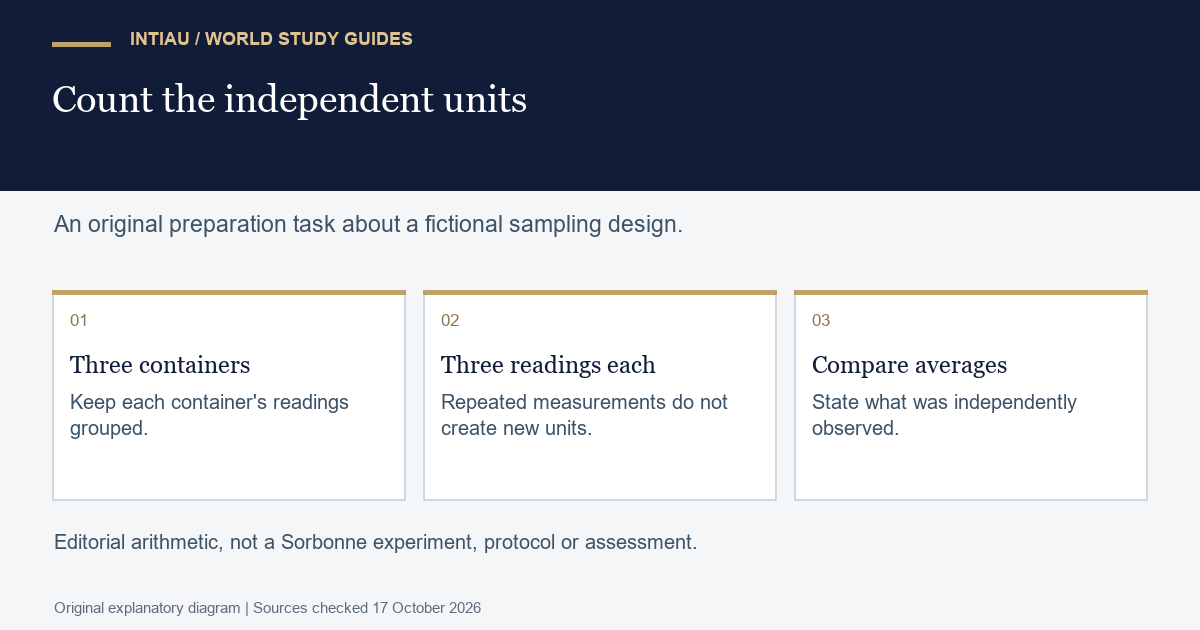
Consider three imaginary containers, each measured three times. Container A gives readings 9, 10 and 11; B gives 19, 20 and 21; C gives 29, 30 and 31. The readings are abstract units, with no organisms, chemicals or real experiments involved. Calculate a mean for each container and then describe what a pooled mean would represent.
A’s mean is 10, B’s is 20 and C’s is 30. The nine readings sum to 180, so the pooled mean is 20. The mean of the three container means is also20 because each container has the same number of readings. That numerical agreement does not make the three observations within one container independent containers.
Now imagine a labelling change: retain all three readings for A and B, but keep only C’s first reading, 29. The seven retained readings total 119, giving a pooled mean of 17. The three available container means are 10, 20 and 29; their equally weighted mean is 59 divided by 3, about 19.67. The answers differ because one method weights containers by the number of retained measurements.
Neither number is automatically the answer to every scientific question. If the aim is to summarise all recorded readings, the pooled mean describes those readings. If the aim is to give each container equal weight, averaging container summaries implements that choice. The report must state the intended unit and the effect of the changed recording pattern.
Draw three boxes and place each reading inside its own container. Below the boxes, show both calculations for the unequal-recording case. This small sketch prevents a list of numbers from obscuring their grouping. A later statistical analysis would need an appropriate model and study design; this task supplies neither a significance test nor a causal result.
Finish with two sentences: one numerical finding and one limitation. For example, the unequal-recording pooled mean is 17, while an equally weighted container summary is approximately 19.67. The hypothetical readings do not establish why containers differ or whether that difference generalises. Clear arithmetic and restrained interpretation belong together.
Language and application profile
The faculty’s French-language preparation page stresses written and spoken French and recommends B2 preparation. That recommendation is not a universal admission decision or an English-taught designation for the licence. An exhaustive language map for this licence was not verified here; confirm the language of the exact pathway with the faculty.
The first-year application page, updated 13 October 2026, separates procedures by applicant profile and links non-EU guidance. Its Parcoursup application dates are 19 January–12 March 2026, already past at this guide’s 17 October 2026 check. Use the route for your qualification and residence; no 2027 calendar is inferred here.
Prepare the administrative checklist before turning a subject preference into a final application choice. Keep qualification recognition, language evidence, entry level and curriculum edition separate. If a route-specific rule is unclear, refer the exact question to the faculty rather than extrapolating from another applicant’s category.
Three life-sciences questions
Is a single-discipline route the only published option?
No. The licence page also describes distinct combinations with other disciplines.
Is the selected informatics module explicitly English-taught?
No. The linked outline lists French.
Do nine repeated readings necessarily mean nine independent units?
No. In the exercise they are grouped within three containers.
For INTIAU information, use Courses or Contact.
Related guides
View the study diagram