The Indian Institute of Technology Delhi in India is independent of INTIAU. Its textile department is based at Hauz Khas, New Delhi. The department’s undergraduate overview describes a four-year, eight-semester BTech using the older title Textile Technology. The newer curriculum portal uses a different programme title and course-code framework. department overview
Use the correct curriculum framework
The institute labels its new curriculum portal “2025 onwards.” That cohort boundary matters when comparing it with older departmental course documents: an earlier code or credit count should not silently become a current requirement. curriculum edition
Programme TT1 is titled B.Tech. in Textile and Fibre Engineering. It requires 143 graded credits, with departmental core and elective study alongside basic sciences, general engineering, humanities and open-category work. Eight non-graded units are listed separately. Major Project-I is departmental core; Major Project-II appears among departmental electives. These categories should not be collapsed into a claim that both projects are compulsory for everyone. TT1 framework and full course list
When comparing programmes, place required and optional components in separate columns before counting attractive course names. A course’s presence in a catalogue does not establish that it is compulsory, available every term or appropriate without prerequisites. This is especially important when a programme has changed its structure.
A map of the published components
This table groups selected components by category. It does not reproduce a complete timetable.
| Area | Selected actual components | Comparison question |
|---|---|---|
| Supporting science and engineering | Calculus; chemistry and physics laboratories; programming; probability and statistics | Which model connects a material measurement with an engineering decision? |
| Departmental core | Structure and Properties of Fibres; yarn and fabric manufacture; preparation, colouration and finishing | How does processing change the property you need to explain? |
| Project and optional depth | Major Project-I; departmental electives, including Major Project-II | What is required, and what depends on a later choice? |
A real outline, with its older edition attached
The department still links a Course of Study 2020/21 extract. Its TXL211, Structure and Physical Properties of Fibres, covers molecular architecture, crystalline and amorphous structure, characterisation and mechanical, moisture, optical and thermal properties. This is an actual published course outline, inspected on the PDF’s first page. It is an older example, not a verified outline for the newer TXL1101 course with a different code and credit arrangement. The comparison shows why a similar title is insufficient evidence of identical content or prerequisites. Consult the applicable current course specification before relying on the older themes for registration or credit planning. dated departmental course extract
Admission and the campus distinction
IIT Delhi’s international undergraduate guidance identifies JEE Advanced as the admission route for its listed engineering programmes and links foreign-national eligibility information. It describes the four-year BTech separately from five-year dual degrees. Its older programme list retains Textile Technology wording, so the newer TT1 curriculum is the source used here for the current curriculum title. international undergraduate route
The current joining page is explicitly for the 2026/27 class and identifies JEE Advanced2026 among the entry routes. Its document-verification dates are past as of 17 October 2026. Joining instructions for admitted students are not a new application window, and this guide does not infer a 2027 schedule from them. 2026/27 joining guidance
The verified material concerns the Delhi department and curriculum, not an assumed programme at another campus. Confirm the intended entry year’s selection, qualification and teaching-language instructions directly; an English-language webpage or an English-learning component alone does not establish the language of every class.
Original exercise: intensity and total use
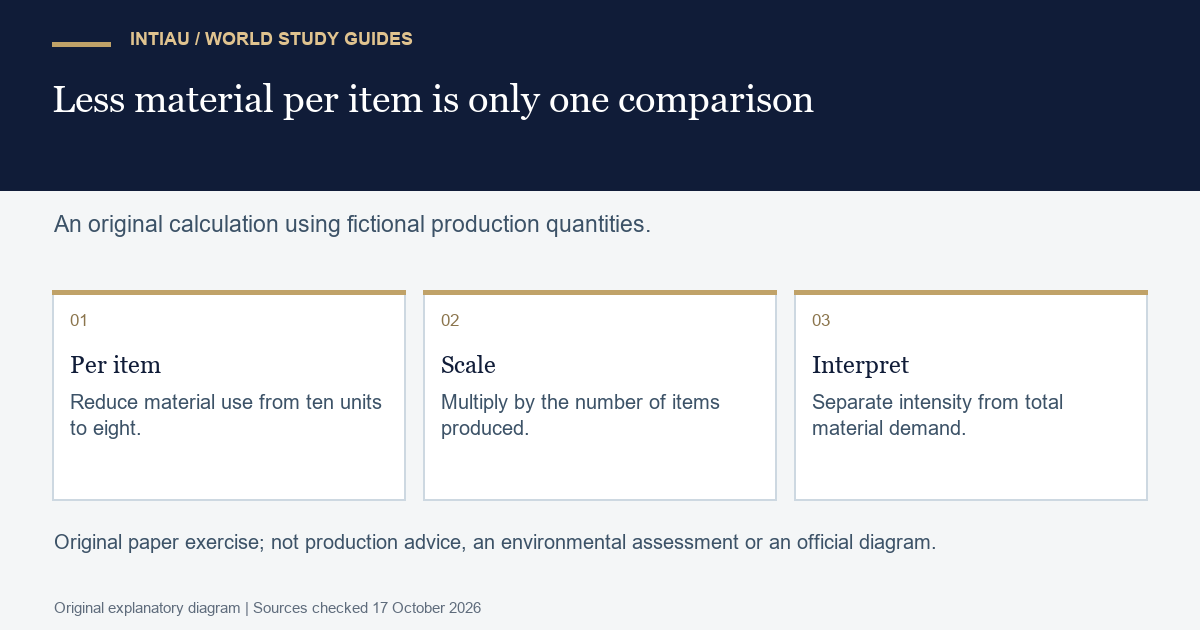
A fictional process uses ten units of material per item and makes 100 items, consuming 1,000 units. A revised process uses eight units per item but makes 150 items, consuming 1,200 units. Material intensity fell by 20%, while total use rose by 20%. Explain why both statements can be correct. Now calculate the greatest whole-number output at eight units per item that keeps total use at or below 1,000: 125 items. That arithmetic does not establish environmental superiority, because durability, rejected items, energy and the purpose of the output have not been specified. Write a comparison statement that identifies the functional unit and one missing factor. The example uses fictional quantities and is not a textile-production recommendation.
Three practical questions
Is the older course outline the new course’s verified syllabus?
No. The edition, code and scope are stated separately; equivalence is not inferred.
Are both listed major projects compulsory?
No. The portal places Project-I in core and Project-II among electives.
Does lower material use per item guarantee lower total use?
No. The original calculation shows why output volume must also be specified.
For INTIAU’s own information, see Courses and Contact.
Related guides
View the study diagram