Shanghai Jiao Tong University’s 材料科学与工程 undergraduate programme belongs to its School of Materials Science and Engineering, independently of INTIAU. This guide concerns the school’s regular materials programme, rather than combining it with an international pilot, a double-degree option or a minor.
Identify the route before reading the courses
The school’s programme and plan page links its 2022 training-plan document. It describes abilities in mathematical modelling, literature-based problem analysis, engineering design, experimentation and the responsible use of simulation tools. Environmental effects, safety and engineering judgement belong alongside technical analysis.
The linked plan is the place to check graduation categories for an individual cohort. Its downloadable Word file was not readable in this review, so no credit total or English award classification is inferred from it. Keep the Chinese programme title when asking the school which current plan and award wording apply.
Selected undergraduate subjects, with their source edition
The school’s English profile brochure, printed pages 09–10, separates undergraduate subjects from master’s and doctoral courses. The table below selects its fall and spring examples. The brochure is undated and does not establish a 2026 student’s complete compulsory sequence.
| Published grouping | Selected undergraduate subjects |
|---|---|
| Fall foundations | Fundamentals of Materials Science and Engineering-1; Physics of Materials |
| Fall practice | Mechanical Behavior of Materials; Materials Lab (1) |
| Spring foundations | Fundamentals of Materials Science and Engineering-2; Thermodynamics of Materials |
| Spring analysis and practice | Structural and Chemical Characterization of Materials; Materials Lab (2) |
Read the groupings as a connection between concepts, measurement and interpretation. A laboratory name alone tells you little about the instruments, assessment or supervision. Those questions require the current course brief, not an extrapolation from a brochure.
A real course connects processing to performance
The official Fundamentals of Materials Science course entry examines relationships among processing, structure, properties and performance in metals, ceramics and polymers. Its second part, MSE 2606, includes diffusion, phase diagrams and phase transformations. The listed learning formats include lectures, discussion, tutorials, laboratory work and cases, with calculus and college physics as prerequisites.
That entry describes an English-language undergraduate offering through a virtual-exchange platform. It supports the selected learning themes here; it does not establish an entirely English-taught degree or a place in a particular 2026 class.
Original exercise: compare two fictional specimens
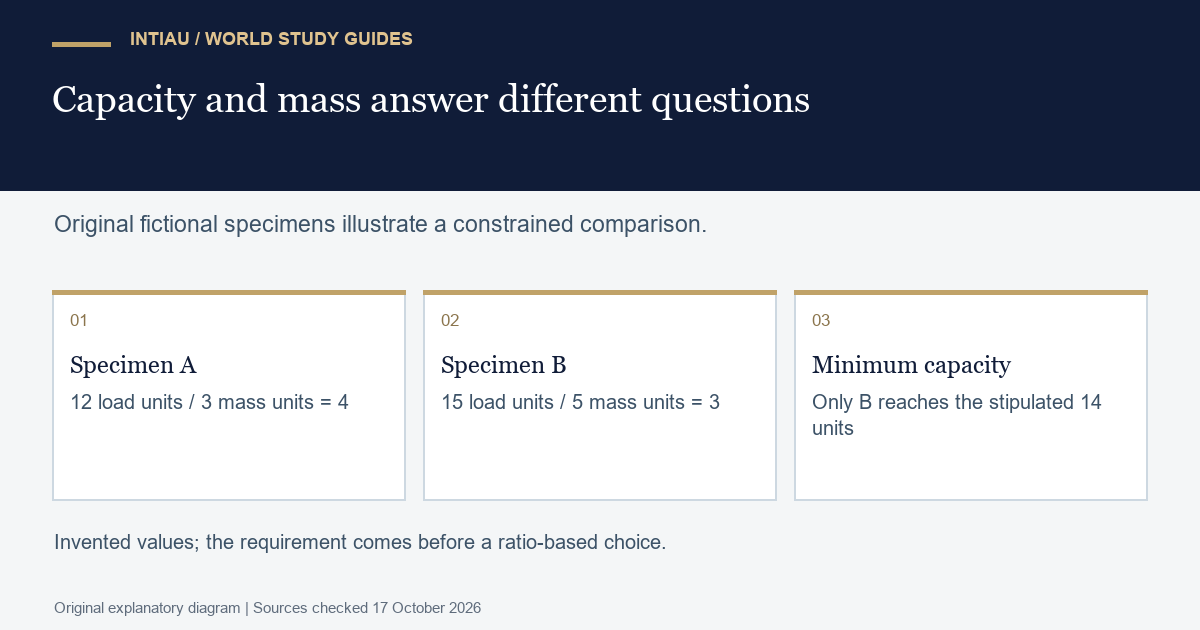
Suppose a fictional brief supplies two specimens with the same dimensions. A carries 12 arbitrary load units and has mass 3 units; B carries 15 and has mass 5. Their load-to-mass ratios are 4 and 3. B carries more total load, while A has the larger ratio. Neither calculation tells you the failure mechanism.
Now add a constraint requiring at least 14 load units. B meets it and A does not. Write the design requirement before selecting a material: optimising a ratio cannot override a minimum capacity. List the missing evidence you would request next, such as test conditions, repeated measurements and how the specimens were processed.
Finish with a three-column note: supplied observation, calculation and unanswered question. Use only these invented values; this is a reading exercise, not a specimen test or an SJTU assignment.
Applicant route and date check
The 2026 Chinese-taught international undergraduate guide requires a high-school qualification, eligible foreign nationality, academic evidence and language evidence. It includes CSCA requirements and programme-specific subjects. Its regular application round ended on 10 March 2026; that window is past as of 17 October. Consult the programme list and the next official cycle before planning an application.
Compare broader subjects through Courses, or use Contact for an INTIAU enquiry. SJTU determines its own admissions and academic requirements.
Questions readers ask
Is the brochure a current graduation checklist?
No. It is an undated selection of subjects, not a verified cohort-specific credit audit.
Does one English course establish the degree language?
No. The course entry describes that offering, not the instruction language of every programme requirement.
Is the cited 2026 application window still open?
No. The regular round ended in March 2026. A future application needs its own published notice.
Official sources checked 17 October 2026 are linked beside the relevant claims.
Related guides
View the study diagram