KAIST is a separate institution; its Industrial Design undergraduate pathway is not an INTIAU programme or partnership. The College of Engineering lists Industrial Design within its B.S. undergraduate classification.
The official undergraduate overview connects product and digital-media projects with engineering, technology and human behaviour. The department is based in Daejeon.
Design comparison becomes more useful when you define the interaction you want to improve. Choose an everyday situation in which someone must understand a device, recover from an error or coordinate with another person. Write the difficulty without naming a solution. Then use the curriculum to ask how your assumptions could be investigated, represented and tested.
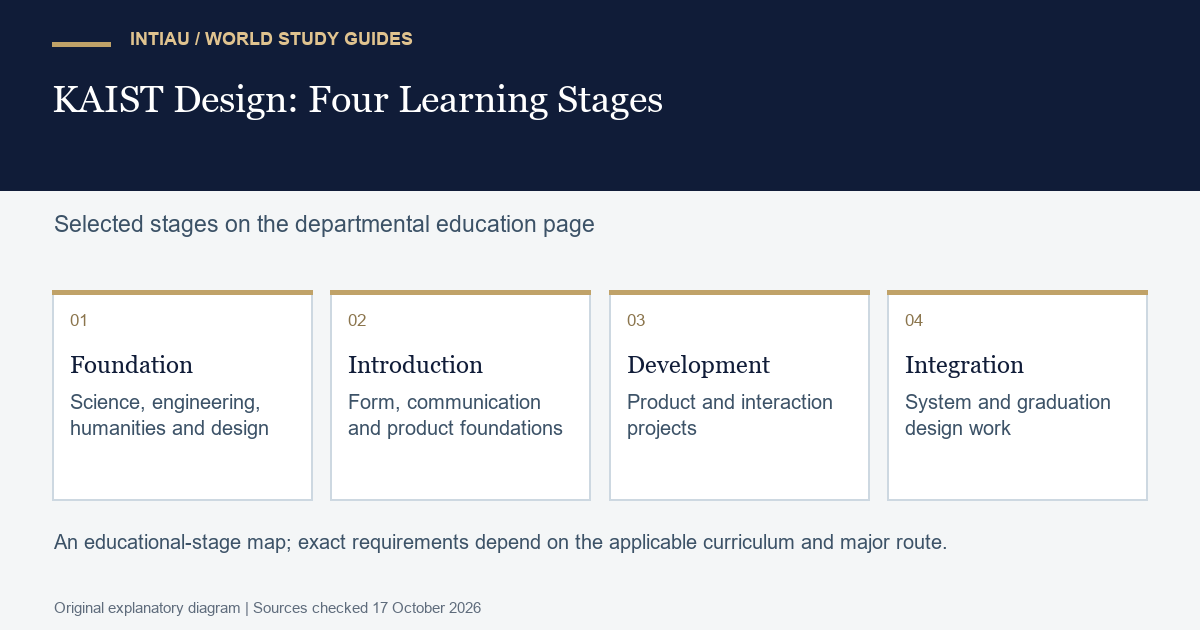
Read the department’s four learning stages
| Stage | Selected official components |
|---|---|
| Freshman foundation | ID201 Introduction to Design; ID202 Idea & Expression. |
| Sophomore introduction | ID213 Product Design; ID220 Interaction Prototyping. |
| Junior development | ID301 Interactive Product Design; ID304 User Experience Design. |
| Senior integration | ID403 System Design; ID409 and ID414 Graduation Design Studios. |
Treat the stages as a way to inspect development, not a promise that every listed course runs in an identical form every year. In your notes, distinguish representing an idea from testing an interaction and integrating a complex project. An attractive portfolio example may demonstrate a possibility; it does not establish the compulsory requirements for your own major route.
Use a course example without inventing its assessment
The linked departmental map supplies real course examples for comparison. Choose one of the interaction courses in the table and write three questions to resolve from the relevant syllabus: what users or situations are investigated, what is prototyped and what counts as evidence of improvement? The public map alone does not justify an invented weekly schedule or assessment weighting.
A useful reading record has three columns: confirmed course title, published description available and question still open. Leave the middle column blank where the source gives only a title. This makes a limited but accurate comparison stronger than a detailed account built from assumptions about what a design course ought to teach.
Practical exercise: compare two recovery paths
Invent a simple ticket machine used by someone who selects the wrong destination. Sketch two paper interfaces for recovering from that mistake. In the first, offer a clear backward step. In the second, show a summary before confirmation. State the situation, the user’s goal and the information they need at each point; do not assume everyone reads the same language or recognises the same symbol.
Ask a peer to talk through the sketches without coaching. Record where they hesitate, what they expect a button to do and whether they know that the mistake has been corrected. Use fictional journeys and no personal data. Avoid describing one successful walkthrough as proof of universal usability: a single participant can expose a problem without establishing how common it is.
Revise one version and document the change. Your output is a short interaction sequence, a test note and a statement of the limits of the evidence. Include an alternative interpretation of the hesitation you observed. This original preparation exercise is not an admissions portfolio rule, a KAIST assignment or a substitute for an actual course syllabus.
Separate admission from the choice of major
KAIST’s international admissions guidance states that freshmen enter with an undeclared major and choose after the second semester. Its 2027 eligibility page sets different high-school completion dates for Spring and Fall entry and requires applicants to meet the international-citizenship conditions.
Checked on 17 October 2026, the 2027 calendar gives 22 October 2026 at 6pm KST for Early application and document submission, and 14 January 2027 at 6pm KST for Regular Fall applications. Recommendation letters have separately listed deadlines.
Create one checklist for admission and another for exploring the major. Record the precise track before copying a date. Then check whether the document, recommendation and interview instructions apply to that track. The department’s educational map is useful for deciding what to explore; it does not replace the current university application guide or formal curriculum requirements.
Three pathway questions
Do international freshmen enter directly into this major?
No. KAIST describes an undeclared freshman year followed by major choice.
Is the table a newly published 2027 syllabus?
No. It selects examples from the current departmental education map.
What should a prototype comparison record?
The user’s goal, observed difficulty, revision and limits of the test, rather than an unsupported claim that one interface is best.
Official source trail
- College undergraduate classification
- Industrial Design education map
- Industrial Design undergraduate overview
- International undergraduate eligibility
- International application calendar
For INTIAU information, visit INTIAU Courses or INTIAU Contact. These links do not submit an application to the separate institution discussed above.
Related guides
View the curriculum diagram