The University of New South Wales is a separate institution; its Bachelor of Design is not an INTIAU programme or partnership. Program 4825 offers Computational Design, Industrial Design and Integrated Design specialisations.
A useful comparison begins with what you want to learn to change. Are you interested in an object, an interaction, a visual system or the rules behind a digital model? Write one sentence describing that interest before reading course titles. Keep it provisional: an undergraduate design education should also expose the limits of your first preferred approach.
Follow a sequence rather than collect attractive titles
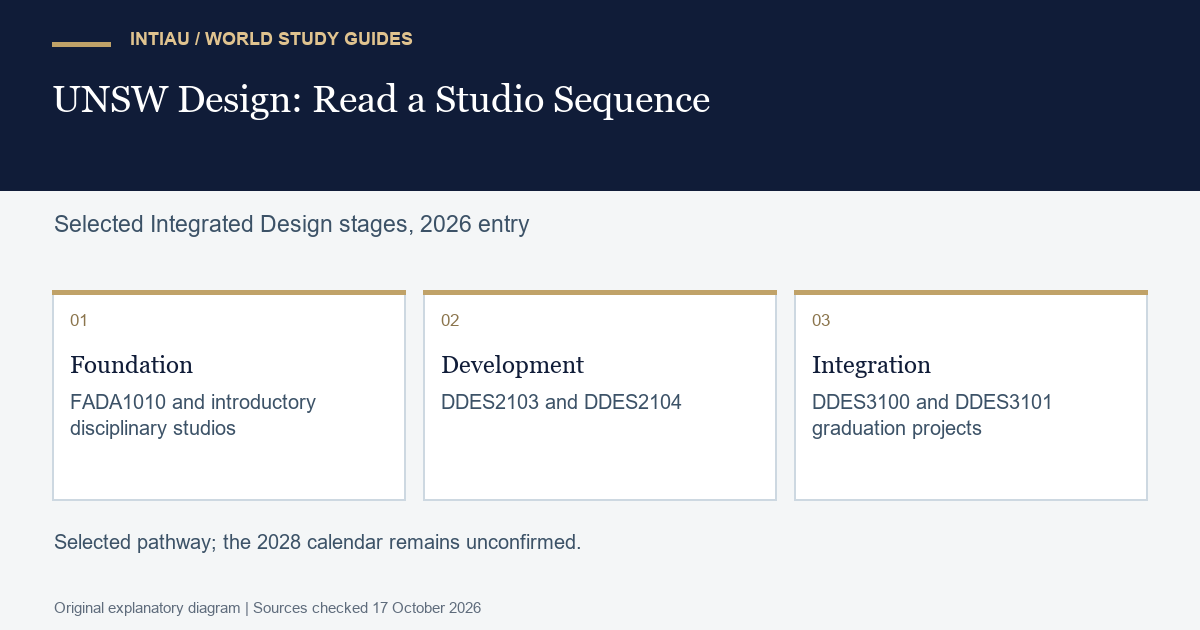
The Term 1 2026 map supplies this Integrated Design illustration, not a new 2027 timetable.
| Stage | Selected official components |
|---|---|
| Year 1 | FADA1010 Design Collaboration Studio 1; DDES1101 Design and Identity. |
| Year 2 | DDES2103 Design and Empathy; DDES2104 Design and Society. |
| Year 3 | DDES3100 and DDES3101 graduation projects; 2028 calendar unconfirmed. |
Read this as a dependency story. In your notes, separate the ability to produce a convincing artefact from the ability to explain whose problem it addresses. A comparison sheet should show where you would practise each ability, where feedback enters and what later work depends on. Do not assume two programmes are equivalent because both use the word studio.
Inspect one real course entry
DDES1101 Studio 2: Design and Identity is listed at Paddington in the 2026 timetable. The timetable warns that offerings can change and that the course outline takes precedence where activity descriptions differ.
For any selected studio, look for the problem brief, process documentation, critique opportunities and assessment criteria in the relevant outline. Record information that remains unavailable instead of filling the gap with an assumption. Timetable hours describe scheduled activity; they do not by themselves explain the time needed to research, make, revise or document a project.
Practical exercise: a brief that survives disagreement
Use a fictional shared kitchen where six residents repeatedly misplace reusable containers. Spend ten minutes defining the problem without proposing an app, label or storage product. Identify three possible users with different needs: the resident in a hurry, the person who cleans and the person who cannot reach high shelves. List one observation that could challenge each initial assumption.
Draw three different interventions on plain paper. For each, write the action a user must take, the material or information required and one likely failure. Choose a version using explicit criteria: accessibility, cleaning effort, reversibility and ease of understanding. Give each criterion a reason rather than inventing a precise score that your evidence cannot justify.
Now ask a peer to explain the proposal back to you. Record one misunderstanding and revise the drawing. Your output is a one-page decision record containing the original brief, rejected alternatives, a changed prototype and a short account of the evidence behind the change. This is an independent preparation exercise, not a university assignment or portfolio specification.
Check the application route and the calendar
Checked on 17 October 2026, applications for all 2027 intakes are open. The page links domestic UAC and international routes and warns about duration changes around the 2028 Flex-Semester calendar.
Before applying, record your qualification, applicant category and intended starting term. Open the route linked for that category, then compare academic and English requirements with your actual evidence. Keep a separate list of curriculum questions, such as studio availability, so an admissions answer is not mistaken for confirmation of a future enrolment plan.
Questions to close before choosing
Is this one fixed specialisation?
No. The course page identifies three specialisations; the table above selects Integrated Design.
Is the table a confirmed 2027 entrant plan?
No. It uses the Term 1 2026 commencing-student map.
What should my comparison produce?
A sourced sequence of learning decisions, an independently tested brief and a short list of questions that need an official answer.
Official source trail
For INTIAU information, visit INTIAU Courses or INTIAU Contact. These links do not submit an application to the separate institution discussed above.
Related guides
View the curriculum diagram