Karlsruhe Institute of Technology is a German institution separate from INTIAU. Its Maschinenbau BSc is German-taught, normally six semesters and 180 ECTS. This guide concerns that Karlsruhe programme, rather than the separately listed Mechanical Engineering International degree.
Mechanical-engineering comparisons become more useful when a proposed object is followed through several questions: what should it do, what behaviour is assumed, how might it be made, and what evidence would verify the result? A subject list supplies possible tools, but the order and limits of their use still matter. Choose a simple imagined object before comparing specialist options.
Foundation, direction and practical work
The faculty programme page places broad foundations in the first four semesters before later specialisation.
| Stage | Selected emphasis |
|---|---|
| Foundations | Mathematical, scientific and engineering subjects |
| Later direction | Options including applied materials, computational engineering and sustainable energy |
| Practical and final work | Advanced practical placement, project work and bachelor thesis |
The SPO 2023 handbook for winter 2026/27, dated 21 August 2026, includes Fertigungstechnik und Werkstoffkunde. This 15-credit module connects materials structure and properties with manufacturing-process selection and includes a materials practical component. Its learning aims include explaining process characteristics and arranging suitable processes into a production sequence. This is a short example, not the full syllabus.
Read the official component requirements before assuming that all manufacturing knowledge belongs to a single class. When comparing curricula, separate a materials property, a process choice and the measurement used to check a finished result. They may be related without being interchangeable. Keep practical placement requirements distinct from an informal personal project.
Worked exercise: compare two invented sequences
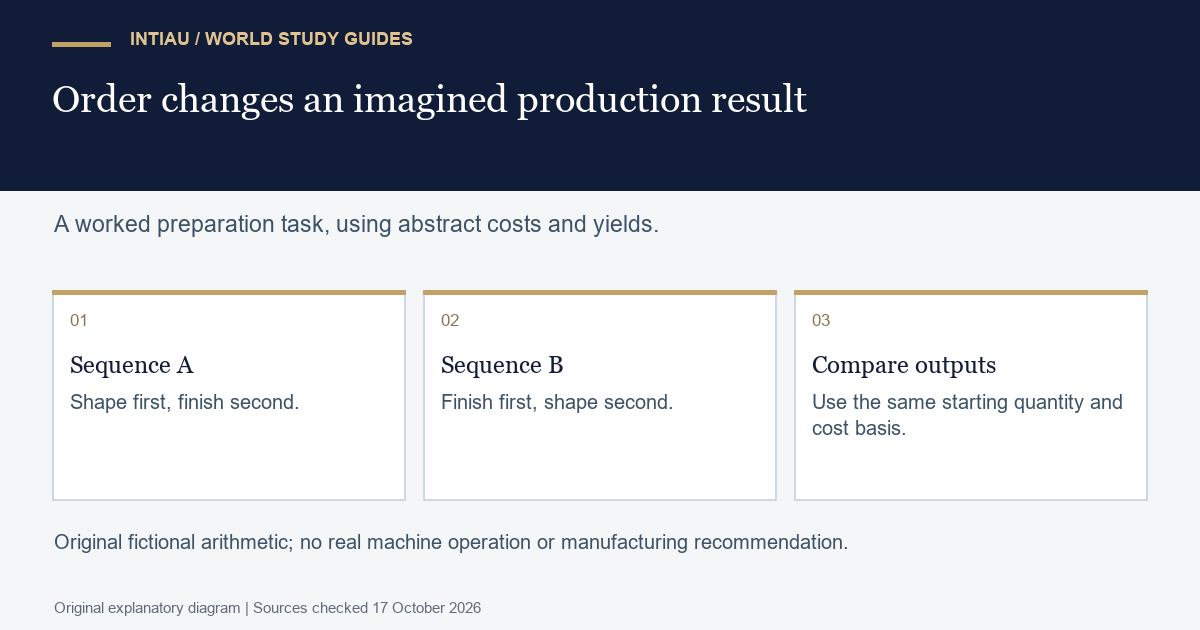
Suppose a fictional production exercise starts with 100 identical blanks. Sequence A shapes all blanks and then finishes the surviving items. Shaping costs two units per blank and retains 90% of them; finishing costs one unit per surviving item and retains 80%. Sequence B finishes first and then shapes, with the same step costs and retention percentages. These are invented abstract values, not operating instructions.
In sequence A, shaping costs 200 and leaves 90 items. Finishing those 90 costs 90 and leaves 72. Total cost is 290, and cost per retained item is 290 divided by 72, about 4.03 units. Keep the intermediate quantity visible, because finishing is charged only for the items reaching that step.
In sequence B, finishing 100 items costs 100 and leaves 80. Shaping those 80 costs 160 and leaves 72. Total cost is 260, or approximately 3.61 per retained item. The final quantity is the same because 0.9 times 0.8 equals 0.8 times 0.9. The cost differs because the more expensive shaping step is applied to fewer items in sequence B.
Under this deliberately simplified model, B costs 30 fewer units for the same retained quantity. That is the complete arithmetic conclusion. It is not a recommendation to finish before shaping in a real process. The model assumes the retention rates remain unchanged by order, that costs are proportional to item counts and that the finished item has identical acceptable properties in both cases.
Challenge one assumption. If shaping after finishing destroys the required surface, the two outputs are no longer equivalent, even if the numerical retention counts match. A cost calculation cannot repair a missing functional requirement. Likewise, a fixed setup cost could change the comparison for a smaller batch; it would need an explicit additional term.
Prepare a two-column worksheet with each starting quantity, intermediate quantity, step cost and final quantity. Add a final line stating which quality requirement the arithmetic leaves untested. Ask another reader to reproduce the totals. This exercise tests whether you enjoy tracing a system through stages and checking its assumptions, without using machinery or handling materials.
Application route and language
The faculty application gateway links the KIT application portal and separate bachelor guidance. Follow the bachelor route and the instructions for your qualification category; master entrance-test information on the same page is a different process.
The degree overview specifies German knowledge at C1. Recognition of an entrance qualification and applicable language evidence must be checked with KIT. This guide was checked on 17 October 2026 and does not turn the page’s annually presented dates into a confirmed 2027 calendar.
When building a shortlist, record the exact degree title beside the teaching language. Similar English translations can conceal different admissions and curriculum arrangements. Save the applicable handbook edition and ask a focused question if a rule or practical requirement remains unclear.
Three engineering questions
Is this the same listing as Mechanical Engineering International?
No. KIT lists that as a separate programme; this guide concerns German-language Maschinenbau.
Which handbook edition supports the module example?
The winter 2026/27 SPO 2023 handbook, dated 21August 2026.
Does the cheaper fictional sequence establish a real process choice?
No. It depends on assumptions about costs, retention and equivalent output quality.
For INTIAU information, use Courses or Contact.
Related guides
View the study diagram