RWTH Aachen University is a German institution separate from INTIAU. Its Civil Engineering BSc in Aachen is German-taught, normally six semesters and 180 ECTS.
A useful civil-engineering comparison connects a physical representation with the decision it can support. A drawing, a numerical balance and an account of materials answer different questions. Begin with one question you want to understand, then identify which scientific foundations would help you address it. Avoid treating a programme’s range of application areas as evidence that every student develops the same specialist profile.
Use the actual curriculum edition
The published plan valid from winter 2026/27 belongs to the 2020 examination-regulation framework.
| Component | Examples |
|---|---|
| Scientific foundations | Mathematics, mechanics, statistics and hydromechanics |
| Civil-engineering foundations | Materials, structures, geotechnics and planning |
| Later direction | Two complete specialisation directions, institute practice and thesis |
Baustoffkunde is a real named materials module in the plan. The source distinguishes compulsory and elective components; the table above does not reproduce every requirement or a full module syllabus.
The institute’s indexed teaching overview discusses materials properties, applications and durability, together with maintenance and repair. This is institute-level context. A current module-specific outline was not retrieved, so those themes are not presented as the verified 2026 syllabus or assessment of Baustoffkunde.
Compare a subject’s position as well as its name. A materials module and a structural calculation can concern the same imagined object while using different evidence. One asks about behaviour and properties; another asks how an idealised system carries a load. Neither description alone proves that a design is feasible. Keep the official module requirements beside your own interpretation of how the subjects connect.
Worked exercise: two balances, one simplified model
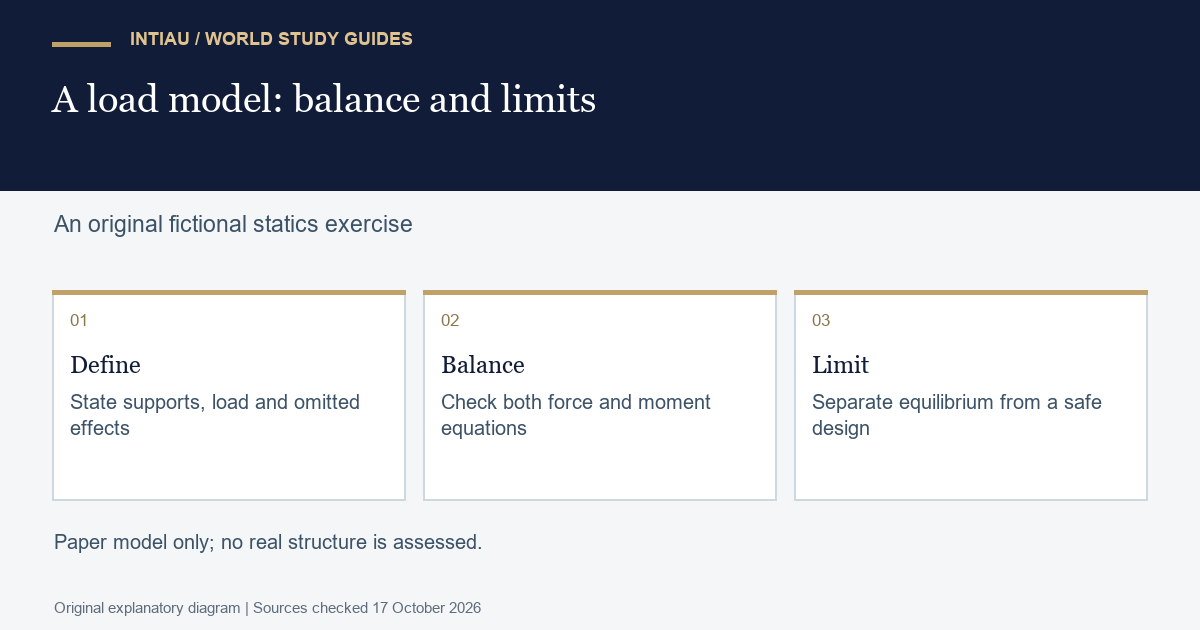
This original exercise uses an imaginary weightless bar and abstract units. Two supports, A and B, are ten distance units apart. A single downward load of six force units acts four distance units from A. Assume a static, planar model with upward reactions at both supports and no other forces. The task is to explain an idealised balance, not to assess a real structure.
Let the upward reactions be R_A and R_B. Force balance gives R_A + R_B = 6. Taking moments about A gives ten times R_B = six times four. Therefore R_B = 2.4, and R_A = 3.6. Check the force total: 3.6 + 2.4 = 6. Also check the moment statement using the distance measured from A rather than silently changing the reference point.
Now take moments about B as an independent arithmetic check. The load is six distance units from B, so ten times R_A = six times six. The result is R_A = 3.6 again. This second equation does not add a new physical effect; it tests whether the distances and signs used in the first calculation are consistent.
Move the same load to six distance units from A. Its moment about A becomes 36, so R_B becomes 3.6 and R_A becomes 2.4. The reactions exchange values. Explain why the support nearer the moved load carries the larger reaction under the stated model, rather than memorising the pair of answers without their geometry.
List what you have not calculated: deformation, internal stresses, connection behaviour, material deterioration or the capacity of either support. Equilibrium alone cannot answer those questions. A mathematically balanced model can omit the very effect that controls a real object’s behaviour. Adding an unsupported decimal place would not repair that omission.
Create a small output sheet containing both diagrams, the two force totals and the moment checks. Mark every assumption beside the drawing. Ask a reader to reproduce one result without an oral explanation. If the result differs, inspect units, distances and the chosen reference point before changing the numerical answer. Add a sentence explaining which observation would contradict the assumed model. For example, movement would conflict with its static assumption and require a different analysis. No construction, loading or physical testing is part of this exercise.
Application route and current instructions
Use the faculty’s bachelor application guidance and its linked university instructions for your applicant category. Application, German-language evidence and any required practical preparation must be checked together. This guide, checked on 17 October 2026, does not supply an unconfirmed future deadline.
Keep an entry checklist separate from the curriculum map. A subject that interests you does not establish recognition of a school qualification, while a completed application does not settle later option choices. Save the relevant cohort and regulation edition with each planning note.
Three civil-engineering questions
Is this the English-language title of an English-taught degree?
No. German is the programme’s listed teaching language.
Is the plan dated for a particular framework?
Yes. It is valid from winter 2026/27 under the 2020 framework.
Does the worked balance establish structural safety?
No. It solves only the explicitly simplified equilibrium model.
For INTIAU information, use Courses or Contact.
Related guides
View the study diagram