Leiden University is separate from INTIAU; International Studies is its Bachelor of Arts. The English-taught, three-year programme is based in The Hague, not the city of Leiden.
A useful international-studies comparison begins with a defined place and question. Knowing many events is different from explaining a particular change. Ask what local context contributes, what a wider comparison adds and which words may carry different meanings across settings. These questions make a regional interest more precise without pretending that one region is internally uniform.
Read regional and disciplinary study together
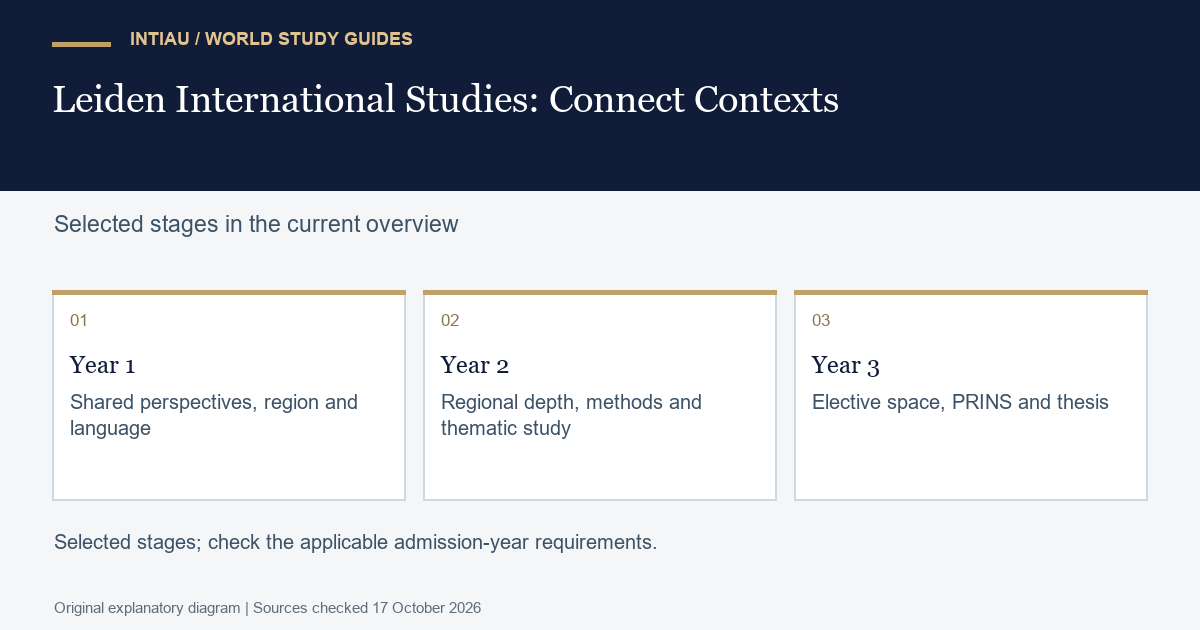
| Year | Selected components |
|---|---|
| 1 | Shared disciplinary foundations, regional history and culture, language study. |
| 2 | Regional depth, research methods and thematic seminars. |
| 3 | Elective space, Practising International Studies and thesis. |
The overview describes a choice among eight regions. This selected map is not a complete syllabus or a promise that every individual arrangement will fit.
Build your own comparison with two axes. One records the region and language you want to investigate. The other records the disciplinary perspective: a historical question, an economic explanation, a political institution or a cultural interpretation. Add a note where the same material could support more than one perspective, and specify what would change in your method.
One actual politics course, with its edition
The 2025/26 Politics entry is a five-EC, English-language course for International Studies in The Hague. It develops comparative political reasoning around states, nations, diversity and forms of government. This selected dated course does not establish an unchanged future assessment or reading list.
When reading a course description, distinguish a concept from an indicator. A word such as participation needs a definition before you can compare observations. A public meeting, an election result and an interview may each illuminate a different part of the question. Their availability does not make them interchangeable evidence.
Original worked exercise: compare two accounts of a delay
This exercise is created for this guide, not assigned by Leiden. Invent two short reports about the same fictional public service. The first says a response arrived “within twelve hours”; the second says users waited “more than twelve hours”. Before declaring the reports contradictory, identify the event each writer may be timing.
Perhaps one measures the automatic acknowledgement and the other the substantive response. Construct a simple timeline: request at 08:00, acknowledgement at 09:00 and substantive answer at 22:00. The first interval is one hour and the second fourteen hours. Both descriptions could now be accurate while referring to different outcomes.
Write a shared definition for the comparison you actually want to make. Specify whether weekends count, when the clock starts and what qualifies as an answer. Explain how the definition would affect the evidence you collect. Do not silently change the definition halfway through because one version produces a more striking result.
Next imagine that the reports were written for different audiences. List two reasons their authors might emphasise different intervals without assuming dishonesty. Then propose an additional source that could distinguish a measurement problem from a difference in performance. State what the source would show and what it could leave unresolved.
Finish with a comparison matrix containing the original wording, the operational definition, the evidence and an alternative interpretation. Ask a peer to locate any conclusion that goes beyond the invented record. Revise it narrowly. This small exercise connects close reading, contextual interpretation and transparent comparison; it is not a claim about a real country, institution or public service.
Follow the university’s application sequence
Leiden’s programme instructions begin with Studielink, followed by the university’s online portal. Applicants whose diploma does not grant automatic admission must complete the admission application; later registration remains a separate step.
The route was checked on 17 October 2026. This guide does not infer a 2027 deadline from an undated instruction. Record your qualification, applicant category and intended entry year, then use the matching current calendar. Keep language and regional preferences separate from the evidence needed to establish eligibility. A completed academic comparison is preparation, not an admission decision.
Frequently asked questions
Is the programme taught in The Hague?
Yes. That is its listed city.
Is the Politics example newly dated 2027?
No. The cited entry is 2025/26.
Does Studielink alone complete admission?
No. Follow the university portal’s next steps.
For INTIAU’s own information, visit Courses and Contact. Leiden controls its academic and admission requirements.
Related guides
View the study diagram