
The University of Ottawa offers the Honours BSocSc in International Development and Globalization; this independent guide describes that university programme, not an INTIAU award or partnership. Official catalogue.
A development proposal can sound persuasive while leaving its central reasoning unclear. Who identifies the problem? Which change is expected, and what observation would support that expectation? Use the curriculum as a way to investigate those questions rather than treating a list of subjects as a promise that every intervention will work.
Match the option and the source edition
The faculty separates the standard honours programme from its In-depth Experiential Learning Stream. Its admissions section asks for the applicant’s education level and education system before displaying requirements. Faculty options and entry selector.
The 2026-2027 catalogue states that the programme is offered in English and French and flags changed requirements, directing readers to earlier calendars for the previous version.
Checked on 17 October 2026, these sources support a study comparison rather than a personalised entry decision. Choose the precise programme option and intended language first. Then record the academic edition and your application cycle separately. An earlier calendar may explain a previous student’s route, but it should not silently become the checklist for a new applicant.
A selective study sequence
| Stage | Selected published examples | Question to practise |
|---|---|---|
| First year | DVM 1100, introductory economics, writing and social-science choices | How is the problem framed? |
| Second year | DVM 2105, DVM 2106 and SCS 2150 | Which explanation needs evidence? |
| Third year | DVM 3150, DVM 3160, DVM 3170 and DVM 3350 | How do methods and implementation interact? |
| Fourth year | Advanced DVM and other approved optional courses | Where should the investigation become deeper? |
DVM 3170 is Quantitative Reasoning for International Development; DVM 3150 concerns qualitative methods and fieldwork. They illustrate complementary forms of evidence.
The recommended sequence is guidance, with adjustments possible for course offerings or equivalencies.
Worked exercise: inspect a project claim
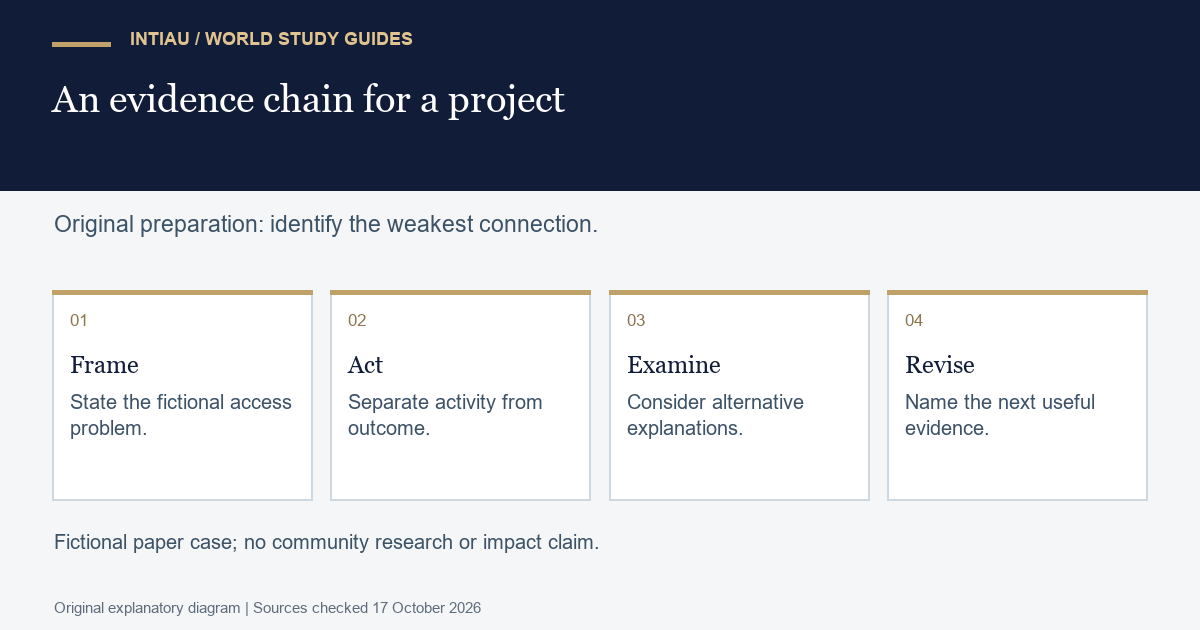
Invent a proposal to improve access to a community reading room. Keep it entirely fictional and conduct no interviews. The proposed activity is to extend opening hours. Its immediate output is additional hours available; the desired outcome is that more people can use the room. Write those as separate statements. Counting an activity does not by itself establish its intended effect.
Suppose the fictional room opens for ten extra hours and records twenty extra visits. A proposal author calls this a success. List at least three alternative explanations before agreeing: the new hours may coincide with an examination period, previous hours may have been unusually quiet, or the same small group may account for most additional visits. These are hypotheses, not claims about an actual community.
Now add an access concern. Imagine that the new hours occur only when a bus service is unavailable. A total visit count might conceal who is still excluded. Draw a simple evidence plan with one numerical measure, one question about lived experience and one ethical limit. Do not invent testimony or imply consent from imaginary participants; describe what would need appropriate approval in real research.
Revise the original project statement to include its uncertainty. For example, the extension may increase access, but the available count cannot show whether the benefit reaches those facing the greatest barriers. Propose the next useful comparison, such as a matched period with the same calendar conditions, while acknowledging that it would still leave unanswered questions.
Finish with a one-page chain linking problem, activity, output, outcome, evidence and limitation. Ask another reader to identify the weakest arrow. If the reader disputes your assumed connection, record that objection rather than replacing it with a more confident adjective. A traceable disagreement is a useful preparation outcome.
Prepare questions for academic advice
Use your exercise to decide which skill you want to develop: historical explanation, quantitative comparison, qualitative inquiry or project reasoning. Identify a published course example that addresses the skill, then check its description and prerequisites. Do not infer that a course title guarantees a placement, a particular field location or permission to conduct research.
Keep a second page for the applicant route, entry term, teaching language and unresolved requirements. This separates your academic interests from the administrative evidence the university may request. Save links and the date consulted so an adviser can understand the exact version behind a question.
Frequently asked questions
Are all honours options identical?
The faculty lists standard honours and the In-depth Experiential Learning Stream separately. Compare the exact option’s requirements.
Is the recommended sequence a guaranteed timetable?
No. It is a planning guideline and may need adjustments for offerings or equivalencies.
Can I use the exercise as evidence of community impact?
No. Its people, visits and proposal are invented. It demonstrates how you examine a claim, not an actual intervention or outcome.
View the study diagram
Official sources
For other independent study comparisons, see INTIAU Courses; general enquiries can use Contact. The named university decides its own admissions and academic requirements.