Lincoln University in New Zealand is a separate institution; its Bachelor of Landscape Architecture is not an INTIAU programme or partnership. This is the four-year, 480-credit undergraduate route at Lincoln University Campus, rather than the separate graduate-entry version. The programme page lists a 22 February 2027 start.
Begin a landscape comparison with the relationships a design must respect. A site has physical characteristics, existing uses, histories and people with different priorities. A rendered image cannot establish how those relationships were investigated. Write a question about evidence before choosing a preferred design style, then use the course map to identify where analysis, representation and integrated decisions develop.
Read an indicative progression
| Stage | Examples alongside other requirements |
|---|---|
| Intermediate | DESN101 Digital Tools for Design; DESN102 Introduction to 3D Design; DESN103 Visual Communication. |
| First professional | LASC215 Landscape Analysis, Planning and Design; LASC216 Site Design. |
| Second professional | LASC312 Landscape Ecology; LASC322 Sustainable Design and Planning. |
| Third professional | LASC406 Complex Design; LASC409 Major Design; LASC415 Professional Practice. |
The programme describes progression from the intermediate to first professional year as invitation-based on satisfactory achievement. Its indicative structure is not an individually approved plan.
Keep that progression decision separate from initial university admission. For comparison purposes, annotate one selected course with the question it helps you ask: how to represent an observation, how to understand a landscape process or how to justify an integrated response. These are your reading categories, not substitutions for the published compulsory requirements or elective rules.
Inspect a real analysis-and-design course
LASC215 Landscape Analysis, Planning and Design addresses landscape analysis and the policy context of site design. Its outcomes distinguish biophysical, economic, social and cultural characteristics and connect analytical work with site-appropriate responses and community values.
Use a course outcome to ask what kind of work would demonstrate learning. Identifying a feature differs from explaining why it matters, and both differ from selecting a design response. Avoid inventing a weekly project schedule from the outcome list. When a topic is central to your choice, seek the relevant course edition and ask how its assessment makes the stated outcome visible.
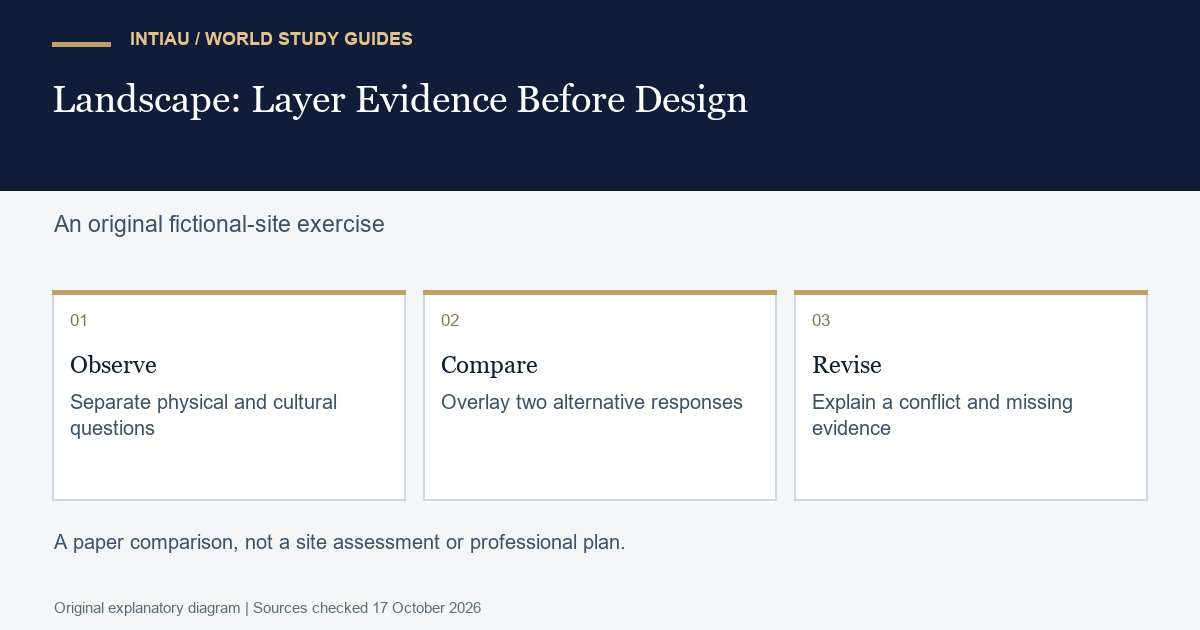
Worked exercise: three layers, two responses
Draw a fictional square site on tracing paper or a simple grid. On layer one, invent a low area where water might collect. On layer two, show a route people already use between two entrances. On layer three, mark an area whose cultural significance is explicitly unknown. The third layer is a question requiring appropriate engagement, not permission to invent a community story.
Sketch option A with a direct route and option B with a route following a higher edge. Keep the entrances and scale identical. For each option, write one possible advantage and one uncertainty. If A crosses the low area, identify the evidence needed to understand that implication. If B changes how people reach a destination, record the extra movement rather than declaring the alternative universally more accessible.
Overlay the three layers and mark a conflict you did not notice in the first sketch. Revise one response. Write a short explanation separating simulated observations, interpretations and unanswered questions. You are not designing drainage, deciding land access or assessing a real place. No site visit, sampling or consultation with actual residents is needed for this preparation exercise.
Your output is a layered map, two comparable responses and a revision note. Ask a peer to trace the evidence behind one line on the proposal. If that line has no clear reason, either supply an explicit assumption or remove it. This is a practical way to distinguish a visually complete image from an argument that can be examined and improved.
Check entry and later requirements separately
Checked on 17 October 2026, Lincoln publishes overseas qualification criteria by education system and states that complete assessments occur after receiving an application and documentation. Use the applicable qualification row; this guide does not infer a universal 2027 closing date.
The 2026 regulations distinguish awards with and without Honours and require approved practical work. A programme description should not be read as an automatic personal registration guarantee.
Prepare a route record covering academic entry, language evidence, professional-year progression and practical requirements. Record which points need individual advice. A grade rule, an application date and a professional recognition statement answer different questions; checking one does not complete the others. Revisit each with the edition relevant to your cohort.
Three landscape questions
Is this the shorter graduate-entry route?
No. This guide concerns the undergraduate route described above.
Does admission settle professional-year progression?
No. The programme identifies a separate achievement-based progression stage.
What should a layered-site exercise produce?
A proposal linked to evidence, a visible revision and questions that remain unresolved.
Official source trail
- Landscape Architecture degree
- 2026 academic calendar
- LASC215 course description
- Overseas entry criteria
For INTIAU information, visit INTIAU Courses or INTIAU Contact. These links do not apply to the separate institution discussed above.
Related guides
View the study diagram