The Bachelor of Science (Nursing) belongs to McGill University, a separate institution; it is not an INTIAU programme or partnership.
McGill describes a three-year nursing sequence including summer sessions. That description must be read alongside the prior-science entry rules.
The first useful question is therefore not simply “How many years is nursing?” It is “Which programme and starting stage match my completed education?” A clear answer prevents a secondary-school applicant, a college-trained nurse and a university transfer applicant from building plans around the same abbreviated course description.
Why three years can become four
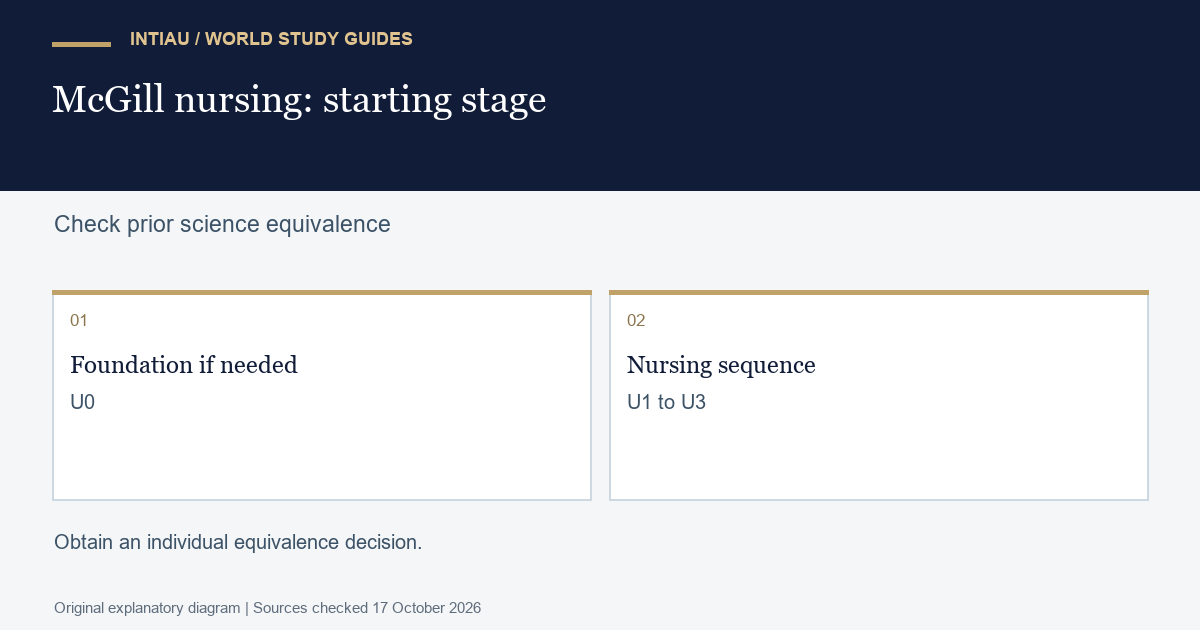
McGill’s course-of-study page requires U0 if foundational sciences or equivalents are incomplete. High-school entrants generally need U0; CEGEP entrants generally begin U1. IB, A-level, French baccalaureate and transfer applicants require equivalence review.
The applicant route chooser separately directs holders of Quebec’s DEC in Nursing, 180.A0, towards Bachelor of Nursing (Integrated) options. BSc(N) and the integrated nursing programme are different routes.
For planning, distinguish the duration of the professional sequence from time needed to complete its entry foundation. Make an inventory of your prior science courses, keeping the institution, date, level and available official description together. Do not award yourself an exemption by matching a course title. Ask for an institutional decision before treating a shorter route as confirmed.
Read the published study stages
This table selects themes from the school timetable rather than reproducing its complete course list. The questions in the final column are independent prompts for comparing learning environments.
| Stage | Selected published study | Question for comparison |
|---|---|---|
| U0, if required | Biology, chemistry, physics and calculus foundations. | Which foundations need formal completion or equivalence review? |
| U1 | Assessment, pathophysiology, development and nursing practice. | How would I link an observation to a clear, careful explanation? |
| U2 | Pharmacology, illness management and clinical learning. | Where would I learn to reconsider an initial interpretation? |
| U3 | Community work, professional issues and practice consolidation. | How are evidence, communication and responsibility brought together? |
A named example is NUR1 311, Infection Prevention and Control, listed in the official programme overview.
Follow a named course into the current catalogue when available, and check prerequisites, teaching period and assessment separately. The example here identifies a course; it does not reproduce a full syllabus or promise an unchanged future delivery. In a professional field, a short topic list should not be mistaken for evidence that a particular practical competence has been assessed.
Application and language planning, checked 17 October 2026
BSc(N) applications are processed centrally through McGill undergraduate admissions, using its online application.
The official Fall 2027 event gives 15 January 2027 for applicants studying, or who last studied, in an overseas or US high school, college or university; Nursing is included. Other applicant categories require their own dates.
The school also requires proof of French proficiency at B2 for admission, with specified exemptions. French requirements for full Quebec licensure are a separate matter.
Keep academic entry, language evidence, health or placement documentation and later professional registration on separate lines of your planning sheet. Confirm the current instructions for your category and intended intake. Meeting a published minimum or assembling documents does not establish an offer, an exemption or eligibility to practise in another jurisdiction.
Original activity: practise an evidence handover
Invent a non-clinical scenario: a community centre wants to improve its signposting. Observe only public, non-sensitive information, or use a completely fictional floor plan. Write three columns headed “observed”, “inferred” and “needs checking”. Notice how easily an interpretation can slip into the first column. Rewrite it as a question that could be answered responsibly.
Produce a brief handover for a second reader: state the issue, the evidence, a limitation and a proposed next check. Ask the reader to identify anything ambiguous. Then compare two nursing curricula by looking for official evidence of how communication, scientific reasoning and supervised practice are developed. This is an independent comparison activity, not a nursing procedure, clinical exercise or McGill assessment task.
Frequently asked questions
Can every applicant finish in three years?
No. Establish whether the foundational U0 stage is required before planning around the nursing sequence alone.
Is the integrated programme another name for BSc(N)?
No. The applicant chooser distinguishes the integrated route for DEC Nursing holders from BSc(N).
Does a similar prior science title guarantee exemption?
No. Keep the supporting evidence and obtain McGill’s equivalence decision before assuming a starting stage.
Browse INTIAU’s own Courses, or use Contact for questions about INTIAU provision.
Related guides
View the curriculum diagram