
The University of Michigan offers the Bachelor of Science in Engineering in Aerospace Engineering; this guide concerns that independent university programme, not an INTIAU programme or partnership. Department overview.
Aerospace study rewards the habit of asking how parts interact. A component that looks attractive in isolation may consume resources needed elsewhere. Read a curriculum with that relationship in mind: first identify the tools that support analysis, then the disciplinary subjects that use them, and finally the opportunities to combine them in a design argument.
Admission and curriculum are separate decisions
Students apply to the University of Michigan and College of Engineering rather than being admitted directly to the Aerospace Engineering department. Official admission route.
The current requirements page records the removal of AEROSP 405 as a requirement from Fall 2025 and warns that substitutions need advisor approval. Use the current programme guide for the applicable elective rules. Requirements and change note.
All sources were checked on 17 October 2026. The dated curriculum change does not establish a future application deadline, nor does a sample sequence reserve places in a class. When comparing older schedules, label them with their edition instead of combining their requirements with newer choices. Keep first-year admission questions separate from the process for declaring the major after enrolment.
Selected curriculum, from tools to integration
| Layer | Published examples | Independent preparation question |
|---|---|---|
| Foundations | Mathematics, chemistry, physics, ENGR 100 and introductory computing | Can I explain my model’s units? |
| Aerospace science | AEROSP 215 solid mechanics; AEROSP 325 aerodynamics | Which assumptions describe the system? |
| Analysis and control | AEROSP 350 aerospace computing; AEROSP 470 control | How would I detect an unreliable result? |
| Design integration | AEROSP 481 Aircraft Design or AEROSP 483 Space System Design | How do competing constraints change a choice? |
The rows condense selected requirements into conceptual layers. They do not replace a full degree audit or specify the semester in which you personally should take each course. Course titles alone also cannot establish transfer equivalence: retain the detailed description and assessment evidence when comparing previous study.
Worked exercise: a paper payload decision
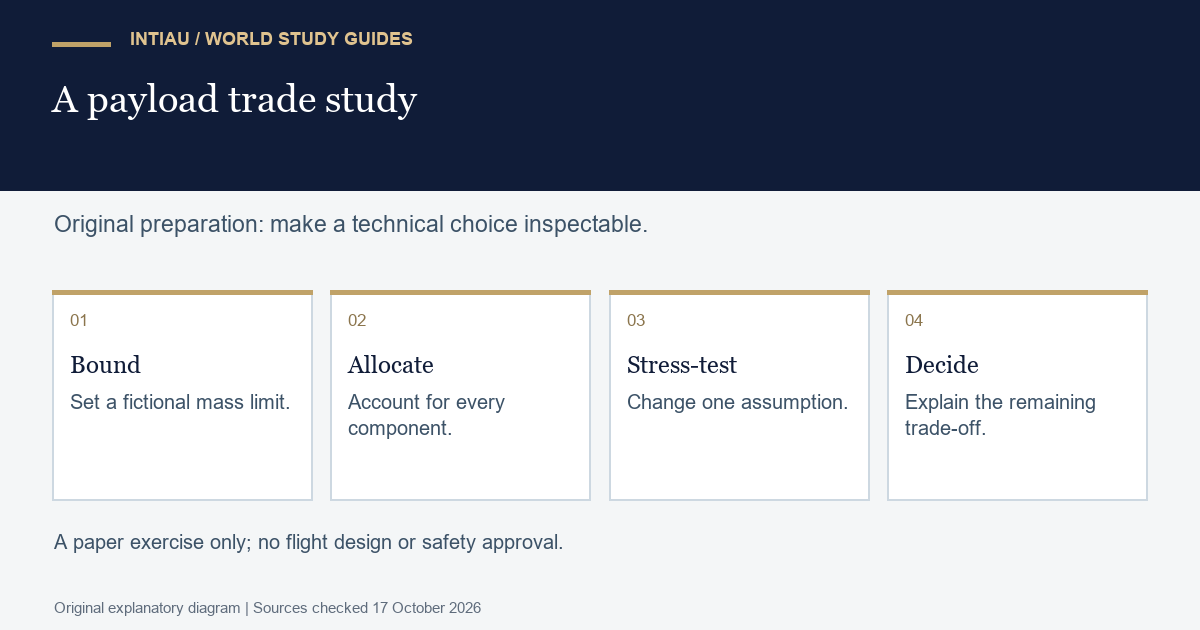
Use a fictional ten-kilogram payload budget. Assign four kilograms to a sensor, three to its enclosure, two to power equipment and one to connectors and mounting. The total reaches the limit exactly. Mark every value as invented and use no real aircraft or launch hardware. This is an arithmetic and explanation exercise, not a construction plan.
Consider an alternative sensor weighing three kilograms. It frees one kilogram, but suppose its fictional measurements are less precise. Write two separate criteria: staying within the mass budget and achieving the observation you need. Do not disguise the loss of precision by describing the lighter option as automatically better. Explain what measurement quality would be sufficient for the invented objective.
Now reserve one kilogram for uncertainty in the original design. Its planned total becomes eleven kilograms, exceeding the limit. Your options include reducing a component allocation, changing the objective, or rejecting the proposal. Choose one and state the consequence. If you reduce the enclosure allocation, label the need for further evidence rather than claiming that the revised enclosure would be safe.
Create a change log with the original total, the revised total, the reason for the change and one unresolved dependency. Ask a reader to reconstruct the arithmetic without asking you for help. If they cannot, improve the labels. The exercise tests whether a decision can be checked, not whether you know an impressive collection of technical terms.
Use the result to plan learning
Identify one part of the exercise that felt difficult. It might be numerical bookkeeping, explaining uncertainty, or comparing two desirable outcomes that cannot both be maximised. Write a small practice goal and a way to judge progress. For example, reproduce the mass calculation from an empty page and explain why the uncertainty allowance changes the decision.
In your research notebook, distinguish a course requirement, an elective choice and an advising approval. Keep space for a documented answer rather than assuming that a course with a similar name will substitute. For admissions planning, record your applicant route and use the university’s relevant cycle instructions; this guide deliberately avoids freezing a deadline or predicting an offer.
Frequently asked questions
Do I apply directly to the aerospace department?
The departmental admissions page directs applicants to the University and College of Engineering rather than direct departmental admission.
Can I follow any older sample schedule?
The page records a Fall 2025 requirement change. Check the applicable programme guide and obtain approval for substitutions.
Does the payload exercise demonstrate design competence?
No. It demonstrates transparent arithmetic and reasoning within an invented case. It provides no qualification, flight approval or assessment credit.
View the study diagram
Official sources
For other independent study comparisons, see INTIAU Courses; general enquiries can use Contact. The named university decides its own admissions and academic requirements.