Nagoya University is a separate institution; its G30 Automotive Engineering Mechanical Engineering program is not an INTIAU programme or partnership. The English-taught four-year route lists a B.Eng. in Automotive Engineering. It is distinct from the programme’s Electrical, Electronic and Information Engineering track.
The School of Engineering is based in Furo-cho, Chikusa-ku, Nagoya. Check the location of an individual laboratory or activity separately from the school address.
An automotive curriculum should be compared through the physical reasoning behind a system, not only through a familiar industry label. Choose a question about energy, motion, materials or control. Ask what must be calculated, what must be observed and how a proposed improvement would be tested. A broad technical foundation can support several applications without making every graduate a specialist in the same system.
Follow a selected mechanical progression
| Year | Illustrative components |
|---|---|
| 1 | Calculus; Linear Algebra; Introduction to Automotive Engineering. |
| 2 | Thermodynamics; Mechanics of Materials; Fluid Mechanics I; Design Practice I. |
| 3 | Control Engineering; Automobile Engineering Laboratory I/II; Design Practice II/III. |
| 4 | Graduation Research A and B. |
The separately linked course list is for 2024 entrants. Keep that cohort boundary visible; it is not a newly confirmed 2027 graduation schedule.
For each selected subject, note a foundation, a method and a possible later use. Then check whether those links are official prerequisites or your own interpretation. Keep a programme snapshot separate from complete graduation rules. This prevents a useful overview from being mistaken for an approved personal timetable, particularly when annual offerings or cohort requirements change.
Inspect a real specialised syllabus
The 2026 G30 Fluid Mechanics I and Tutorial syllabus is an actual specialised course entry linked through the engineering syllabus system. Read its academic year and G30 designation before comparing it with a Japanese-taught course of similar name.
Use the syllabus to record the stated objective, preparation and kind of work expected. Do not infer assessment percentages from the general programme page. If a detailed field is unavailable in the reader, leave that question open and follow the official entry. Accurate identification of the course is useful even when you do not reproduce its complete scope.
Worked exercise: compare two fictional energy budgets
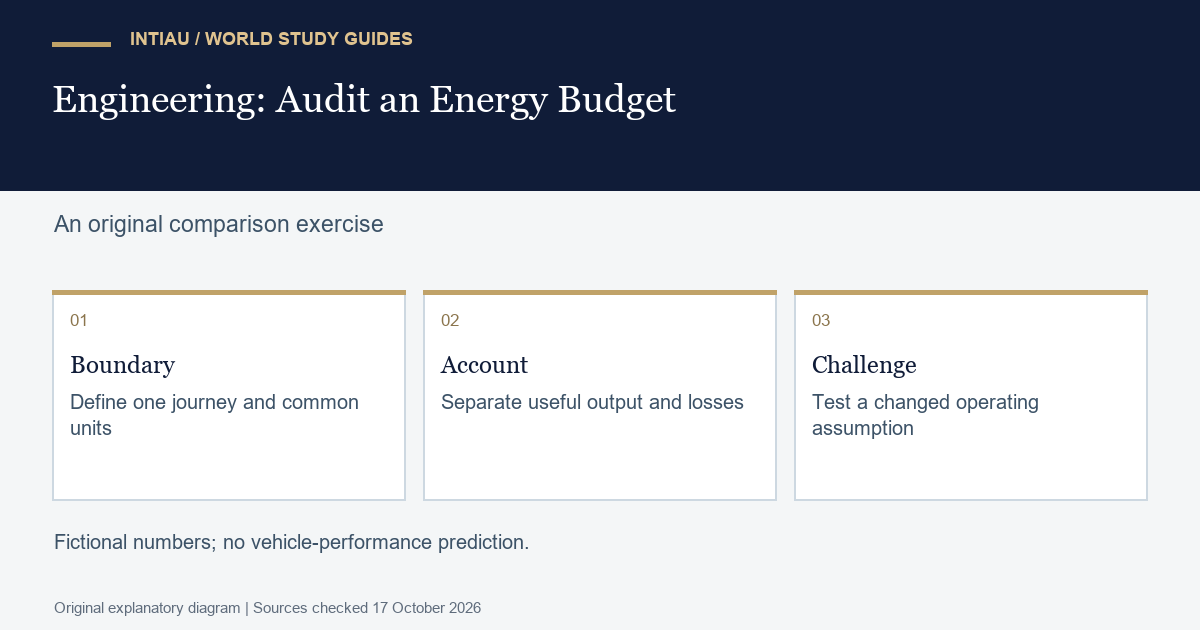
Define one invented journey and a common energy unit. System A receives 100 units, delivers 30 as useful output and loses 70. System B receives 90 units, delivers the same 30 and loses 60. Calculate useful-output fractions of 30 percent and approximately 33 percent. Label the numbers simulated and state that the comparison holds only under the assumed identical useful task.
Now change the conditions so system B requires 10 additional units for an auxiliary function omitted from the first boundary. Recalculate its total input and explain what happens to the comparison. Draw the auxiliary function inside or outside each boundary consistently. The purpose is not to declare a real technology superior; it is to see how an apparently small omission can alter an argument.
Add an uncertainty range to one loss estimate. Identify which missing measurement matters most before another decimal place would be useful. Write a short memo explaining the common task, the accounting boundary and the condition under which your conclusion changes. Ask a peer to reproduce both calculations from your diagram without an oral explanation.
Your output is a pair of energy-flow sketches and a qualified comparison. No vehicle operation, component testing or fuel experiment is needed. Keep the task separate from an official university assignment and avoid converting the fictional calculation into an efficiency, emissions or safety claim about an actual product.
Use the dated admissions calendar
Checked on 17 October 2026, G30’s 2027 admissions page lists first-round opening on 2 November 2026 at 09:00 JST and a deadline of 19 November at noon JST. It separately lists a January second round; programme availability and document stages must be checked in the full guidelines.
Record the exact track and round before copying a deadline. Recommended scores on a programme page are not an admission guarantee. Keep essays and supporting documents under the institution’s current instructions, and distinguish an applicant timeline from the entry-year curriculum you will eventually follow.
Three engineering questions
Is the mechanical track the electrical track?
No. The programme presents them as separate tracks.
Is the linked course-list PDF for 2027 entrants?
No. Its stated cohort is 2024 entrants.
What makes an energy comparison inspectable?
A common useful task, consistent units and explicit system boundaries.
Official source trail
- Automotive mechanical programme
- 2024 entrant course list
- 2026 G30 Fluid Mechanics I
- 2027 undergraduate admissions
- Engineering school location
For INTIAU information, visit INTIAU Courses or INTIAU Contact. These links do not apply to the separate institution discussed above.
Related guides
View the study diagram