This independent guide concerns another university’s programme. It does not describe an INTIAU programme, branch or established partnership.
Official sources checked: 17 October 2026. This guide explains the undergraduate routes listed in MIT’s current catalogue. Consult the linked degree charts when planning a programme, because subject choices and requirements can change.
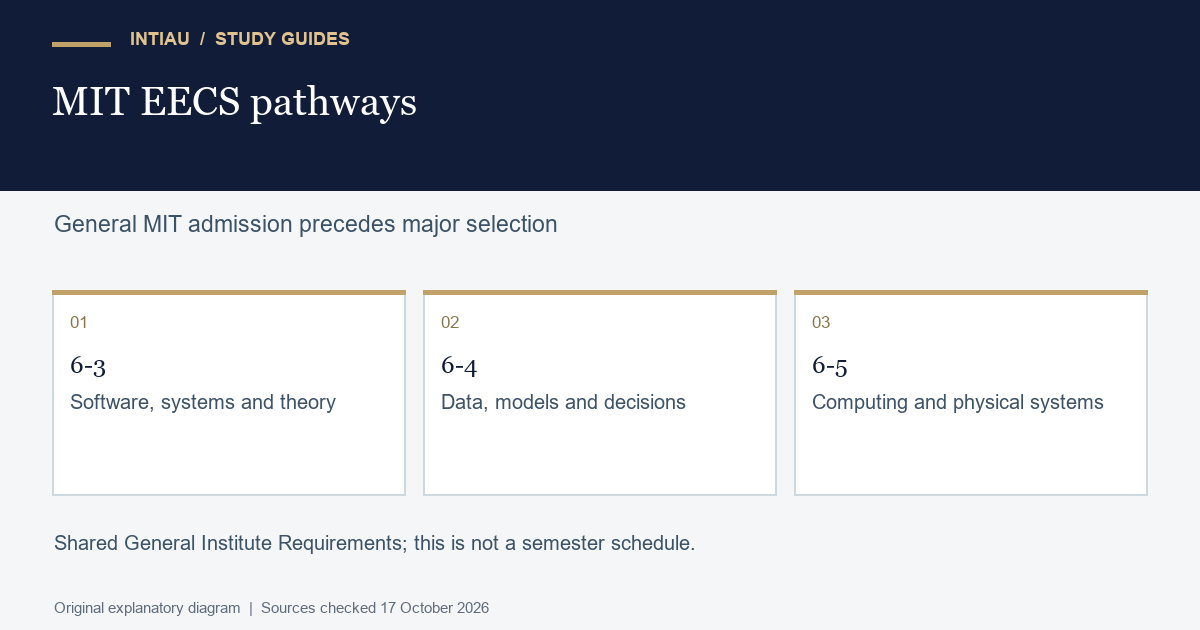
MIT’s Department of Electrical Engineering and Computer Science, usually shortened to EECS, covers several undergraduate degrees. Computer Science and Engineering, numbered 6-3, and Artificial Intelligence and Decision Making, numbered 6-4, share important foundations but organise advanced study differently. Electrical Engineering with Computing, 6-5, provides another route for students interested in physical and computational systems. The numbers identify MIT programmes; they are not application levels or separate entrance examinations. See the official EECS catalogue overview.
Apply to MIT first, then choose a major
A prospective first-year student applies for general admission to MIT rather than directly to EECS. MIT says students select their major at the end of their first year with their first-year adviser. The application asks about a course of interest, but that indication does not affect the admission decision. Consequently, comparing 6-3 and 6-4 is a way to understand academic fit; it is not a strategy for selecting an easier departmental application route. This distinction is set out in MIT Admissions’ major-selection guidance.
International applicants use the same application timetable and process described by MIT for domestic applicants. MIT evaluates school records in their educational context and asks for a school report and transcript. Applicants who have already enrolled at another university should examine the transfer rules instead of assuming the first-year route applies. Start with the official international applicant guidance.
At the check date, MIT requires the SAT or ACT for prospective first-year and transfer applicants. Its English-proficiency recommendation depends on language background, and the testing page distinguishes those examinations from the SAT/ACT requirement. Check the current tests and scores policy rather than treating a programming certificate as a substitute for required application evidence.
Understand the education around the major
An EECS degree includes MIT’s General Institute Requirements as well as the departmental programme. These bring together mathematics and science, humanities, arts and social sciences, laboratory work, and communication. A student comparing computing degrees should therefore leave room for substantial study outside computing. Communication requirements also operate within the major. The General Institute Requirements explain the rules and permitted overlaps; adding every requirement as if it were a separate subject would misrepresent the workload.
Compare 6-3, 6-4 and 6-5 by their required work
6-3: The published chart combines programming, software construction, algorithms and theory with low-level programming and computer systems. It also includes a mathematical choice and structured advanced electives. For a reader interested in software reliability, the useful question is how the foundations connect to later systems or programming work. Read the complete 6-3 degree chart, including its alternatives and footnotes.
6-4: The chart establishes programming, algorithms, linear algebra, and probability or inference foundations, then requires breadth across five perspectives: data, models, decisions, computation and people. Advanced work includes an application communication requirement, and a listed subject must satisfy the social and ethical responsibilities requirement. This structure helps distinguish an AI degree from a short course about using current software tools. See the official 6-4 degree chart.
6-5: The published programme combines mathematical and computing foundations with system design, an integrative laboratory and advanced track choices. It is relevant to a comparison involving electronics, hardware and the interaction between physical systems and computing. Examine the 6-5 chart before assuming that every EECS route has the same core.
A stage map, rather than an invented semester timetable
The catalogue gives requirements rather than one compulsory semester sequence for every student. The following original comparison groups those requirements into learning stages; it does not assign a subject to a particular year or replace prerequisite advice.
| Stage | 6-3 focus | 6-4 focus |
|---|---|---|
| Build foundations | Programming, mathematical reasoning and algorithms. | Programming, algorithms, linear algebra and uncertainty. |
| Develop breadth | Software, low-level computation, systems and theory. | Data, models, decisions, computation and human considerations. |
| Develop depth | Approved track electives and communication within the major. | Advanced applications, communication and responsible computing. |
| Integrate the degree | Complete Institute-wide requirements and check overlaps against the chosen chart. | |
For advanced choices, MIT publishes a separate EECS track list. Its computer science headings include architecture, interaction, programming tools, security, systems and theory. A practical comparison exercise is to pick two intellectual problems that interest you, locate relevant track subjects, and then trace their prerequisites. This produces a more informative shortlist than comparing programme names alone.
Frequently asked questions
Can an international school-leaver apply directly to 6-3?
No. First-year admission is to MIT generally; the major is selected later. See MIT’s admission guidance.
Is 6-4 the same degree title as 6-3?
No. They lead to differently titled Bachelor of Science degrees, as shown in the EECS catalogue.
Does choosing computing remove humanities study?
No. The Institute requirements still include humanities, arts and social sciences.
Where can I check whether a subject changed?
Use the current degree chart alongside the department’s curriculum and subject-update pages.
Continue your course comparison
For information on INTIAU’s own educational pages, visit Courses. Institutional enquiries can start with Relations or Contact. These links do not establish an MIT partnership, credit-transfer agreement or application service; MIT’s official sources govern its programmes and admissions.
Compare these pathways with the Oxford Computer Science course guide and use the curriculum-comparison workshop to separate compulsory study, options and application requirements.
View the explanatory diagram