
The Federal University of Santa Catarina offers Engenharia Mecânica in Florianópolis; this independent guide concerns that UFSC undergraduate programme, not an INTIAU award or partnership. Programme curriculum index.
Mechanical reasoning includes knowing when an apparently small variation changes whether components can work together. A curriculum comparison can begin with that habit: identify the underlying tools, the models used to connect them, and the later opportunities to combine analysis with a design question. Portuguese names below are retained for checking the official records.
Curriculum version and admission cycle
The course index distinguishes curricula 2025.1 and 2006.1, with 1991.1 marked extinct. Do not merge them into one checklist.
The official 2027 unified entrance site states that registration closed on 23 September 2026. That deadline was past when checked on 17 October 2026. Official selection site.
A curriculum version answers a different question from the availability of a selection route. The table uses the published course-203 report for curriculum 2025.1. It does not reopen a closed application process or establish how a previous student transfers into a newer matrix. Ask the university which version applies before deciding on registration or recognition of earlier study.
Selected progression in the published report
| Layer | Actual selected example | English reading aid |
|---|---|---|
| Early material study | EMC5092 Introdução à Ciência dos Materiais | Introduction to materials science |
| System analysis | EMC5600 Fundamentos de Vibrações | Fundamentals of vibration models |
| Eighth and ninth phases | EMC5801 Planejamento do Projeto Final de Curso; EMC5803 Projeto Final de Curso | Project planning followed by final-course work |
| Practice component | EMC5805 Estágio Profissional em Engenharia Mecânica | Professional placement for curriculum 2025.1 |
The official report describes EMC5600 through mathematical models of vibrating systems, including free and forced vibration.
The placement guidance distinguishes EMC5805 from the older curriculum’s EMC5522. Placement guidance.
Worked exercise: an invented tolerance chain
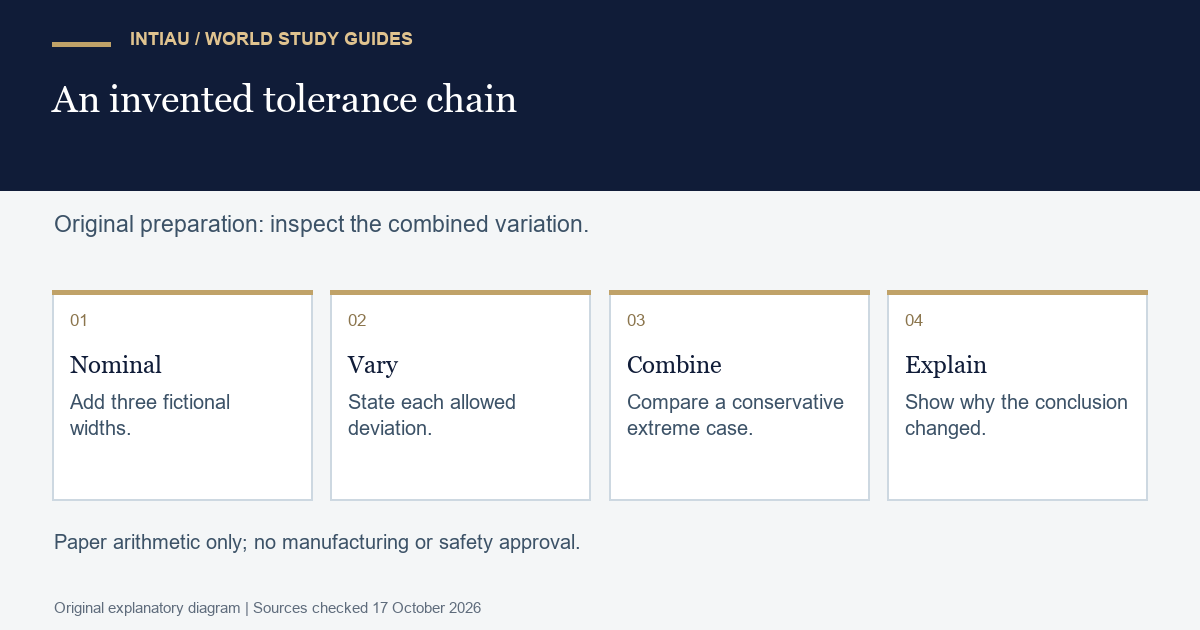
Draw three fictional blocks that must fit inside a paper frame. Give them nominal widths of ten, twenty and ten arbitrary units. Their combined nominal width is forty. Let the frame’s interior width be forty-one. The nominal spare space is therefore one unit. State that this is an invented arithmetic model, not a manufacturing drawing.
Assign possible width deviations of plus or minus 0.2, 0.3 and 0.1 units. Under the deliberately conservative assumption that all three blocks are simultaneously largest, their combined width is 40.6. If the frame is exactly forty-one, the remaining space is 0.4. Write the sum so the reasoning can be checked.
Now allow the frame itself to be 0.5 units narrower than nominal. Its smallest width becomes 40.5. Combined with the largest blocks, your simple model gives a deficit of 0.1 units. The nominal arrangement appeared comfortable, but a stated combination of variations changes the conclusion. Do not assume that the variations cancel merely because some can be positive and others negative.
Consider two revisions. One reduces a block’s nominal width by 0.2; the other changes the assumed variability. Explain which revision changes the intended geometry and which changes the evidence you would need about production. Neither choice can be declared feasible without additional information. Keep the numerical comparison separate from a real engineering recommendation.
Finish with a small uncertainty ledger: nominal value, allowed deviation, extreme case and unresolved assumption. Ask a reader to reconstruct both the initial spare-space result and the later deficit. If the explanation relies on an unlabelled diagram or a hidden sign convention, revise it.
Connect the exercise with learning goals
The exercise can reveal whether you need practice with signs, units, boundary conditions or explaining a conservative scenario. Keep a corrected calculation and describe what changed your judgement. Do not treat a worst-case arithmetic result as a statistical prediction; the model contains no measured distribution or probability.
For academic planning, retain the exact curriculum code, phase and course name beside each question. A selected subject description does not establish every prerequisite, available place or approved substitution. For admissions, use the actual selection notice and applicant category rather than extrapolating from a course’s continued existence.
Frequently asked questions
Can I combine the old and new curriculum codes?
The course index lists distinct versions. Confirm the applicable version rather than building a hybrid checklist.
Was the cited 2027 registration deadline still ahead?
No. The official site gives 23 September 2026, already past on the checking date.
Does the tolerance exercise approve an assembly?
No. All dimensions and variations are fictional. It supports explanation of uncertainty and supplies no manufacturing or safety approval.
View the study diagram
Official sources
For other independent study comparisons, see INTIAU Courses; general enquiries can use Contact. The named university decides its own admissions and academic requirements.