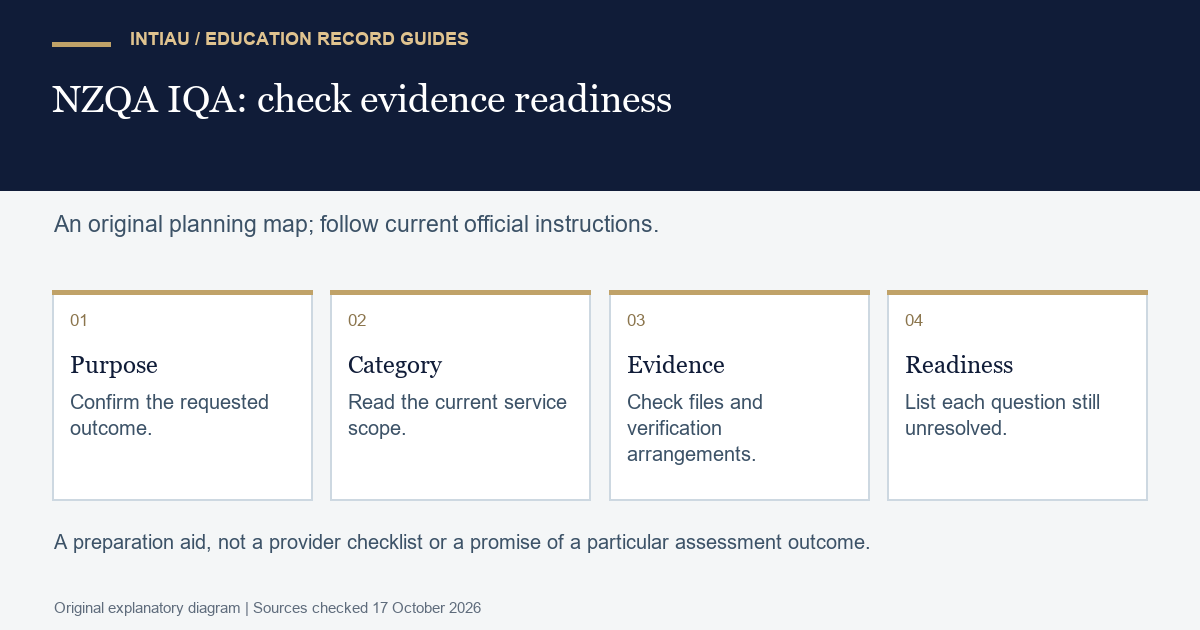
The New Zealand Qualifications Authority (NZQA) evaluates overseas qualifications for use in New Zealand; it is separate from INTIAU. Its official overview advises applicants to confirm the need for an evaluation with the receiving organisation. This guide uses current official content checked on 17 October 2026.
Choose an IQA for the actual purpose
An International Qualification Assessment compares an overseas qualification with a level and qualification type on the New Zealand Qualifications and Credentials Framework. The current page distinguishes Standard, Skill Shortage List and Teaching IQAs. It excludes incomplete programmes, ordinary secondary-school qualifications and stand-alone work-experience evidence from the evaluation scope.
Standard IQAs can support employment, further study or required immigration recognition outcomes. Skill Shortage List IQAs address specified occupational requirements, and the page directs applicants to confirm the need with Immigration New Zealand. Do not choose a category solely because a job title resembles an occupation named elsewhere.
Write the recipient’s requirement before writing the service name. Ask whether it needs a framework comparison, a specific occupational assessment or something else. Keep any immigration application decision separate from the educational comparison. If an employer requests additional screening, clarify that request independently rather than assuming an IQA supplies every form of employment evidence.
Understand the teaching distinction
The Teaching IQA guidance compares overseas teaching qualifications against New Zealand Initial Teacher Education requirements. It evaluates the qualification rather than a teaching licence, permit or professional registration. The page directs applicants to the Teaching Council for registration matters and distinguishes registration-related assessment from teacher salary purposes.
Prepare verified evidence before applying
The document page, updated 27 July 2026, says documents must be verified before application. It requests the award certificate, full academic record, passport information and applicable name-change evidence. Upload copies of original documents, with complete colour scans and recognised English translations where needed. Missing or unclear evidence leaves an application incomplete; a scan and an acceptable verification route are different requirements.
The application guidance asks applicants to confirm the IQA type and number of applications, gather all evidence, and use the application portal. It distinguishes waiting-for-information status from evaluation and quality review. The completed outcome is an electronic recognition statement. Its current appeal guidance also distinguishes applications submitted before 30 July 2026, so check which rules apply to the original application date.
| Planning question | Action | Keep separate |
|---|---|---|
| Who needs the outcome? | Confirm the recipient’s purpose. | Your assumption and its actual instruction. |
| Which service applies? | Read the current category guidance. | A qualification title and the requested assessment. |
| Is evidence ready? | Inspect each file and its verification plan. | File possession and acceptable verification. |
| What needs follow-up? | Track each unresolved item. | Submission, review and a completed outcome. |
Original exercise: audit readiness without submitting
Make a private inventory with one line for each proposed qualification. Use five headings: purpose, evidence held, missing item, verification question and responsible person. Fill the purpose column from the recipient’s answer. In the evidence column, describe the document rather than recording passport numbers or other identifiers in a worksheet you may share.
Test two hypothetical problems. First, imagine that a clear transcript scan exists but you have not established how its authenticity will be verified. Keep both observations visible; do not mark the entire evidence row complete. Second, imagine that the award is a general academic degree while the recipient’s request concerns teaching preparation. Draft a question about the appropriate service instead of treating the occupational goal as evidence of a teaching qualification.
Finally, ask another person to read only your action descriptions. Could they tell which item needs a document, which needs clarification and which requires a recipient decision? Revise vague entries such as “sort out assessment” into a specific next step. This exercise is original preparation advice, not an NZQA application, occupational determination or prediction of a framework level.
Frequently asked questions
Can I submit work experience instead of a completed qualification?
The IQA scope excludes stand-alone work-experience evidence and incomplete programmes. Check the published qualification eligibility rules.
Is a teaching licence itself the qualification assessed?
No. NZQA evaluates formally awarded teaching qualifications, not professional registration, permits or licences.
Is a readable upload enough to make an application ready?
Not by itself. The document guidance requires all evidence and an acceptable verification arrangement before applying.
Use INTIAU’s Degree Verification route or Contact page for its own record enquiries. NZQA applications follow NZQA’s official process.
Related guides
View the evaluation workflow