The University of Otago is a separate institution; its Bachelor of Science with a Geology major is not an INTIAU programme or partnership. The BSc is a three-year degree.
Geology study is based in Dunedin. The departmental study page connects its teaching with the surrounding geological setting.
The most useful starting question is not how many spectacular locations a course mentions. Ask whether you want to infer a history from incomplete physical evidence. A good comparison record should distinguish what was observed, what was measured and what was inferred. Keep those categories separate even when the explanation initially seems obvious.
Follow the major across paper levels
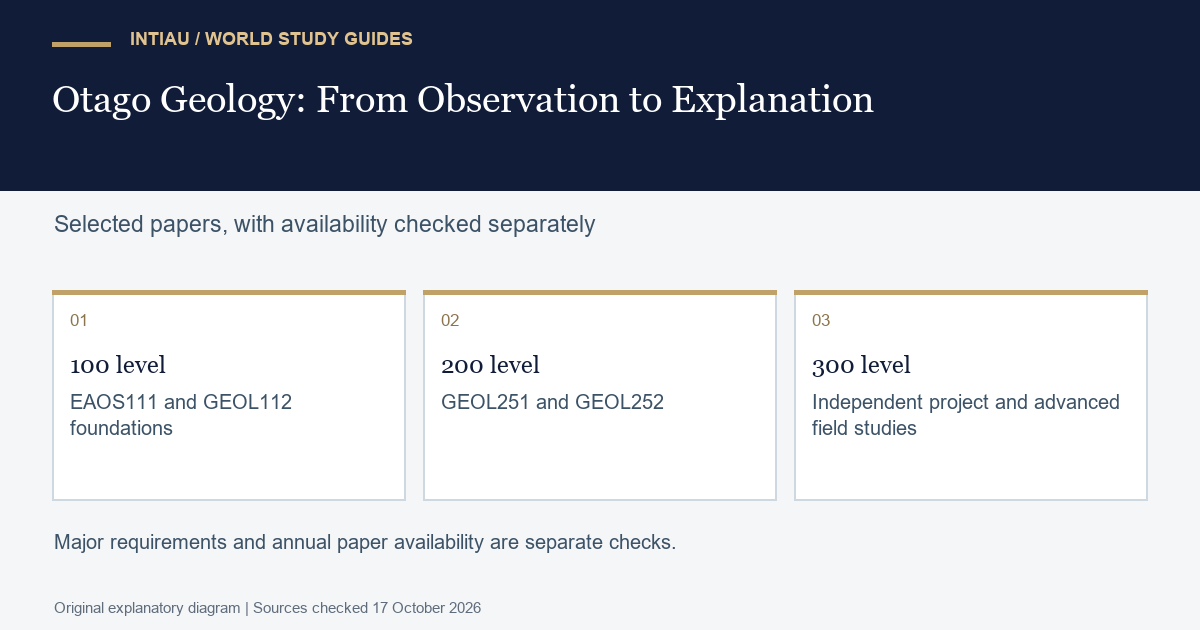
| Stage | Selected official components |
|---|---|
| 100 level | EAOS111 Earth and Ocean Science; GEOL112 Dynamic Earth: A New Zealand Perspective; a quantitative option. |
| 200 level | GEOL251 Minerals and Rocks; GEOL252 Field Studies and New Zealand Geology; further choices. |
| 300 level | GEOL302 or GEOL304 independent project; GEOL344 Advanced Field Studies; GEOL353 Earth Evolution and Plate Tectonics; further choice. |
The selected table is a map for reading, not a complete point-by-point plan. When comparing another degree, trace the connection between identification, spatial interpretation and independent work. Check the rules before assuming a project can replace a required paper. A course list and an approved personal timetable are different documents, even when they contain similar names.
The 2027 paper list separately identifies offerings. For example, it lists GEOL252 in Semester 1 and marks some other papers as not offered in 2027. A paper appearing in a major schedule does not establish annual availability.
Read a field-studies example at the right date
GEOL252 describes field observation, mapping and interpretation followed by laboratory work. Its visible 2026 arrangements include residential field camps and internal assessment. Use that dated example to understand the type of work; confirm future camp dates and requirements from the relevant edition.
For a field-based course, ask how preparation, travel, observation, recording and later analysis fit together. Your personal planning sheet should include a space for accessibility questions and any equipment or travel information that needs an official answer. Avoid treating a teaching-period label as the first date on which every activity begins.
Practical exercise: observation before explanation
Use a fictional drawing of three rock layers crossed by a dark band. Label it as a simulated example. Write five statements that describe only visible relationships: which line crosses another, where a boundary changes direction and which features appear continuous. Do not name a geological process yet. Ask a peer to underline any statement that already contains an interpretation.
Next propose two possible histories that could produce the drawing. For each history, identify one additional observation that would help distinguish it from the other. You might need a closer view of a contact, an orientation measurement or evidence from a neighbouring exposure. Explain why another photograph of the same feature may not provide independent evidence.
Create a notebook-style page containing the sketch, a legend, your observations and two competing explanations. Add a confidence statement that identifies the weakest assumption. Then change one fictional observation and rewrite the conclusion. Your output demonstrates how a conclusion responds to evidence; it does not require entering a field site, collecting specimens or claiming that an invented sketch represents local geology.
Check the applicant calendar without mixing categories
As checked on 17 October 2026, Otago lists 15 November 2026 for offshore international full-degree applications for Semester 1 2027 and 10 December for onshore international applicants. Its international dates page also distinguishes application, accommodation and arrival milestones.
Record the deadline that matches your situation, then work backwards from the documents that take longest to obtain. Keep paper selection questions separate from university admission. If a field course affects arrival planning, seek the current course instructions before booking travel. A general semester date cannot settle that question on its own.
Three paper-planning questions
Does a major list prove that every paper runs each year?
No. Check the annual paper list; it explicitly marks non-offerings.
Are the GEOL252 arrangements above a 2027 guarantee?
No. The detailed example described here is the visible 2026 edition.
What should I compare beyond course names?
Look for the progression from observation to interpretation, the evidence expected in independent work and practical questions that need current confirmation.
Official source trail
- Geology major schedule
- Geology paper availability
- GEOL252 paper information
- International application dates
- Geology study location
For INTIAU information, visit INTIAU Courses or INTIAU Contact. These links do not submit an application to the separate institution discussed above.
Related guides
View the curriculum diagram