The University of Queensland is a separate institution; its Bachelor of Advanced Science (Honours), including the Environmental Science major, is not an INTIAU programme or partnership. The four-year programme is based at St Lucia.
The earlier Environmental Science (Honours) listing says that award is no longer available. This guide therefore examines a current same-university route rather than treating an older award title as open for new entry.
Choose a comparison question before reading a long course list. For example: would this pathway help you explain why two nearby waterways produce different biological observations? Separate the scientific question from a management decision. You may need measurements to answer the first and additional social, legal or practical evidence to justify the second.
Read the major planner as a staged selection
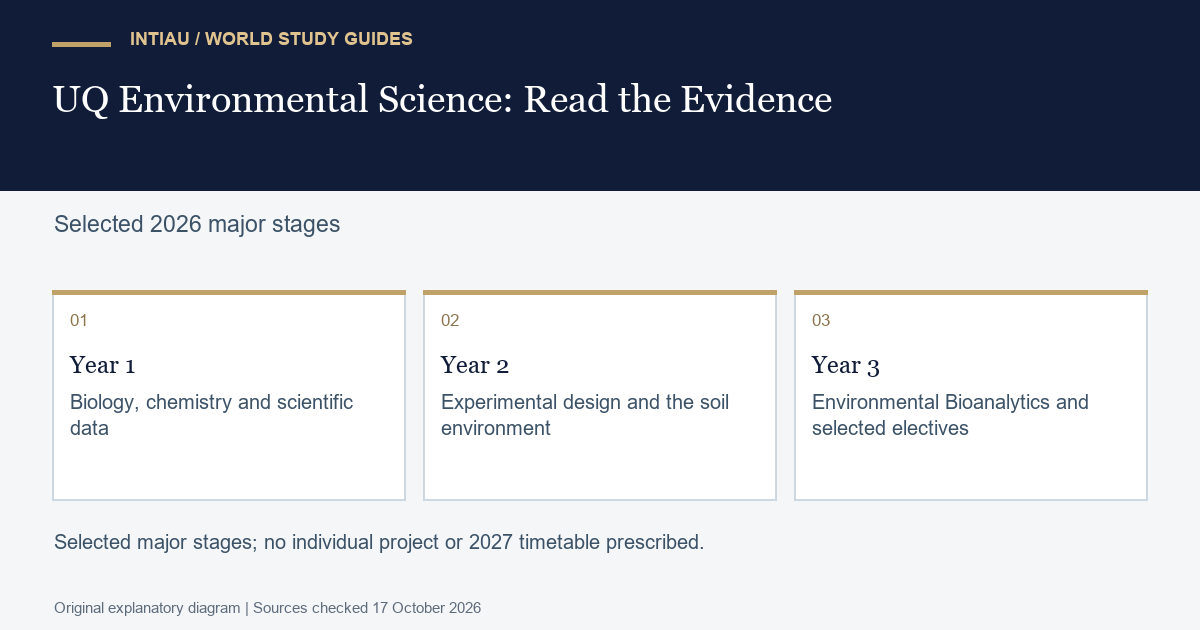
These selections from the 2026 major planner illustrate that edition, not an approved 2027 enrolment plan.
| Stage | Selected official components |
|---|---|
| Year 1 | BIOL1050 Organisms: Interactions and Functions; CHEM1100 Chemistry 1. |
| Year 2 | Experimental design options; LAND2003 The Soil Environment. |
| Year 3 | ENVM3010 Environmental Bioanalytics; selected environmental electives. |
Add a second column to your own planner for the evidence you would learn to produce: a defensible observation, an analysis, a model or a written explanation. Mark the relationship as your interpretation unless the official course description states it. This turns a list of names into questions you can ask an academic adviser without inventing course outcomes.
Inspect an actual environmental analysis course
The Semester 2 2026 ENVM3010 profile describes biological measurement using biomolecules, including environmental DNA applications. It combines lectures with laboratory and computer practical work and develops analysis and communication of datasets. The example belongs to that published teaching period.
Read a profile in three passes. First identify the scientific object being measured. Next ask what could distort the measurement. Finally inspect how results are communicated. A method can be sophisticated while still answering a narrow question. Compare its limitations as carefully as its apparent power, particularly when a result might influence a decision affecting a place or community.
Practical exercise: design a fictional sampling comparison
Imagine two ponds with different shaded areas. You want to compare a fictional indicator measured in water samples. Create a paper plan with four headings: question, sampling unit, possible confounders and evidence needed. Choose whether your unit is a location, a bottle or a time period. Explain why collecting several bottles at one point may not answer the same question as sampling several locations.
Prepare six invented observations for each pond and label them explicitly as simulated. Include one unusually high result. Calculate a simple average with and without that value, then write two explanations: a possible environmental difference and a possible sampling or recording problem. Do not delete the observation merely because it makes the pattern less convenient.
Your output is a one-page sampling diagram, a small labelled dataset and a short uncertainty statement. Ask a peer to find the weakest inference. Revise the design by changing one feature, such as timing or replication. This independent exercise helps you judge whether you enjoy the reasoning involved; it is not a research protocol or permission to collect biological material.
Keep entry requirements separate from research progression
For 2027 entry, the course page distinguishes direct UQ applications from QTAC routes according to schooling and applicant category. It lists English, mathematics and science prerequisites. The published 2027 starts are 22 February and 26 July; check your applicable application deadline separately.
Make a document checklist from your own qualification rather than assuming that a similarly named school subject satisfies a prerequisite. Then create a second checklist for later curriculum decisions. An undergraduate admission offer and permission for a particular research project answer different questions. Use the live programme page and formal course rules when making an actual application or enrolment decision.
Three route checks
Is the older Environmental Science Honours title the current route here?
No. Its official listing says it is no longer available.
Does the table describe a new 2027 syllabus?
No. It selects entries from the 2026 major planner.
What should my comparison retain?
The award name, source edition, applicant category, evidence-producing activities and unresolved questions, each recorded separately.
Official source trail
- Advanced Science Honours programme
- Earlier Environmental Science Honours listing
- Environmental Science major planner
- Environmental Bioanalytics, Semester 2 2026
For INTIAU information, visit INTIAU Courses or INTIAU Contact. These links do not submit an application to the separate institution discussed above.
Related guides
View the curriculum diagram