
The University of Pretoria offers BScAgric in Agricultural Economics in Agribusiness Management; this independent guide describes that university programme, not an INTIAU award or partnership. Official 2027 programme page.
Agricultural decisions connect physical production with prices, costs and uncertainty. A useful study comparison asks how the programme develops both the scientific context and the reasoning needed to examine a business choice. Keep a model’s arithmetic separate from a claim that its assumptions will hold in a real enterprise.
Separate 2027 entry from 2026 study records
The 2027 page gives 30 June 2026 as the South African and international closing date. It was already past on 17 October 2026. Its NSC/IEB requirements are not a universal foreign-qualification checklist, and minimum results do not guarantee admission.
The curriculum evidence used here is the 2026 yearbook, which distinguishes fundamental and core work and requires completion of earlier prescribed study before the final year. 2026 programme record.
Keep these dates in separate columns. A future entry label does not make a passed deadline future, while a yearbook describes academic requirements rather than confirming an offer. Where a page cannot be retrieved directly, the official indexed record remains a limited source; request clarification before relying on an individual registration decision.
Selected progression and module examples
| Layer | Published example | Question for comparison |
|---|---|---|
| Initial preparation | Academic information management and language and study skills | Can I explain and organise evidence? |
| Applied analysis | LEK 320 Agricultural economics: whole-farm planning and risk | How does an uncertain assumption affect a choice? |
| Research integration | LEK 433 Research project: Agricultural economics | Which contemporary problem can be investigated? |
The LEK 320 record includes business planning, financial analysis and scenario assignments.
The LEK 433 record identifies LEK 310 and LEK 320 prerequisite conditions. The table is selective, not a complete degree audit.
Worked exercise: compare fictional enterprises
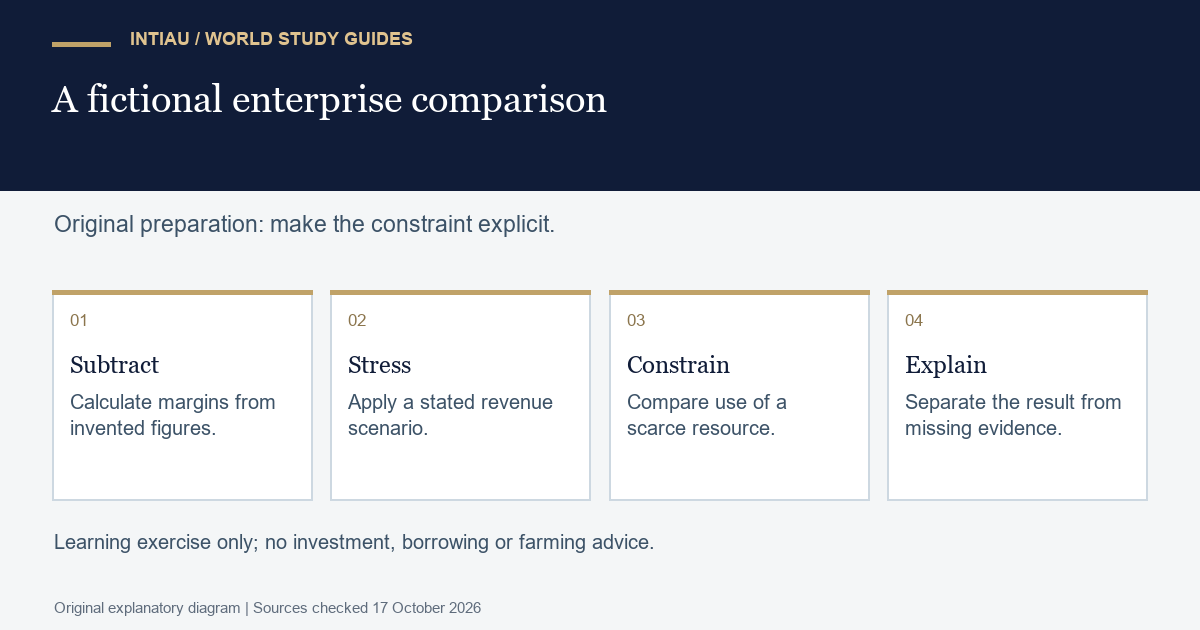
Imagine two invented crop enterprises, A and B, with figures in arbitrary currency units. A expects revenue of one hundred and variable costs of sixty. B expects revenue of one hundred and twenty with variable costs of seventy-five. The resulting simple margins are forty and forty-five. Write the subtraction and state exactly which costs the calculation includes.
Now apply a fictional revenue reduction of twenty percent to both. A’s revenue becomes eighty and its margin twenty. B’s revenue becomes ninety-six and its margin twenty-one. B still has the larger margin, but the difference has narrowed. This does not establish a probability of either outcome; it merely shows what the stated scenario does to the arithmetic.
Add a separate resource constraint. Suppose A needs ten units of a scarce resource while B needs fifteen. Their original margins per resource unit are four and three. A now looks stronger on that particular ratio. Explain why neither total margin nor margin per resource unit can decide the question without knowing the actual constraint and objective.
Change the available resource to twelve units and forbid partial enterprises in this imagined case. B no longer fits, even though its unconstrained total margin was higher. Record the assumption about indivisibility. If partial activity were allowed, the comparison would need a different model rather than a casual change to the conclusion.
Finish with a decision sheet containing objective, resource limit, included costs, scenario and missing evidence. List fixed costs, timing of receipts, production variation and environmental effects as unresolved questions. Do not invent a market forecast or treat the fictional numbers as investment, borrowing or farming advice.
Prepare for a useful academic conversation
Identify whether your main interest lies in the calculation, the production context or the decision under uncertainty. Select one skill to practise and preserve both the initial and revised comparisons. An unexplained preference for the highest number is less informative than a transparent account of why a constraint changed the decision.
For previous-study comparisons, collect module descriptions, assessment evidence and the applicable yearbook. Similar names do not automatically establish credit. For entry planning, identify the precise applicant qualification route and the current official notice; an NSC table should not be copied into a checklist for every education system.
Frequently asked questions
Was the cited 2027 application deadline still future?
No. The page’s 30 June 2026 closing date had passed by the checking date.
Is the research project an actual module?
Yes. LEK 433 is a 2026 undergraduate research-project record with specified prerequisite conditions.
Can the enterprise exercise guide an investment?
No. All figures and scenarios are invented and omit essential evidence. The purpose is to explain a comparison, not recommend a financial decision.
View the study diagram
Official sources
For other independent study comparisons, see INTIAU Courses; general enquiries can use Contact. The named university decides its own admissions and academic requirements.