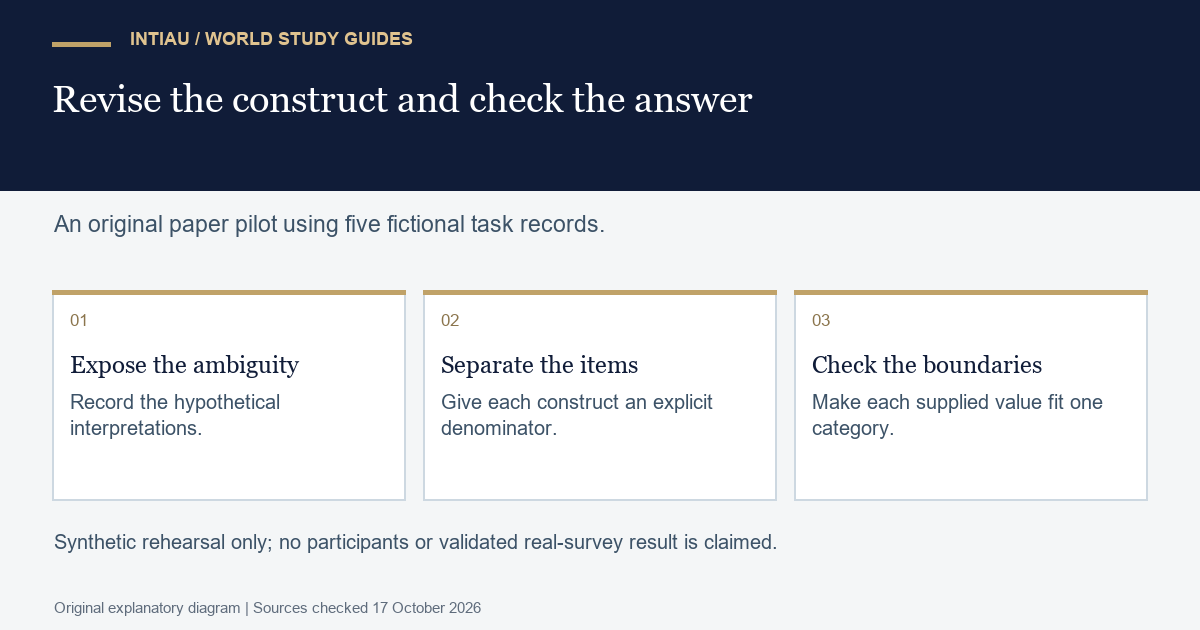
This self-study workshop rehearses questionnaire revision using invented task records and hypothetical interpretations. You will identify an ambiguous item, split two different constructs and check that revised response options handle boundary values. This is a paper pilot exercise, not research with respondents or a substitute for testing a real questionnaire with its intended users.
The Government Analysis Function guidance discusses separating double questions, specifying periods and testing interpretation. Checked on 17 October 2026, its page is marked under review; it is not presented here as a newly revised standard.
Find what the original item combines
The invented question is “Do you regularly finish tasks quickly and accurately?” A hypothetical reader interprets quickly as under ten seconds but answers mainly about speed. Another answers mainly about avoiding errors. Both might choose yes while answering different questions. These are constructed interpretations, not findings from interviewed people.
| Task | Duration | Recorded errors |
|---|---|---|
| One | 8 seconds | 0 |
| Two | 12 seconds | 1 |
| Three | 9 seconds | 0 |
| Four | 15 seconds | 0 |
| Five | 10 seconds | 0 |
Before revising the wording, write the information need. Here it is to count timely completions and error-free completions within these five supplied tasks. There is no need to ask about someone’s usual work, satisfaction or personality. Those would be different constructs with different evidence needs.
Complete worked revision
Replace the combined item with two questions: “Of the five fictional tasks on this sheet, how many were completed in ten seconds or less?” and “Of those five tasks, how many finished without a recorded error?” Each accepts an integer from zero through five.
The first worked answer is three: tasks one, three and five. The second is four: tasks one, three, four and five. Task four shows why the constructs should not be collapsed. It is error-free but exceeds the stipulated speed threshold. Task five shows why “ten seconds or less” needs its inclusive boundary.
The wording also removes the vague frequency term regularly. A reader does not need to choose a personal definition of regularity; the denominator and task set are explicit. This makes the exercise reproducible without claiming that the new wording has been validated for a population.
Now consider an alternative duration item with choices “zero to five”, “five to ten” and “ten or more” seconds. A value of five fits two stated ranges, and ten also fits two. Replace them with “zero through five”, “more than five through ten” and “more than ten”. Under those revised ranges, the supplied durations produce counts zero, three and two.
Keep a revision log
Use one row per issue with the original wording, hypothetical interpretation, construct, proposed change and answer check. For the combined item, the issue is two constructs in one response. For the range item, it is overlapping boundaries. A revision log is more useful than merely labelling a question bad.
Suppose another version asks about last week without naming dates or a shared reference point. Our sheet cannot establish whether a hypothetical reader uses a calendar week or a rolling seven days. For this practice, refer instead to the five task records shown. Do not quietly mix that bounded dataset with an unspecified recall period.
A paper rehearsal can expose logical ambiguity, but it cannot establish how actual intended respondents understand the complete questionnaire in context. It supplies candidate revisions and questions for a later properly governed evaluation. No real person needs to answer any item in this exercise.
For a final extension, remove the duration for task five while retaining its zero-error record. The speed count is then not completely known: two qualifying tasks are observed, and one duration is missing. The accuracy count remains four. A missing value in one construct should not silently erase evidence for another.
Questions and completion criteria
Submit the two revised items, their distinct worked counts, the non-overlapping range answers and a revision log. State the remaining boundary: these synthetic examples justify a logical repair, not a claim that a real survey has been piloted successfully.
Why separate a question that asks about two constructs?
A single response can otherwise leave their meanings entangled.
How many supplied tasks meet the ten-second-or-less rule?
Three, including the task lasting exactly ten seconds.
Does this paper exercise contain real pilot participants?
No. The records and interpretations are invented.
This is an original INTIAU editorial self-study activity; no qualification is awarded. Use Courses or Contact for institutional information.
Related guides
View the study diagram