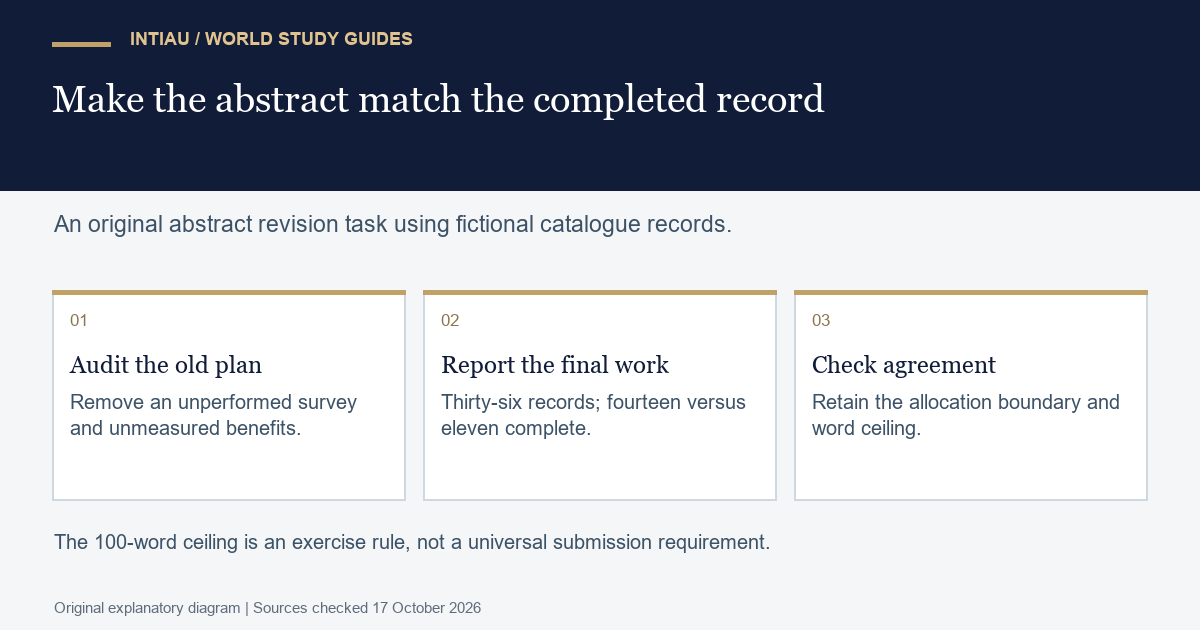
This self-study workshop revises an abstract after a fictional paper is complete. You will remove promises the paper did not fulfil, preserve its actual scope and write a compact account of the question, method, result and boundary. The finished output is an informative abstract checked against a supplied completion dossier.
Make the abstract agree with the finished work
The USC Libraries abstract guide describes an informative account of the study’s purpose, design, findings and conclusions. It recommends writing the abstract after the paper and checking that its information agrees with the completed text.
The original fictional paper concerns catalogue-record completeness, not real student or customer records. Its final dossier contains 36 invented item records. Eighteen were checked with a field checklist and eighteen with an unstructured note sheet. Fourteen checklist records and eleven note-sheet records contained all five required fields after checking. Allocation was not random. Checking time and cost were not recorded.
Audit the outdated draft
Original fictional draft: “This groundbreaking project will prove that checklists save time and money. We plan to survey staff and inspect hundreds of records. The results will transform catalogue management. A checklist is expected to eliminate missing information in every case.”
| Draft element | Completed dossier | Revision decision |
|---|---|---|
| Future plans | The paper’s exercise is complete. | Describe the completed comparison. |
| Staff survey and hundreds of records | No survey; 36 fictional records | Replace the invented method and scope. |
| Time and financial savings | Neither measure was recorded. | Remove both benefits. |
| Every case complete | 14 of 18 checklist records were complete. | Report the actual result and exception. |
Before reading the model, write four notes: what was examined, how the records were compared, what was found and what inference remains unavailable. Use a maximum of 100 words for your practice abstract. This is a constraint for the exercise, not a universal journal or university requirement.
Read the complete worked abstract
“This fictional document exercise compared record completeness after two checking approaches. Thirty-six invented catalogue records were divided between a five-field checklist and an unstructured note sheet, with eighteen records in each set. After checking, fourteen checklist records and eleven note-sheet records contained every required field. The checklist set therefore had three more complete records. Because allocation was not random, the comparison does not establish that the checking approach caused the difference. Time and cost were not measured. The exercise supports a bounded description of completeness in these records and identifies conditions for a more controlled follow-up.”
The model uses 96 words under a space-separated count. It gives the comparison, size, result and main boundary without calling the finding transformative. It does not imply that no checklist record had missing fields: four remained incomplete. It also avoids citing a chart number that a reader would need the full paper to interpret.
Check every sentence against the dossier
Underline each number in your abstract and locate its source in the dossier. Thirty-six equals eighteen plus eighteen. Fourteen minus eleven equals three. The word “complete” means all five required fields, not a general judgment of record quality. A record could satisfy that definition while containing a spelling mistake; the exercise supplied no accuracy audit.
Then circle each benefit claim. If your abstract says the checklist was faster, cheaper or easier, remove that phrase unless the finished dossier contains the relevant measure. A brief abstract has less room for explanation, so an unsupported adjective can do disproportionate damage. Replacing “proved” with “suggested” does not make an absent time measure appear.
Choose three search terms from the actual activity: catalogue records, completeness checklist and document comparison. Do not select “staff attitudes” just because it appeared in the old plan. Keywords should describe the completed exercise a reader would encounter, rather than the project you once intended to conduct.
Use a six-point revision rubric
Award one point each for the correct corpus, both checking approaches, exact counts, the non-random-allocation boundary, no unmeasured benefits and agreement with the 100-word exercise constraint. The model earns six. If your version omits time and cost entirely, it can still earn the fifth point provided it makes no claims about them.
For a second paper variation, imagine the completed paper later corrects the checklist count from fourteen to thirteen. Revise the abstract’s result and difference to thirteen and two. Do not change the overall corpus or invent a new method. This isolates the habit of updating a summary when its underlying record changes.
Must every abstract contain exactly 100 words?
No. That is this exercise’s ceiling. A real submission’s format and length requirements would need to be read separately.
Can the abstract keep a planned survey that never happened?
No. The fictional completed paper used document records only. Retaining the survey would misdescribe its method.
Does completeness mean every field is accurate?
Not here. The supplied definition requires five fields to be present. The dossier does not establish the truth or spelling of their contents.
This is original INTIAU editorial self-study practice; no qualification is awarded. Browse Courses or use Contact for editorial enquiries.
Related guides
View the study diagram