Rhodes University teaches undergraduate Ichthyology in Makhanda, South Africa. This independent guide concerns its BSc subject route, not an INTIAU qualification or partnership. The department’s Ichthyology II description introduces freshwater and marine fish diversity and functional biology.
A major begins after first-year foundations
The departmental guidance places Ichthyology II in the second year and Ichthyology III in the third. Registration in the subject is separate from admission to university. For the major, it specifies earlier zoological study and Ichthyology II, together with Chemistry I and two semester credits from the stated quantitative/computing choices. These supporting credits are corequisites for graduation, not necessarily subjects that must all be completed before registering for Ichthyology III. Read the departmental progression guidance.
| Stage | Selected actual components |
|---|---|
| First-year preparation | Relevant cell, zoology and botany study; Chemistry I and supporting quantitative credits |
| Second year: Ichthyology II | ICH201 and ICH202; fish diversity, form and function |
| Third year: ICH301 | Applied and Quantitative Biology |
| Third year: ICH302 | Environmental and Global Change Biology |
Keep prerequisites and corequisites in separate columns when planning. One determines whether a later course can be entered; the other may describe accompanying study required for the eventual major. Treating every condition as a first-year school admission requirement would misrepresent the route. Treating them all as optional would be equally misleading.
What the actual 2026 descriptions teach
The indexed official 2026 calendar describes ICH301 through molecular biology, behavioural ecology and quantitative biology. ICH302 addresses invasion, conservation and global-change ecology. It includes practical reports, essays, seminars and supervised year-long research. ICH301 and ICH302 are each listed at 30 credits. These are selected current calendar details; the full PDF could not be retrieved directly during review. Consult the actual 2026 calendar.
The departmental Ichthyology II page carries an older 2015 update and explains fish diversity through morphology and physiological adaptation. It is useful introductory context, but does not replace the newer calendar for assessment or cohort rules.
To judge subject fit, try explaining how a biological observation becomes a quantitative question. An apparent difference between two groups might concern their identity, their starting conditions, their environment or the way observations were collected. A good report states which comparison the data can support before proposing an explanation. This connects an interest in fish with the analytical work needed to investigate them.
University admission has a different evidence boundary
The university entry page requires eligibility for bachelor’s study plus faculty requirements and warns that minimum requirements do not guarantee selection. However, it explicitly retains a 2024 criteria table despite a 2025 page-update date. Its listed BSc Mathematics and science thresholds should therefore not be relabelled as confirmed 2027 criteria. International qualification instructions are separately described on that page.
The gateway now labels a prospectus link “2027,” but the linked PDF could not be read during this review. Exact current school-subject thresholds, the complete BSc credit audit and a current application deadline are consequently not established here. Use the official prospectus gateway and confirm the applicable record before applying.
A useful enquiry distinguishes admission to the BSc, first-year subject selection and later entry to the major. Give the institution the name of your school qualification and intended entry year. That is more precise than asking whether an interest in marine life alone qualifies you for an advanced subject.
Original exercise: size and growth
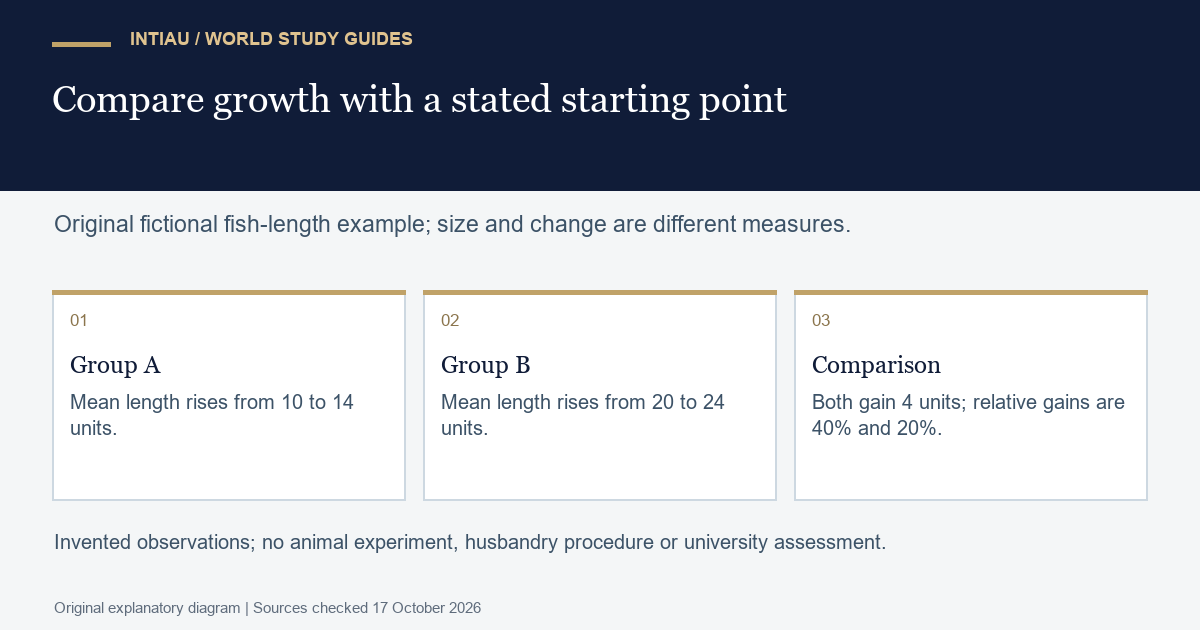
Imagine two fictional groups. A’s mean length rises from 10 to 14 units; B’s rises from 20 to 24. Both increase by four units. Relative to the starting means, the increases are 40 percent and 20 percent. B remains larger, while A has the greater proportional increase.
Write three separate statements about final size, absolute change and percentage change. Then ask whether the observations cover equal periods and comparable groups. Without those conditions, do not claim one group has a generally faster biological growth rate. This original arithmetic exercise uses invented values, not experimental fish data, an animal-care procedure or a Rhodes assessment.
Questions to settle
Does Ichthyology II start in first year?
No. The department places it in the second year of undergraduate study.
Does the reviewed 2026 course include global-change themes?
Yes. They appear in the ICH302 description.
Are the older admission-table values confirmed for 2027?
No. The current prospectus contents were not verified; the older table remains dated.
Official reading
- Ichthyology II description (page updated 2015)
- Major entry and corequisites (published departmental guidance)
- Academic calendar (2026)
- University entry guidance (contains 2024 criteria; updated 2025)
- Prospectus gateway (2027 link; checked October 2026)
For other study topics, browse INTIAU Courses; use Contact for questions about INTIAU services. University applications belong with the institution named above.
Related guides
View the study diagram