The University of the Western Cape offers BSc Biodiversity and Conservation Biology in South Africa. This independent guide follows programme 3217, not an INTIAU qualification or partnership. It keeps that mainstream route separate from an extended programme or postgraduate honours study.
A three-level science curriculum
The 2026 programme rules specify three years and 360 credits, with 120 at each level. Their choices matter: Level 3 says to select four modules from the listed group, not to take all five. Read the complete 2026 rules.
| Level | Selected curriculum structure |
|---|---|
| 1 | Life Sciences; a Chemistry pair; Earth Science; English-development and Statistics choices |
| 2 | BDC211, BDC221, BDC222 and BDC223, plus one specified elective pair |
| 3 | Four from BDC332–335 and Environmental and Water Science 321 |
The university’s listing presents the programme as full-time undergraduate study. A collection of module names should therefore be read as a structured degree, with choices and progression conditions, rather than as an independent menu of short courses.
When comparing science programmes, preserve words such as “both,” “one group” and “four modules.” Losing those small instructions can turn a valid selection into an impossible workload or omit a needed foundation. A useful planning sheet has separate columns for compulsory study, permitted alternatives and prerequisites. Do not add together every alternative merely because it appears in the official table.
A detailed real module: Biogeography and Global Ecology
The 2026 BDC334 outline identifies Biogeography and Global Ecology as a 30-credit module offered within programmes 3217 and 3015. It compares past, present and projected distributions, continental drift and glaciation, environmental drivers, island biogeography and global change. Students analyse environmental and ecological data and communicate a reasoned position. Its stated prerequisites are BDC211, BDC221 and BDC223. These are selected actual learning themes, not a complete reproduction of the outline. Inspect the module record.
That scope suggests a concrete readiness question: can you distinguish a pattern from an explanation for the pattern? Two places might have the same number of species while containing different organisms. A historical explanation and an account of current environmental conditions also answer different questions. Prepare to describe the observation first, then explain what evidence would allow you to choose among competing interpretations.
Minimum requirements and an application deadline are separate
For applicants matriculating from 2008, the 2026 rules require an NSC bachelor’s pass and at least 33 UWC points, English at Level 4, another language at Level 3, Mathematics at Level 4, and Physical Sciences or Life Sciences at Level 4. Final selection remains subject to faculty criteria.
UWC’s published 2027 application guidance gives a general closing date of 30 September 2026. That date is past on this guide’s 17 October check. It does not establish an open late application or a place in programme 3217. Applicants should use the relevant qualification and applicant-category instructions. Consult the university’s application guidance.
Keep the curriculum year and intended entry year separate in your notes. The reviewed degree rules are a 2026 academic record; a 2027 admissions page is a different document. If your school qualification falls outside the NSC route described above, request the applicable assessment of that record rather than converting the listed levels yourself.
Original exercise: count and composition
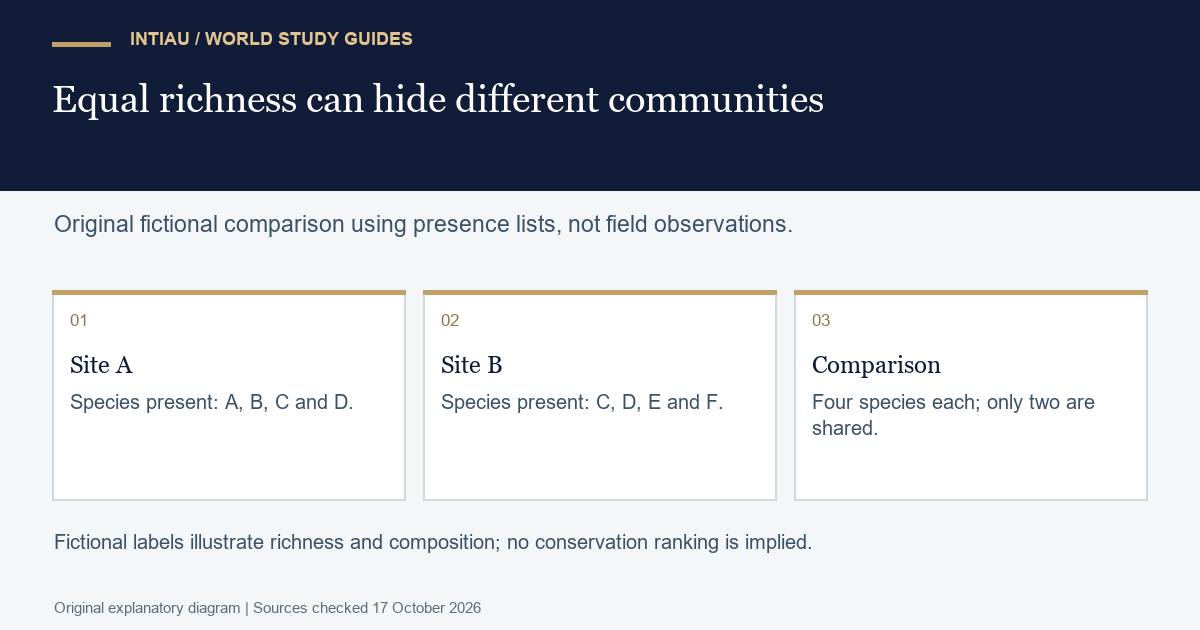
Imagine Site A contains species labelled A, B, C and D. Site B contains C, D, E and F. Both have four species, so their richness is equal in this invented record. Yet only C and D are shared, and the combined list contains six distinct species.
Write one sentence about richness and another about composition. Then suppose a follow-up visit misses D at Site A. You now need to consider whether the species disappeared or the observation failed to detect it. List the repeated observations you would want before asserting a change. Do not rank the sites for conservation using these labels alone: abundance, sampling effort and the identities of the organisms are unspecified. This is an original reasoning exercise, not field data or a UWC assessment.
Questions to settle
Must a student take all five listed Level 3 modules?
No. The 2026 table specifies a selection of four.
Does BDC334 have stated prerequisites?
Yes: BDC211, BDC221 and BDC223.
Is the general 2027 closing date still future?
No. The published date was 30 September 2026.
Official reading
- Programme listing (2026 programme 3217)
- Programme rules (2026)
- Biogeography and Global Ecology (2026 BDC334)
- Application guidance (2027)
For other study topics, browse INTIAU Courses; use Contact for questions about INTIAU services. University applications belong with the institution named above.
Related guides
View the study diagram