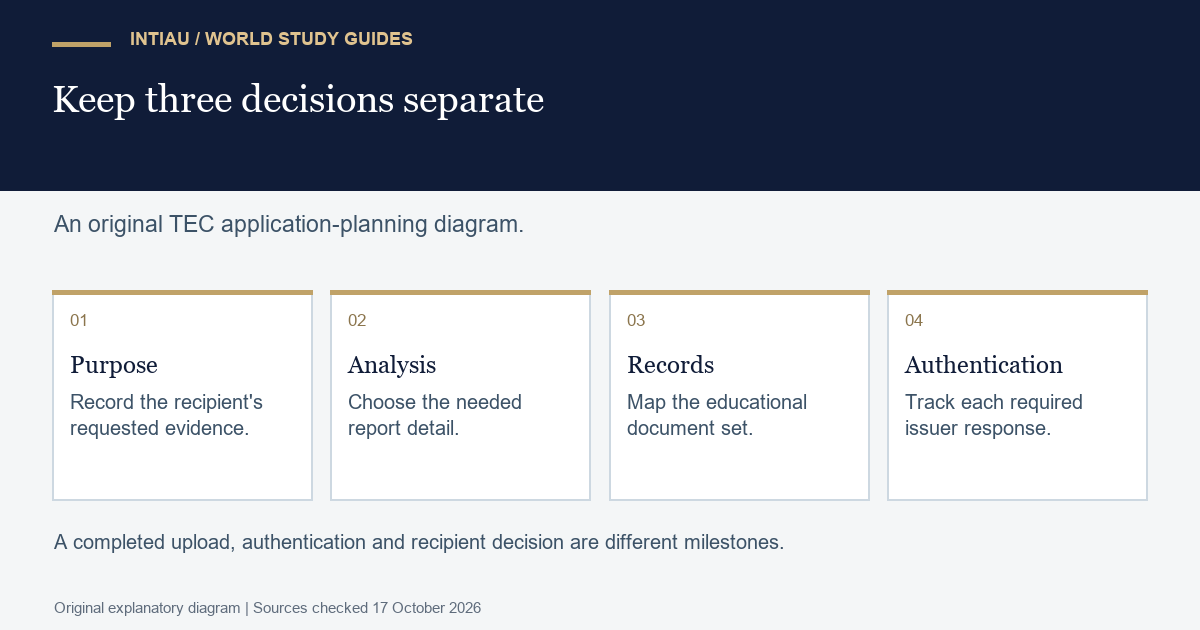
A request to The Evaluation Company, also known as TEC and formerly SpanTran, involves several decisions that should not be collapsed into one. The report’s level of detail, the records needed to prepare it and any authentication work are connected but distinct. Keeping those decisions separate produces a clearer application plan and more useful follow-up questions.
Choose the analysis around its intended use
TEC’s General Analysis gives an overall equivalency without individual course, credit or grade analysis. Its course analysis includes more detailed academic information. The appropriate service depends on the receiving organisation’s requirements.
Start with a short written purpose statement: the application, the receiving organisation and the evidence it requests. If the request concerns individual subjects, ask how much course detail is needed before ordering a report chosen only for convenience. If the recipient changes, revisit the choice rather than assuming that the earlier order remains suitable.
The WES report-choice guide provides a comparison of report detail and package decisions. Similar terminology does not make two providers’ products interchangeable.
Separate collection from authentication
TEC’s policy requires authentication of the highest postsecondary credential per country of study and professional credentials from most countries. A recipient can impose additional verification requirements.
TEC’s document guidance calls for relevant academic records and certified English translations of non-English documents. Where verification is required, official records may need to come directly from the institution or examination authority.
Build two linked lists. The first describes the educational record set. The second records any authentication action, its responsible office and its status. A complete set of clear files can still have an unresolved authentication question. Conversely, confirmation of one award does not automatically answer every question about course-level content.
| Fictional study stage | Record question | Authentication question |
|---|---|---|
| First degree in Country A | Which transcript and award records describe the study? | Which issuer must answer the applicable request? |
| Later degree in Country B | What additional record set supports this award? | Is the required action recorded separately? |
| Recipient requests more evidence | What precise item is missing? | Does the recipient require an additional confirmation? |
This example does not specify the policy of either fictional country. Its value is the structure: one row cannot hide a second institution, and a provider requirement cannot erase an additional recipient requirement.
Use status labels that answer a real question
Keep “collected”, “submitted”, “authentication requested” and “accepted” distinct. Record who owns the next action. A reference number can connect correspondence to an application, but it does not itself describe the quality or completeness of the evidence. Keep that identifier privately while sharing only the status information a helper needs.
If a file is put on hold, identify the stated reason before sending a replacement. Ask whether the issue is legibility, an omitted record, an issuing source or a recipient condition. Each leads to a different action. Repeated uploads without a clear hypothesis can make it harder to tell which version answers the request.
Check the final handover against the original purpose
Before treating the process as complete, compare the report received with the purpose statement. Confirm that the document belongs to the intended application and that the recipient’s delivery instructions have been followed. Keep an open question open if the receiving organisation has not answered it; do not convert an administrative milestone into a promise of admission or recognition.
The qualification-verification guide explores why confirming a record and deciding its use are separate tasks. Browse further independent credential evaluation guides. These pages do not submit an order to TEC.
Questions about analysis and authentication
Does a more detailed report remove the need to confirm recipient requirements?
No. More detail is not automatically the correct detail. Keep the recipient’s requested evidence as the reason for choosing the analysis.
Why keep a separate authentication list?
It makes responsibility and unresolved issuer responses visible. A folder of collected records and an authenticated record set represent different states in the workflow.
What should a useful follow-up question contain?
Identify the unresolved item, the relevant instruction and the action you propose. Keep private identifiers in the authorised correspondence rather than in public progress notes.
Official references
Checked 17 October 2026: academic analysis, authentication requirements and document guidance. Read the current country and credential instructions for an actual application.
Related guides
View the process diagram