
The University of Toronto’s St. George Faculty of Arts & Science computer science route is a University of Toronto offering, not an INTIAU programme or partnership. This guide explains its admission categories, later programme entry and curriculum, with official information checked on 17 October 2026.
Identify the campus and the application stage
The department’s prospective-student guidance places this route within Arts & Science at St. George. Mississauga, Scarborough and the Faculty of Applied Science & Engineering have separate routes. Keep the division on your application consistent with the programme you actually intend to study.
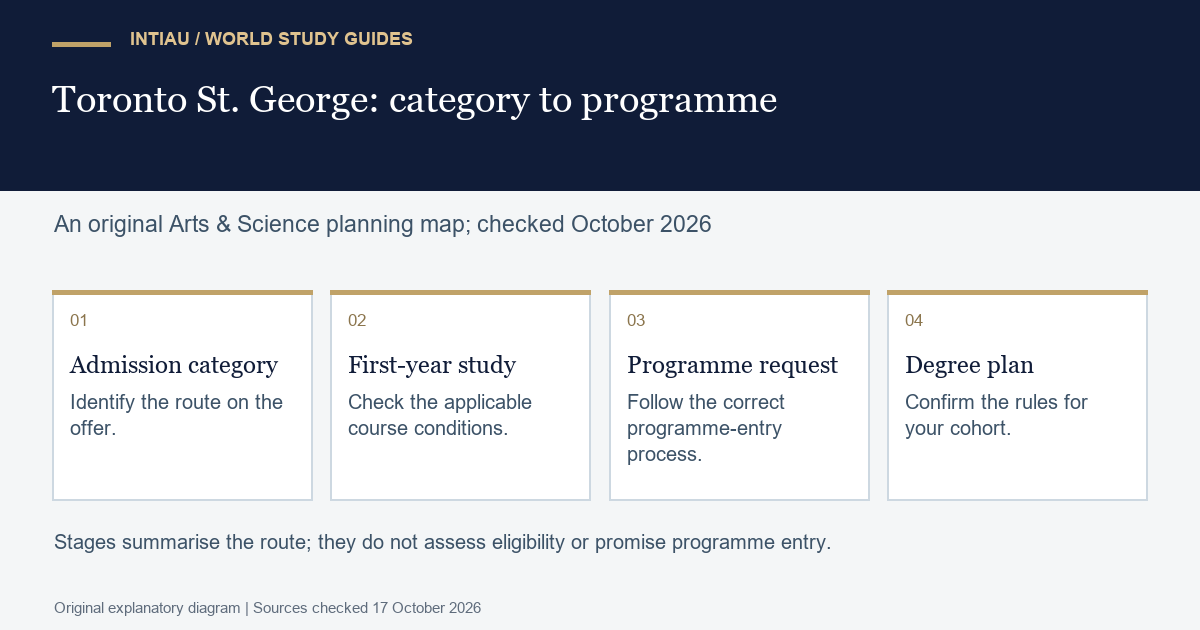
At St. George, entering an admission category and entering a Computer Science programme are different steps. First-year courses depend on the admission category; students subsequently request a programme. An offer to Arts & Science should therefore be read for its category and conditions, rather than treated as proof that every later computer science option is available.
Understand the first-year entry routes
The CMP1 admission-category instructions, checked on 17 October 2026, specify a conditional route to the CS Major and Specialist: at least 4.0 full-course equivalents, 70% in CSC110Y1, 77% in CSC111H1, the listed mathematics requirements and a timely programme request. Conditions must be met within the stated twelve-month period. Read the full official conditions before planning courses; this guide does not assess anyone’s eligibility.
Students from other Arts & Science admission categories use a competitive route. Current guidance identifies CSC148H1 and CSC165H1 or CSC240H1, a supplementary application and programme-request requirements. The relevant courses must be completed at St. George for programme admission. Published minimum grades are eligibility conditions rather than a forecast of the competitive result.
Read the curriculum as a sequence of capabilities
The current Computer Science Major calendar entry specifies an 8.0-credit programme within the wider degree. The table is an original learning-stage summary, not a replacement timetable or a complete course list.
| Stage | Examples in the published requirements | Planning question |
|---|---|---|
| Foundations | Introductory computing, reasoning and mathematics routes. | Which first-year sequence matches my admission category? |
| Core development | CSC207, CSC236 or CSC240, CSC258, CSC263 or CSC265, and statistics. | Have I traced each prerequisite before choosing a later course? |
| Upper-year depth | Advanced selections, a 400-level CSC component and an integrative activity. | Which permitted choices support the area I want to investigate? |
Compare the Major with a Specialist or Minor by looking at the actual requirements and your intended combination of subjects. A larger number of computing courses is only one consideration. Think about whether you want room for another discipline, which advanced subjects interest you, and the preparation those subjects need.
Account for the September 2027 degree designation
Toronto’s Bachelor of Computer Science announcement states that the new honours BCS designation takes effect on 1 September 2027. It says the designation change does not alter curriculum, admission requirements or programme-completion standards. Eligible programme combinations determine the degree outcome. The department says full 2027–28 degree requirements will appear in the calendar in spring 2027; do not substitute an assumption about the degree title for those published rules.
Prepare a useful course-planning discussion
Make a one-page plan with separate columns for admission-category conditions, programme-entry conditions and degree completion. Put the source and academic year beside each rule. This makes it easier to spot a condition copied from another campus or an older cohort.
Next, work backwards from two upper-year subjects that interest you. List their prerequisite chains, then compare those chains with your first-year route. Leave space for another coherent programme choice while competitive entry remains unresolved. When asking an adviser for help, identify your category, completed courses and the exact decision you need clarified; a focused question is more useful than asking whether computer science is “safe”.
Frequently asked questions
Does admission to an Arts & Science category complete CS programme entry?
No. Distinguish the faculty admission offer from the later programme request and its applicable first-year conditions.
Can I use Scarborough or Mississauga rules for St. George?
Use the rules for your own division. This guide covers St. George Arts & Science; it does not merge the campuses’ programmes or entry processes.
Does the new BCS title remove first-year programme-entry requirements?
The department says the 2027 designation change leaves admission requirements unchanged. Confirm the rules for your entry cohort in the official guidance.
INTIAU information
For a separate comparison with INTIAU’s own study information, see INTIAU courses. Questions about INTIAU belong through its contact page; Toronto applications and academic decisions belong with Toronto.
Compare the division and later-entry questions with the UBC Vancouver Computer Science guide and the separate Oxford Computer Science guide. Use the curriculum-comparison workshop to keep each institution’s admissions and curriculum evidence distinct.
View the curriculum diagram
Official sources
Checked 17 October 2026: department overview, CMP1 route, other admission categories, CS Major calendar and 2027 BCS announcement.